When printing notebooks, flyers, planners, invitations, or business materials, many people get confused between A5 and A6 paper sizes.
At first glance, they may look similar, but their dimensions, uses, and practicality are quite different. Understanding the difference between A5 and A6 can help you choose the right paper size for printing, designing, studying, or office work.
If you are a student, designer, business owner, or someone buying stationery, this guide explains everything in simple words.
What Is A5 Paper Size?
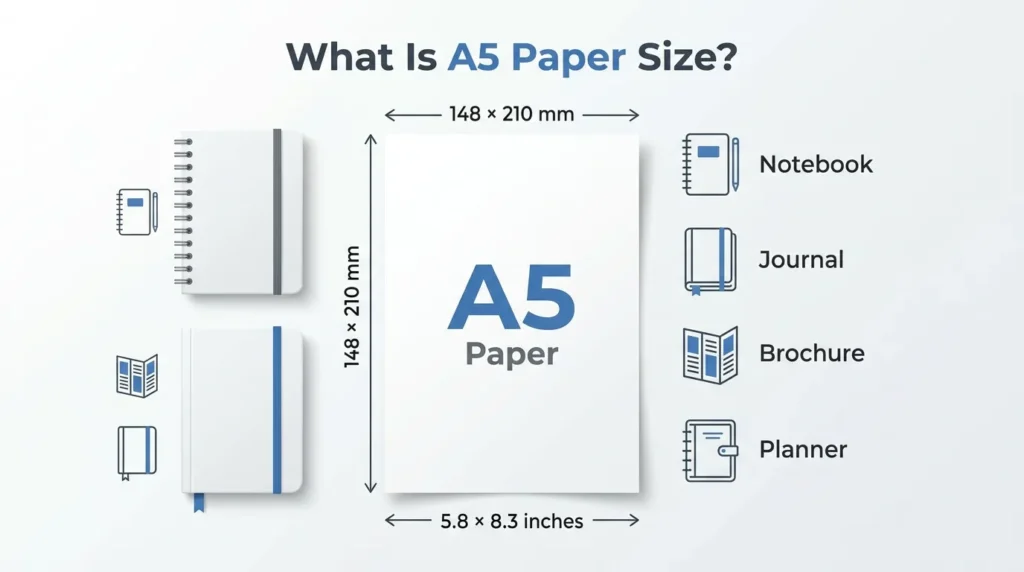
A5 is part of the ISO 216 international paper size system. It is commonly used for notebooks, journals, brochures, diaries, and booklets.
A5 Dimensions
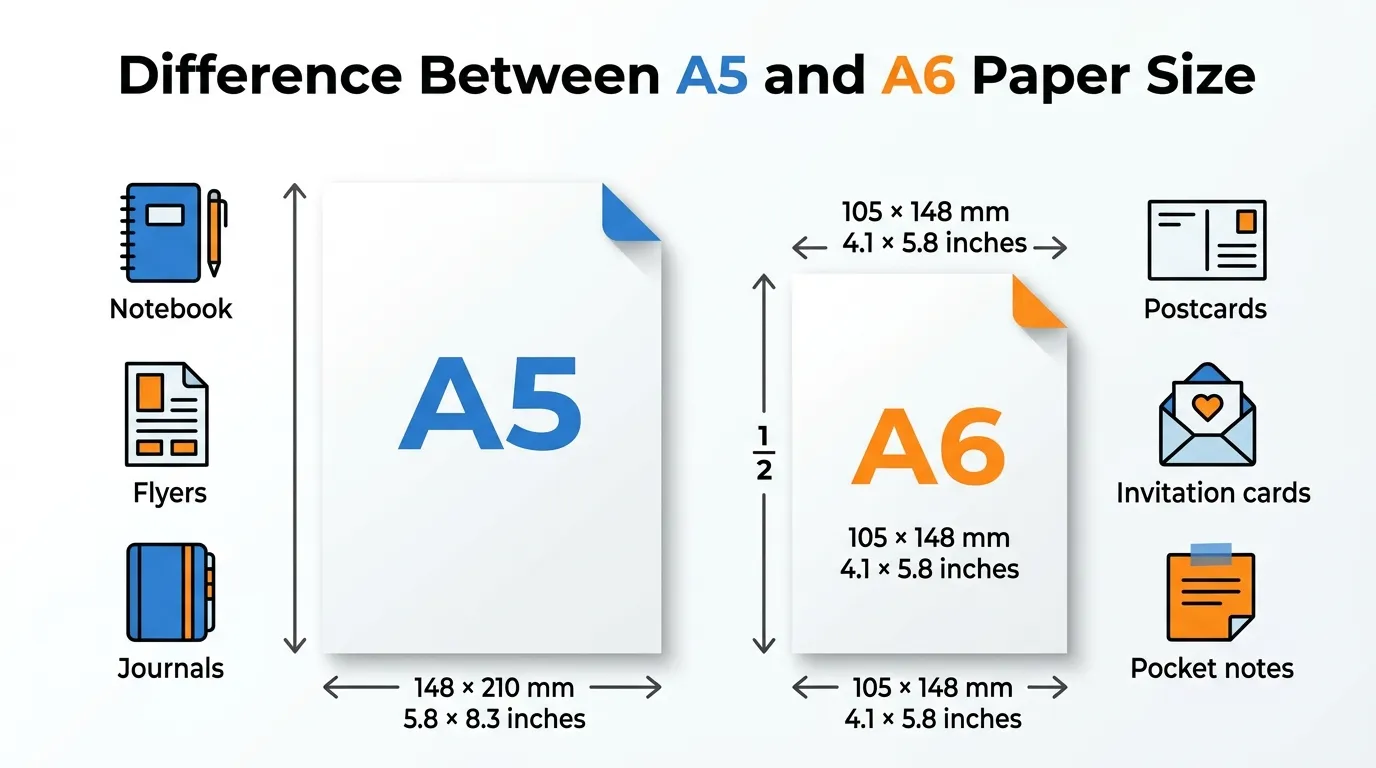
- In millimeters: 148 × 210 mm
- In centimeters: 14.8 × 21 cm
- In inches: 5.8 × 8.3 inches
A5 is exactly half the size of A4 paper when folded in half.
What Is A6 Paper Size?
A6 is smaller than A5 and is widely used for postcards, pocket notebooks, invitations, flashcards, and mini planners.
A6 Dimensions
- In millimeters: 105 × 148 mm
- In centimeters: 10.5 × 14.8 cm
- In inches: 4.1 × 5.8 inches
A6 is half the size of A5 paper.
Difference Between A5 and A6
The main difference between A5 and A6 is size. A5 is larger and provides more writing or printing space, while A6 is compact and easier to carry.
| Feature | A5 Paper | A6 Paper |
|---|---|---|
| Dimensions | 148 × 210 mm | 105 × 148 mm |
| Inches | 5.8 × 8.3 in | 4.1 × 5.8 in |
| Size Relation | Half of A4 | Half of A5 |
| Writing Space | More | Less |
| Portability | Moderate | High |
| Common Uses | Notebooks, brochures | Postcards, mini notes |
| Printing Cost | Slightly higher | Lower |
| Best For | Detailed content | Quick notes |
A5 vs A6 Size Comparison
A5 offers nearly double the usable space compared to A6. This makes A5 ideal for longer writing, sketching, note-taking, and professional documents.
A6, on the other hand, is much more compact. It easily fits into small bags, purses, or even pockets, making it perfect for portable use.
If you frequently write detailed notes or print documents with images and text, A5 is the better choice. If portability matters most, A6 wins.
Common Uses of A5 Paper
A5 paper is extremely popular because it balances portability and writing space.
A5 Is Commonly Used For:
- School notebooks
- Journals and diaries
- Business brochures
- Study planners
- Workbooks
- Restaurant menus
- Bullet journals
- Event programs
Because of its readable size, many publishers also use A5 for paperback books and manuals.
Common Uses of A6 Paper
A6 is smaller and more convenient for quick communication or portable note-taking.
A6 Is Commonly Used For:
- Postcards
- Greeting cards
- Invitation cards
- Pocket notebooks
- Flashcards
- Mini calendars
- To-do lists
- Pocket planners
Its compact design makes it excellent for travel and quick access.
Which Is Bigger: A5 or A6?
A5 is bigger than A6.
In fact:
- Two A6 sheets equal one A5 sheet.
- One A5 sheet folded in half becomes A6.
This size relationship follows the standard A-series paper format.
A5 vs A6 for Printing
Choosing between A5 and A6 for printing depends on your project needs.
Choose A5 If:
- You need readable text
- Your design contains images
- You want professional-looking brochures
- You need more writing space
Choose A6 If:
- You want compact prints
- You are printing invitations or postcards
- You need lower printing costs
- Portability is important
A5 vs A6 Notebook
Many people compare A5 and A6 notebooks before buying one.
A5 Notebook Advantages
- Easier for long writing sessions
- Better for students
- More comfortable for sketching
- Larger page layout
A6 Notebook Advantages
- Lightweight and portable
- Fits easily into bags
- Great for quick notes
- Ideal for travel
If you take extensive notes daily, A5 is usually better. If you need a small notebook on the go, A6 is more practical.
A5 vs A6 for Journaling
Journaling styles often determine the best paper size.
A5 Journals
A5 journals are preferred for:
- Bullet journaling
- Creative writing
- Detailed planning
- Habit tracking
A6 Journals
A6 journals are better for:
- Short daily notes
- Gratitude journaling
- Travel journaling
- Quick reminders
Is A6 Too Small?
A6 can feel too small for users who write extensively or need space for diagrams and layouts. However, for simple notes and portability, many people find it perfect.
If you mainly use your notebook for short reminders or lists, A6 works well. If you need space for organization and creativity, A5 is usually more comfortable.
Advantages of A5 Paper
1. More Writing Space
A5 gives users enough room for detailed notes and larger handwriting.
2. Better Readability
Printed text and graphics appear clearer and easier to read.
3. Professional Appearance
Brochures and planners in A5 often look more polished.
4. Versatile Usage
Suitable for both personal and professional purposes.
Advantages of A6 Paper
1. Highly Portable
A6 easily fits into small spaces and is travel-friendly.
2. Cost-Effective
Smaller paper often reduces printing costs.
3. Convenient for Quick Notes
Ideal for reminders, lists, and short messages.
4. Minimalist Design
Compact layouts look clean and organized.
Disadvantages of A5 Paper
- Less portable than A6
- Slightly more expensive to print
- Takes more storage space
Disadvantages of A6 Paper
- Limited writing area
- Can feel cramped
- Less suitable for detailed documents
How to Choose Between A5 and A6
Your choice depends on how you plan to use the paper.
Choose A5 If You:
- Need larger writing space
- Create planners or journals
- Print brochures or documents
- Prefer better readability
Choose A6 If You:
- Want something portable
- Carry notes while traveling
- Need compact cards or invitations
- Prefer minimalist notebooks
A-Series Paper Size System Explained
The A-series paper system follows a simple rule:
- A0 is the largest size.
- Each next size is created by folding the previous size in half.
That means:
- A4 folded in half becomes A5.
- A5 folded in half becomes A6.
This system keeps proportions consistent across all sizes.
Frequently Asked Questions
Is A5 double the size of A6?
Yes. A5 is twice the size of A6 in terms of surface area.
Which is better for studying, A5 or A6?
A5 is generally better for studying because it provides more writing space.
Is A6 good for journaling?
Yes, especially for short entries, gratitude journaling, and travel notes.
Can I print flyers in A6 size?
Yes. A6 is commonly used for promotional postcards and mini flyers.
Which paper size is more portable?
A6 is more portable because it is smaller and lighter.
Conclusion
Understanding the difference between A5 and A6 paper sizes helps you choose the right format for your personal or professional needs.
A5 is larger, more spacious, and ideal for notebooks, planners, and detailed printing. A6 is smaller, lightweight, and perfect for portable notes, postcards, and compact designs.
If you value writing space and readability, A5 is the better option. If portability and convenience matter more, A6 is the ideal choice.
Read More Posts:
Difference Between 1X and XL:(Simple Size Guide You Must Know)
Difference Between Idiom and Metaphor:(Easy Guide) for 2026
Difference Between 4T and 2T:(Simple Guide You Must Read) 2026

I am Steven Pinker is a Canadian-American cognitive psychologist, linguist, and popular science author known for his work on language, mind, and human nature.He is the author of influential books like The Language Instinct and The Sense of Style, where he explains grammar and usage with scientific clarity.At wordrar.com, his ideas continue to inspire readers who want to understand grammar, comparison, and clear communication more deeply.