A few years ago, I walked into a kitchen store with a simple plan. Buy a KitchenAid mixer. Walk out in ten minutes.
Forty-five minutes later, I was still standing there, completely overwhelmed.
There were at least eight different KitchenAid mixers on display. Some looked almost identical. The prices ranged from around $300 to over $700. A salesperson tried to explain the difference between the Artisan and the Pro 600 and I nodded along while understanding almost nothing.
I eventually grabbed the one that looked most familiar, brought it home, and spent the next hour wondering if I had made the right choice.
Many people first assume that KitchenAid is just one mixer with a few color options. That is completely understandable. From a distance, they all look the same. Same iconic silhouette. Same tilt-head or bowl-lift design. Same planetary mixing action.
But the differences between KitchenAid mixer models are real, practical, and genuinely matter depending on what you plan to bake, how often you bake, and how much dough or batter you typically make at one time.
Choosing the wrong model means either overpaying for power you never use, or buying something underpowered that struggles every time you make a dense bread dough or a double batch of cookies.
This guide explains everything in simple English with practical examples so you can clearly understand the real difference between every major KitchenAid mixer model.
What Is a KitchenAid Tilt-Head Mixer?
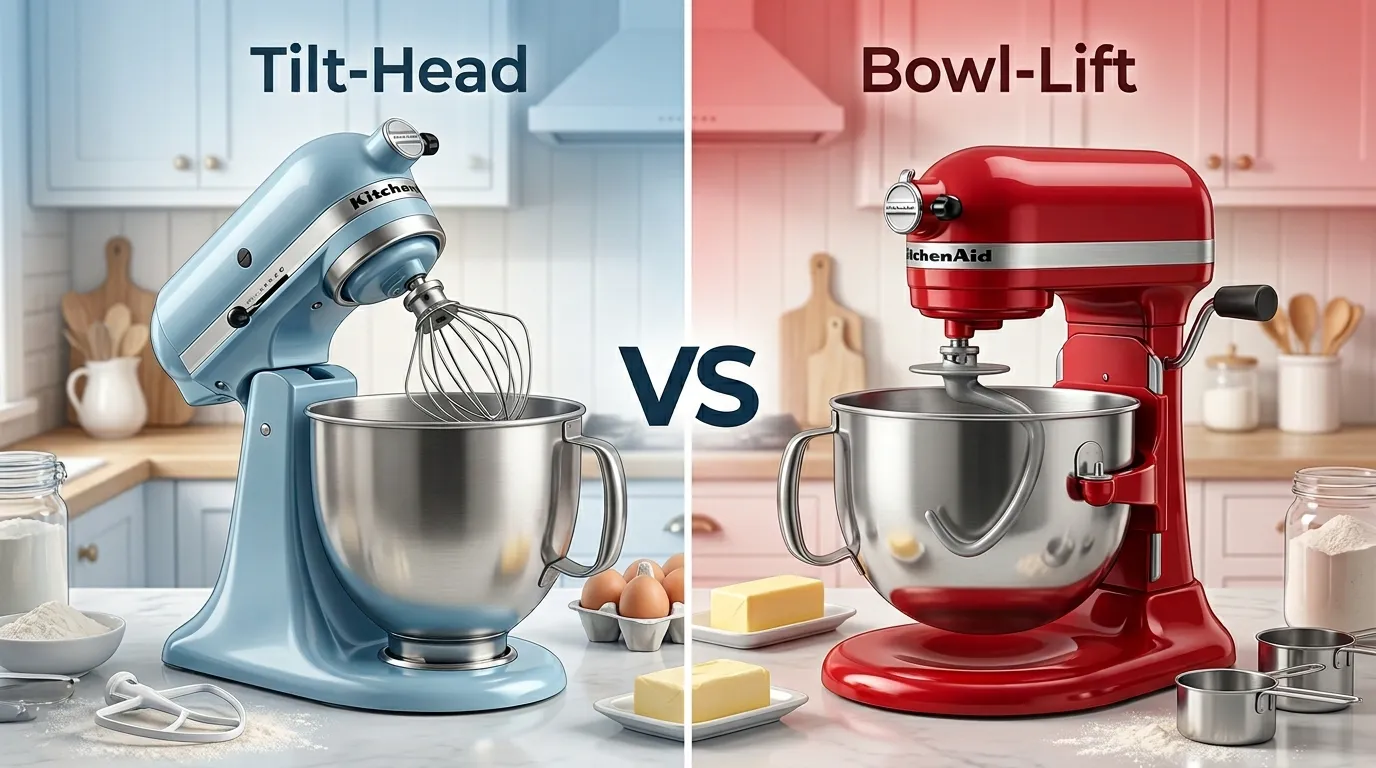
A tilt-head KitchenAid mixer is the classic design most people picture when they think of the brand. The head of the mixer, which holds the motor and the mixing attachment, tilts back on a hinge. This lets you lift it up and away from the bowl so you can add ingredients, scrape down the sides, or swap out attachments easily.
Tilt-head models are the most popular KitchenAid mixers sold. They come in the widest range of colors. They are generally more affordable than the professional bowl-lift models. And they work beautifully for most home baking tasks including cookies, cakes, whipped cream, mashed potatoes, and lighter bread doughs.
The tilt-head family includes several models at different price points and bowl capacities. The most well-known is the Artisan Series, but KitchenAid also makes the Classic, the Classic Plus, the Artisan Mini, and the Artisan Design Series within the tilt-head category.
The key thing to understand is that tilt-head mixers are designed for regular home bakers. They handle most recipes with ease. Where they start to struggle is with very large batches, very stiff doughs like bagels or pizza dough made repeatedly, or professional-level volume.
Who typically uses tilt-head KitchenAid mixers:
- Home bakers who bake a few times a week
- People who make standard recipes like one loaf of bread or two dozen cookies
- Beginners getting their first stand mixer
- People who want a wide variety of color choices
- Those with limited counter or cabinet space
What Is a KitchenAid Bowl-Lift Mixer?
A bowl-lift KitchenAid mixer uses a different mechanism. Instead of tilting the head, the bowl itself locks onto two side arms and lifts up into position to engage with the mixing attachment. To remove the bowl, you lower it back down on those arms.
This design was originally developed for commercial and semi-professional use. The bowl-lift construction is sturdier. The motor sits in a fixed, non-moving head which allows for a more stable, powerful performance during heavy mixing tasks.
Bowl-lift models are typically the larger, more powerful KitchenAid mixers. The most famous is the Professional 600 Series, which comes with a 6-quart bowl. KitchenAid also makes the Professional 5 Plus (5-quart), the Pro Line Series (7-quart), and the Commercial 8-Qt mixer in this category.
In real-world use, the bowl-lift design shines when you are making large batches, heavy doughs, or running the mixer for extended periods. The locking bowl mechanism keeps everything more secure under load. You get less wobble and less noise when the mixer is working hard.
The trade-off is that bowl-lift mixers are taller, heavier, and require more clearance under your kitchen cabinets. Some people also find the bowl-lift mechanism slightly less convenient for small batches because the bowl needs to be locked in position before mixing can start.
Who typically uses bowl-lift KitchenAid mixers:
- Serious home bakers who bake multiple times per week
- People who regularly make bread, pizza dough, or bagels
- Those who frequently double or triple recipes
- Small home bakery owners or cottage bakers
- Cooks who want maximum durability and long-term performance
Quick Comparison Table: KitchenAid Mixer Models
| Feature | Artisan Mini | Classic / Classic Plus | Artisan Series | Pro 5 Plus | Professional 600 | Pro Line / Commercial |
|---|---|---|---|---|---|---|
| Bowl capacity | 3.5 qt | 4.5 qt | 5 qt | 5 qt | 6 qt | 7-8 qt |
| Motor (watts) | ~250W | ~250W | ~325W | ~450W | ~575W | ~650W+ |
| Design type | Tilt-head | Tilt-head | Tilt-head | Bowl-lift | Bowl-lift | Bowl-lift |
| Approx. price | $280-$380 | $280-$380 | $350-$500 | $400-$500 | $450-$600 | $700-$1,200+ |
| Color options | Many | Fewer | Most (150+) | Fewer | Fewer | Very few |
| Best for | Small kitchens, small batches | Budget buyers, basic baking | Most home bakers | Frequent bakers | Heavy use, bread doughs | Semi-pro, high volume |
| Cookie capacity | ~4 dozen | ~6 dozen | ~8-9 dozen | ~8-9 dozen | ~13 dozen | ~14+ dozen |
| Bread dough | Light only | Light-medium | Light-medium | Heavy | Very heavy | Commercial loads |
| Height | Shortest | Standard | Standard | Taller | Tallest | Tallest |
| Weight | Lightest | Medium | Medium | Heavy | Heaviest | Very heavy |
| Attachment hub | Yes | Yes | Yes | Yes | Yes | Yes |
The Biggest Difference Between KitchenAid Mixers
The single most important difference between KitchenAid mixer models is bowl size and motor power combined.
These two things work together. A bigger bowl without more motor power is not helpful. More motor power without a bigger bowl is wasted. KitchenAid generally scales both together as you move up the product line.
The second biggest structural difference is tilt-head versus bowl-lift. This affects stability, convenience, and what the mixer handles well under load.
Everything else, including color, finish, accessories included in the box, and minor design details, matters much less than bowl size, motor power, and the tilt-head versus bowl-lift distinction.
If you understand those two things, you can confidently pick the right model.
Key Differences Explained
1. Bowl Size and Batch Capacity
This is the most practical day-to-day difference between KitchenAid models.
The Artisan Mini has a 3.5-quart bowl. That sounds like plenty, but in practice it means you can make about one standard cake recipe or one batch of cookies. It gets cramped with anything larger.
The Classic and Classic Plus have a 4.5-quart bowl, which is the old standard size. It handles most typical recipes well but can overflow with very large batches.
The Artisan Series bumps up to 5 quarts, which is the current sweet spot for most home bakers. You can comfortably make two batches of cookies, one large loaf of bread dough, or a double cake recipe.
The Professional 600 at 6 quarts gives you noticeably more room. Thirteen dozen cookies in one batch is the number KitchenAid often quotes for this model. For anyone who bakes regularly for large families, events, or small sales, this extra volume matters a lot.
The Pro Line and Commercial models at 7 to 8 quarts are for people who genuinely need semi-professional capacity at home.
2. Motor Power and Wattage
More powerful motors handle stiffer doughs without straining, run cooler during long mixing sessions, and tend to last longer because they are not being pushed to their limits regularly.
The Artisan Mini and Classic both use motors around 250 watts. This is enough for typical home baking. Cakes, cookies, whipped cream, and mashed potatoes are all within comfortable range. Where these motors struggle is with very stiff bread doughs or extended kneading sessions.
The Artisan 5-quart steps up to around 325 watts. In real-world use, this handles most bread recipes without too much complaint, though it can slow down or even walk across the counter with very dense doughs.
The Pro 5 Plus at 450 watts and the Professional 600 at 575 watts are substantially more powerful. You can feel the difference when kneading a full batch of bagel dough or making pasta dough. The motor barely notices.
One small difference most people overlook: wattage as advertised by KitchenAid refers to input power, not output power. Two mixers with similar wattage can perform differently based on motor efficiency and design. Real-world performance reviews matter more than the wattage number alone.
3. Tilt-Head Versus Bowl-Lift Design
After using both for some time, the practical difference becomes very clear.
Tilt-head mixers are more convenient for everyday baking. You tilt the head back, drop in an ingredient, and get on with it. The bowl is easy to remove and place in the dishwasher. The design is ergonomic and intuitive.
Bowl-lift mixers are more stable under heavy loads. The fixed head means the motor housing does not move at all. The bowl locks in from below, creating a more rigid system overall. When you are kneading a stiff bread dough for eight minutes straight, this stability really shows.
The downside of the bowl-lift is height. These mixers are taller than tilt-head models and may not fit under standard kitchen cabinets without being pulled forward on the counter. This matters more than many beginners realize when planning counter space.
4. Included Attachments
All KitchenAid stand mixers come with three standard attachments: a flat beater (for most mixing tasks), a dough hook (for bread and pasta), and a wire whip (for whipping cream and egg whites).
The difference is in the quality and material of those attachments at different price points.
Entry-level models like the Classic often include coated or painted metal attachments. Higher-end models include burnished or stainless steel flat beaters and dough hooks. Stainless steel is more durable and does not risk chipping over time.
The Artisan models often include a pouring shield, which is a plastic guard that sits over the bowl to prevent splattering when adding ingredients. Lower-end models may not include this.
Some higher-tier models include a flex edge beater, which has a silicone edge that scrapes the bowl as it mixes. This reduces the need to stop and scrape the sides manually. It is a small thing but genuinely useful after the first time you use it.
5. Speed Settings
All KitchenAid stand mixers use the same 10-speed control. Speed 1 is the slowest stir setting. Speed 10 is the fastest, used for whipping air into cream or egg whites.
The speed control does not meaningfully differ between models. What does differ is how the motor responds at each speed under load. A more powerful motor on the Professional 600 will maintain a consistent Speed 2 when kneading heavy dough, while a less powerful motor in the Classic might slow down noticeably under the same load even at the same speed setting.
6. Durability and Build Quality
In real-world use, all KitchenAid stand mixers are built to last. The all-metal construction that KitchenAid uses across its product line is a big reason these mixers are passed down through families.
That said, there are real build quality differences. The Professional 600 and Pro Line series use a heavier-duty gear system and a more robust motor that is designed for more continuous use. Running the Classic at full capacity every day will wear it out faster than running the Professional 600 at the same task.
If you plan to bake five to seven days a week, a more powerful, more durable mixer pays for itself over time by not needing to be repaired or replaced.
7. Size and Counter Footprint
The Artisan Mini is the most compact KitchenAid mixer available. It is noticeably smaller and lighter than other models, making it genuinely practical for small kitchens or apartments. You can store it in a cabinet without much struggle.
The standard Artisan Series is the midrange size, comfortable for most kitchens and easy enough to store.
Bowl-lift models are taller and heavier. The Professional 600 weighs around 29 pounds. Moving it in and out of a cabinet regularly is genuinely inconvenient. Most people who buy bowl-lift models leave them permanently on the counter.
This matters practically. If your kitchen has low cabinets or limited counter space, a tilt-head Artisan may serve you better even if the Professional 600 has more power.
8. Price and Value
The KitchenAid Classic and Classic Plus sit at the entry-level price point, typically $280 to $380, though sales often bring them lower. These are honest, capable mixers for straightforward home baking. Some users later regret not spending a little more for the Artisan, which adds bowl capacity and a slightly more powerful motor.
The Artisan Series is the best-selling KitchenAid model and is widely considered the best value for most home bakers. At $350 to $500 depending on color and sales, it covers the vast majority of home baking tasks.
The Professional 600 is the step up that serious bakers take when they outgrow the Artisan. At $450 to $600, it is not dramatically more expensive than the Artisan but delivers a noticeably larger bowl and more powerful motor.
The Pro Line and Commercial models above $700 are for people who genuinely need that capacity and durability. For most home bakers, they represent power and capacity beyond what the average household needs.
Similarities Between KitchenAid Mixer Models
Despite the differences in power and capacity, KitchenAid mixers across all models share more similarities than many people expect.
Every model uses the same planetary mixing action, where the attachment moves in an orbit around the bowl while also rotating on its own axis. This ensures thorough mixing from every angle without manual intervention.
Every model uses the same attachment hub on the front of the mixer. This means all KitchenAid stand mixer attachments, including the pasta roller, meat grinder, spiralizer, food grinder, and ice cream maker, work with every model regardless of which one you own. This is one of the most valuable features of the KitchenAid system.
All models use the same 10-speed control layout. All use the same tilt-head or bowl-lift bowl locking system within their respective categories. And all are made with all-metal construction that is built to last for decades with normal use.
The iconic design, shape, and silhouette are essentially the same across all models. From a distance, a Classic and a Professional 600 look nearly identical to most people.
Pros and Cons
Pros of Tilt-Head Models (Artisan Mini, Classic, Artisan)
- More affordable entry point
- Easier to lift the head and access the bowl
- More color choices, especially the Artisan
- Lighter and easier to move or store
- Great for standard home baking tasks
Cons of Tilt-Head Models
- Less stable under very heavy dough
- Motor can struggle with stiff or large batches
- Smaller maximum bowl size (5 quarts)
- Head can wobble slightly during heavy use
Pros of Bowl-Lift Models (Pro 5 Plus, Professional 600, Pro Line)
- More powerful motors for heavy loads
- Larger bowl capacity (5 to 8 quarts)
- More stable under continuous heavy use
- Better for frequent baking of bread and dense doughs
- Designed for higher workload frequency
Cons of Bowl-Lift Models
- More expensive
- Taller, may not fit under standard cabinets
- Heavier and harder to move
- Fewer color options
- Bowl-lift mechanism slightly less intuitive than tilt-head
Which KitchenAid Mixer Is Better for Different Situations?
For beginners buying their first stand mixer: The Artisan 5-quart is the right choice for the vast majority of people. It handles everything a beginner will make, comes in hundreds of colors, and sits at a reasonable price point.
For people with small kitchens or limited space: The Artisan Mini is the practical choice. It is compact, lighter, and still handles most everyday recipes. Just accept that large batches are off the table.
For serious bread bakers: The Professional 600 is worth the extra investment. Kneading stiff bread dough repeatedly is exactly what this model was designed for. The Artisan will work but will work much harder.
For people who bake for events, farmers markets, or cottage bakeries: The Professional 600 or Pro Line Series are the right tools. When you regularly make ten or twelve dozen cookies at a time, the 6 or 7-quart bowl earns its place.
For budget-conscious buyers: The Classic or Classic Plus offers reliable KitchenAid quality at the lowest price. If you only bake occasionally and make standard recipes, this is a smart, practical choice.
For students or apartment dwellers: The Artisan Mini fits in a tiny kitchen and can still make one cake or one batch of cookies without complaint.
For people who already own an Artisan and want to upgrade: The Professional 600 is the natural next step. The bowl capacity jump from 5 to 6 quarts and the power upgrade both make a real, noticeable difference.
Common Mistakes People Make When Buying a KitchenAid Mixer
Buying the Mini because it looks cute without checking capacity. Many people are charmed by the smaller size and then frustrated six months later when they cannot make a full batch of cookies without splitting the recipe. The Mini is a specific tool for specific needs, not a universal starter mixer.
Choosing based on color and ignoring model differences. KitchenAid offers the Artisan in far more colors than the Professional 600. Some buyers choose the Artisan simply because it comes in the color they want, without realizing the Professional 600 would suit their baking habits better.
Overpaying for the Pro Line when the Artisan would do. Not everyone needs a 7-quart bowl and a 650-watt motor. Many home bakers who splurge on the Pro Line end up with more mixer than they ever use. Unless you are baking in genuine high volumes regularly, the Artisan or Professional 600 is enough.
Underestimating how often they will use the mixer. Buyers who think they will bake only occasionally sometimes find themselves baking every week once they own a stand mixer. Buying the lowest-end model to save money can mean upgrading sooner than expected.
Ignoring cabinet height clearance. Bowl-lift models are tall. Measuring the distance between your counter and your upper cabinets before buying a Professional 600 is a step many people skip and then regret.
Confusing motor watts with motor quality. A higher wattage number does not always mean a better mixer. Build quality, motor design, and gear system matter too. Read independent reviews alongside the spec sheet.
Expert Recommendation
Choose the Artisan Mini if:
- Your kitchen is genuinely small or storage is very limited
- You cook for one or two people and rarely make large batches
- You want a stand mixer primarily for occasional baking
Choose the Classic or Classic Plus if:
- You are on a tighter budget and bake standard recipes occasionally
- You want a reliable entry-level KitchenAid without the premium price
- Basic baking tasks like cookies and cakes are your main use
Choose the Artisan Series (5-quart) if:
- You are a regular home baker who makes cookies, cakes, breads, and more
- You want the widest range of color options
- You bake two to four times per week with standard-sized recipes
- You want the best all-around value in the KitchenAid lineup
Choose the Professional 600 if:
- You bake frequently and often double or triple recipes
- You make stiff bread doughs, bagel doughs, or pasta regularly
- You want more power and capacity without going fully commercial
- You are outgrowing a tilt-head model
Choose the Pro Line or Commercial if:
- You run a cottage bakery or bake in very high volume consistently
- You need a mixer that runs continuously without overheating
- You regularly make batches larger than what a 6-quart bowl can handle
Avoid the Artisan Mini if:
- You regularly bake full batches of cookies or bread
- You like to double recipes
- You bake for more than two or three people consistently
Avoid the Pro Line if:
- You bake only a few times per month
- You have limited cabinet clearance or counter space
- Budget is a consideration and a Professional 600 would meet your actual needs
Final Verdict
KitchenAid makes excellent mixers at every level. The differences between models are real and practical, but they all share the same fundamental quality, attachment compatibility, and iconic design.
For most people reading this guide, the Artisan 5-quart is the right answer. It handles everything a typical home baker needs, comes in more colors than you could ever choose between, and offers the best balance of capacity, power, and price in the entire KitchenAid lineup.
If you bake bread heavily, make large batches often, or bake multiple times a week, spend a little more for the Professional 600. You will notice the difference in stability and capacity, and you will not outgrow it.
If space is the real constraint, the Artisan Mini is a genuinely good small mixer, just know its limits before you buy.
And if you are still standing in the store like I was, feeling overwhelmed by all the colors and model names, remember this: the biggest decisions are bowl size, motor power, and tilt-head versus bowl-lift. Everything else is secondary.
Frequently Asked Questions
Q: What is the main difference between the KitchenAid Artisan and the Professional 600?
The Artisan is a 5-quart tilt-head mixer with around 325 watts of power, best for everyday home baking. The Professional 600 is a 6-quart bowl-lift mixer with around 575 watts, designed for heavier loads, larger batches, and more frequent use. The Professional 600 is more powerful, more stable under heavy dough, and has a larger bowl, but is also taller, heavier, and more expensive.
Q: Is the KitchenAid Artisan Mini worth buying?
The Artisan Mini is worth buying if you have a very small kitchen, cook for one or two people, and primarily make small batches. It is not the best choice for regular bakers who make full recipes. The limited 3.5-quart bowl means you will constantly be splitting recipes or making multiple smaller batches, which defeats much of the convenience a stand mixer offers.
Q: Which KitchenAid mixer is best for bread dough?
The Professional 600 is the best KitchenAid tilt-head or bowl-lift mixer for bread dough at the home level. Its 575-watt motor and 6-quart bowl handle stiff bread doughs, pizza doughs, and bagel doughs with much less strain than the Artisan. The bowl-lift design also keeps the mixer more stable during long kneading sessions.
Q: Do all KitchenAid mixers use the same attachments?
Yes. Every KitchenAid stand mixer from the Mini to the Commercial 8-quart uses the same attachment hub on the front of the mixer. This means any KitchenAid stand mixer attachment, including the pasta roller, spiralizer, meat grinder, and food processor, fits every model. This universal compatibility is one of the most valuable features of owning any KitchenAid stand mixer.
Q: Is it worth spending more on the Professional 600 vs the Artisan?
For most casual home bakers who bake once or twice a week with standard recipes, the Artisan is genuinely enough. The Professional 600 becomes clearly worth the extra cost if you bake bread or pizza dough regularly, if you frequently make large batches, or if you bake five or more times per week. Over time, a more powerful motor also puts less strain on itself, which can mean better long-term durability under heavy use.
Q: What do most people prefer, tilt-head or bowl-lift KitchenAid mixers?
Most casual home bakers prefer tilt-head mixers because they are easier to use, easier to access the bowl, and available in more colors. Serious bakers and bread bakers who use their mixer heavily tend to prefer the bowl-lift design for its stability and power. Sales numbers suggest the Artisan tilt-head is the most popular model overall, but the Professional 600 is consistently rated highest among frequent bakers.
Q: How long do KitchenAid mixers last?
KitchenAid stand mixers are known for exceptional longevity. With normal home use, an Artisan or Professional 600 can easily last 15 to 25 years or longer. Many people inherit their parents’ KitchenAid mixers and keep using them. The all-metal construction and relatively simple mechanical design contribute to this durability. Higher-end models are designed for more intensive use frequency and may outlast entry-level models under heavy conditions.
Q: Can the KitchenAid Artisan handle pizza dough?
The Artisan can handle pizza dough in moderate quantities, typically one or two standard pizza dough balls at a time. For occasional pizza making, it is fine. If you make pizza every week or regularly make large batches of dough, the motor will work harder than it was designed for over time. In that case, the Professional 600 is a better long-term choice for preserving the motor’s life.
Conclusion:
Choosing between KitchenAid mixers comes down to honest self-reflection about how you actually bake. The Artisan Mini is for small kitchens and small batches. The Classic is for budget-conscious buyers who bake occasionally.
The Artisan 5-quart is the sweet spot for most home bakers. The Professional 600 is for serious bakers who want more power and capacity. The Pro Line is for those baking at near-commercial volumes.
All of them share the same iconic design, the same universal attachment system, and the same all-metal build quality that has made KitchenAid a trusted name in home kitchens for generations. Whatever model you choose, you are buying something built to last for decades.
The only real mistake is buying too small for how much you actually bake, or buying far more than you will ever need.
Pick the one that matches your real baking life, not your ideal baking life.

I am Lynne truss , journalist, and broadcaster best known for her bestselling grammar book Eats, Shoots & Leaves, which highlights the importance of punctuation in clear writing. Her engaging and witty style has made grammar accessible and entertaining for millions of readers worldwide.at wordrar.com, we admire her work for inspiring readers to appreciate the power of precise language and proper grammar.