I still remember sitting in my 7th-grade science class, staring at two beakers on the teacher’s desk. Both looked like plain water to me. She dropped some sand in one and stirred salt into the other. Then she asked the class: “Are these the same thing?”
Half the class said yes. I said yes too.
We were all wrong.
That moment stuck with me, because it turns out the difference between a mixture and a solution is one of those things that feels obvious once you know it, but completely invisible before someone explains it properly.
Many people first assume that anything stirred together in water is “a solution.” Others think mixtures and solutions are just two names for the same concept.
Neither is true, and confusing them can cause real problems, If you are studying for an exam, working in a lab, or even trying to understand something as simple as why your orange juice looks cloudy but your sports drink does not.
This guide explains everything in simple English with practical examples so you can clearly understand the real difference.
What Is a Mixture?
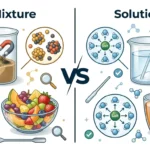
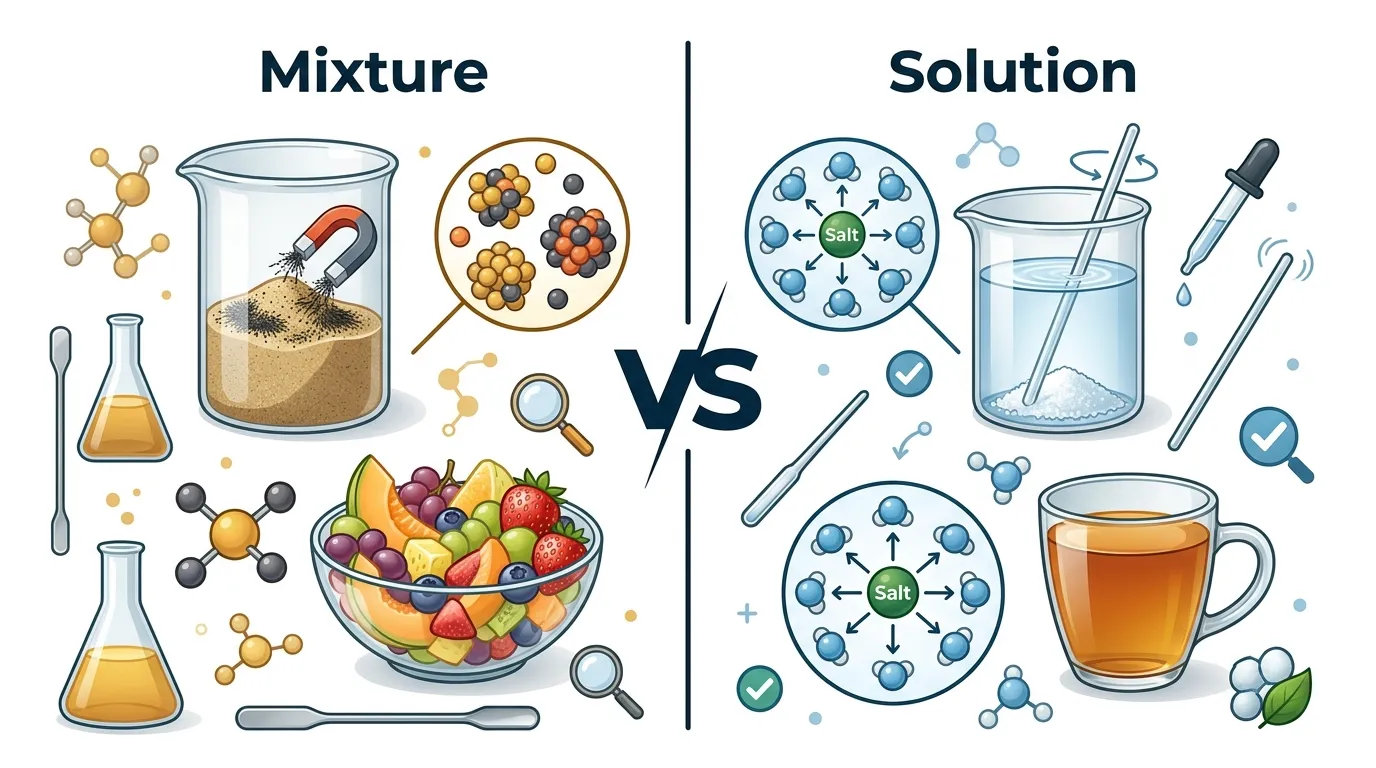
A mixture is formed when two or more substances are physically combined, but they do not chemically react or change. The substances in a mixture keep their original properties. You can usually separate them again using physical methods like filtering, evaporation, or picking them apart.
Think about a bowl of trail mix. You have nuts, raisins, chocolate chips, and maybe some dried cranberries all tossed together. None of them changed. The nuts are still nuts. The chocolate is still chocolate. You could sit there and separate everything by hand if you wanted to.
That is the core idea of a mixture.
Mixtures exist in two main forms. A homogeneous mixture looks the same throughout, with no visible separation. A heterogeneous mixture shows clearly different parts, like oil and water in a bottle.
Sand in water is a classic example of a heterogeneous mixture. The sand particles are visible, they settle to the bottom over time, and you can filter them out easily. Milk is another example, though it looks uniform at first glance. Under a microscope, milk contains tiny fat droplets suspended in water, making it technically a colloid, which is a type of mixture.
The key point: in any mixture, each substance retains its individual identity.
Real-world examples of mixtures:
- Soil (sand, clay, organic matter, water, air)
- Salad (multiple visible ingredients)
- Blood (cells, plasma, proteins, water)
- Granite rock (different minerals visible under a lens)
- Air itself (nitrogen, oxygen, argon, and other gases)
Mixtures are everywhere in daily life, often in forms most people never think about.
What Is a Solution?
A solution is a special type of mixture where one substance dissolves completely and evenly into another. The result is a single-phase system that looks perfectly uniform throughout, with no visible particles, no settling, and no separation over time.
In chemistry, a solution has two parts. The solute is the substance being dissolved, and the solvent is the substance doing the dissolving. When you stir a spoonful of sugar into warm water, the sugar is the solute and the water is the solvent. Once dissolved, you cannot see the sugar anymore. You cannot filter it out. You cannot pick it back out by hand.
The sugar molecules spread evenly between the water molecules at a molecular level.
This is what makes a solution different. The mixing happens at a microscopic, molecular scale. The final product is completely uniform no matter how small a sample you take.
Solutions do not have to involve water, though water is the most common solvent and is sometimes called the “universal solvent” because it dissolves so many different substances. Alcohol-based solutions, like hand sanitizer, are also common. Even solid solutions exist, such as metal alloys. Bronze is a solution of copper and tin. Steel is a solution of iron and carbon.
Real-world examples of solutions:
- Saltwater (salt dissolved in water)
- Vinegar (acetic acid dissolved in water)
- Sports drinks and electrolyte beverages
- Coffee (coffee compounds dissolved in water)
- Brass (zinc dissolved in copper, a solid solution)
- Rubbing alcohol (isopropyl alcohol in water)
One small difference most people overlook is that solutions are always transparent, though they can be colored. A cup of tea is technically a solution. It is colored brown, but you can still see through it. Orange juice, on the other hand, is a mixture because it contains pulp and particles that make it opaque.
Quick Comparison Table
| Feature | Mixture | Solution |
|---|---|---|
| Definition | Two or more substances combined physically | A homogeneous mixture where solute dissolves in solvent |
| Visibility of components | Components may be visible | Components are invisible, dissolved at molecular level |
| Uniformity | Can be uniform or non-uniform | Always uniform throughout |
| Particle size | Larger (1 micrometer or more) | Very small (less than 1 nanometer) |
| Separation possible | Yes, easily by physical methods | Difficult, requires evaporation or chemical methods |
| Settling over time | Heterogeneous mixtures settle | No settling occurs |
| Transparency | Can be opaque or cloudy | Always transparent (may be colored) |
| Chemical change | No chemical change | No chemical change |
| Type | Broad category | A specific type of mixture |
| Common examples | Soil, salad, blood, air | Saltwater, tea, alloys, vinegar |
| Filterable | Yes (for heterogeneous types) | No, particles pass through filters |
| Boiling/melting point | Variable | May differ from pure solvent |
The Biggest Difference
Here is the simplest way to understand the core distinction.
All solutions are mixtures, but not all mixtures are solutions.
A solution is a specific kind of mixture where the mixing happens completely and evenly at the molecular level. A mixture is a broader term that includes everything from chunky soil to fully dissolved saltwater.
The real-world impact of this is significant. In science, medicine, and manufacturing, the difference between these two concepts determines how a substance behaves. A solution will pass through a filter unchanged. A mixture often will not. A solution will not separate on its own. A heterogeneous mixture will.
For beginners, this distinction matters most in exams and in practical science work. Calling a colloid or a suspension a “solution” is technically incorrect and can lead to wrong conclusions about how to separate or analyze a substance.
Key Differences Explained
1. Definition and Category
A mixture is the broader category. It simply means two or more substances combined without a chemical reaction. A solution is a subset of that category, specifically a homogeneous mixture.
Think of it this way: all squares are rectangles, but not all rectangles are squares. Similarly, all solutions are mixtures, but not all mixtures are solutions.
2. Particle Size
This is one of the most important physical differences.
In a solution, the dissolved particles (solute) are at the ionic or molecular level, typically smaller than 1 nanometer. They are so small they are invisible even under a regular microscope.
In a mixture, especially a suspension, the particles can be much larger, sometimes visible to the naked eye. Sand in water has particle sizes well above 1 micrometer.
Colloids fall in between, with particles ranging from 1 to 1000 nanometers. This is why milk looks white and opaque. The fat droplets scatter light even though they are too small to see individually.
3. Uniformity Throughout
A solution is always homogeneous. If you take a sample from the top of a saltwater glass and a sample from the bottom, both will have exactly the same concentration of salt.
A mixture can be either homogeneous or heterogeneous. Stir sand into water and then let it sit. Within a few minutes, the sand will settle at the bottom. The top of the glass will be mostly plain water. The bottom will be mostly sand. The composition varies by location.
4. Separation Methods
Separating a mixture is often straightforward.
- Filtration removes insoluble solids from liquids
- Magnetic separation pulls out iron-containing particles
- Evaporation separates liquids from solids
- Hand-picking works for large visible components
Separating a solution is more involved because the solute is dissolved at the molecular level.
- Evaporation can recover a solid solute
- Distillation separates liquids with different boiling points
- Chromatography separates dissolved dyes or compounds
- Reverse osmosis pushes water through a membrane, leaving solutes behind
5. Clarity and Transparency
In real-world use, this visual test is one of the fastest ways to tell the difference.
A true solution is always transparent. You can see through it clearly, even if it has a color. Black coffee, diluted food coloring in water, and copper sulfate solution are all colored but transparent.
A mixture is often cloudy, turbid, or opaque. Muddy water, milk, paint, and blood are all examples of mixtures where light cannot pass through clearly.
This matters more than many beginners realize. In a laboratory setting, cloudiness is an immediate signal that a substance is not a true solution.
6. Stability Over Time
Solutions are stable indefinitely. Leave a glass of saltwater on a shelf for a week, and the salt will still be evenly distributed throughout the water. Nothing will settle. Nothing will separate.
Many mixtures, especially suspensions, are unstable. Shake a bottle of Italian salad dressing and it looks mixed. Wait five minutes and the oil separates back to the top, the water-based vinegar sinks, and the herbs settle at the bottom.
7. Boiling and Melting Point Changes
Adding a solute to a pure solvent actually changes the physical properties of the solvent in predictable ways. Dissolving salt in water raises its boiling point and lowers its freezing point. This is called a colligative property of solutions.
Plain mixtures do not show this kind of consistent property change because the components are not interacting at a molecular level.
This is why roads are salted in winter (salt water solution freezes at a lower temperature) and why pasta water is salted before boiling (raises boiling temperature slightly).
8. Filtration Behavior
Pass a solution through filter paper and the solute passes right through with the solvent. The solution comes out the other side unchanged. This is because dissolved particles are smaller than the pores in the filter paper.
Pass a suspension or heterogeneous mixture through the same filter and the solid particles are caught. The liquid passes through but the solid components stay behind. This is how water treatment plants remove large particles from water.
9. Effect of Light
A solution does not scatter visible light significantly. This is called the Tyndall Effect, and solutions do not display it.
Colloids and many mixtures do scatter light. This is why a beam of sunlight through a dusty room is visible. The dust particles scatter the light into a visible beam. Pure clean air, which is closer to a solution, does not scatter light in the same way.
10. Concentration
Solutions have a measurable and consistent concentration throughout. You can express exactly how much solute is dissolved in how much solvent, and that ratio holds true for any sample taken from the mixture.
Heterogeneous mixtures do not have a uniform concentration. The ratio of components changes depending on where you sample.
Similarities Between Mixture and Solution
Despite their differences, mixtures and solutions share several important characteristics that explain why beginners often confuse them.
Both are formed by physical combination, not chemical reaction. Neither process creates a new substance. The original components retain their chemical identities. Both can involve solids, liquids, or gases. Both can be separated using physical methods, though the methods differ. Neither involves a change in the chemical formula of the substances involved.
Solutions are technically a type of mixture, which is the biggest source of confusion. When a teacher says “prepare a mixture,” technically a solution would qualify. When they say “prepare a solution,” they are being more specific about the type of mixture required.
This overlap means that in casual conversation, people often use the words interchangeably without causing any real problem. In scientific or technical contexts, the distinction becomes important.
Pros and Cons
Pros of Mixtures
- Easy to separate components again
- Can handle a wide variety of combinations
- Natural and abundant in daily life
- Simple to prepare without precise measurements
- Components remain individually identifiable
Cons of Mixtures
- Inconsistent composition throughout (for heterogeneous types)
- Can settle, separate, or change over time
- Harder to use in precise scientific or medical applications
- Properties can be unpredictable
Pros of Solutions
- Completely uniform and stable
- Predictable physical and chemical properties
- Essential for medicines, biology, and industrial chemistry
- Easy to measure and work with precisely
- Can pass through membranes and biological tissue
Cons of Solutions
- Harder to separate back into original components
- Requires the right solvent and conditions to form
- Can be unstable at extreme temperatures or concentrations
- May change properties of the solvent (boiling point, freezing point)
Which Is Better for Different Situations?
For students and beginners in chemistry: Understanding the solution is more critical because it comes up in nearly every topic, from acids and bases to biological processes.
For cooking: Both matter. Dissolving sugar in water to make syrup creates a solution. Making a salad or stew creates a mixture. Knowing the difference helps understand why recipes sometimes say “dissolve completely” and sometimes just say “combine.”
For medicine: Solutions are preferred for medications because they allow precise dosing and even distribution. Many liquid medicines, eye drops, and IV fluids are solutions. If the drug does not dissolve fully, the patient may get an uneven dose.
For environmental science: Natural water systems are complex mixtures. Drinking water treatment aims to create as pure a solution as possible by removing mixture components like sediment and microorganisms.
For industry and manufacturing: Both are used extensively. Paint is a mixture. Electroplating solutions are true solutions. Metal alloys are solid solutions.
For budget or practical home use: In everyday life, the distinction rarely matters directly. The important thing is knowing when to stir longer (to form a solution) versus when simple mixing is enough (for a mixture).
Common Mistakes People Make
Assuming all liquids that look uniform are solutions. Milk looks smooth and white but is actually a colloid, a type of mixture. Many people incorrectly call it a solution.
Thinking that a cloudy substance cannot be a mixture. All suspensions and colloids are mixtures. Cloudiness is actually a clue that you have a mixture, not a solution.
Confusing “dissolving” with “mixing.” Dissolving means the solute breaks apart at the molecular level. Mixing can mean simply stirring two things together without actual dissolution. Salt dissolves in water. Sand does not.
Believing that a solution can be filtered. This is a common exam mistake. Dissolved particles in a true solution are too small to be caught by filter paper. If a substance can be filtered out, it was not dissolved and therefore was not a solution.
Using the words interchangeably in scientific writing. In casual conversation this is fine. In a chemistry lab report or exam, calling a suspension a “solution” will cost marks.
Thinking solutions are always water-based. Some users later regret not learning this earlier. Solutions can be solid, liquid, or even gaseous. Alloys are solid solutions. Air is a gaseous solution.
Expert Recommendation
Choose to call something a solution if:
- The substance is completely transparent (you can see through it clearly)
- No particles settle to the bottom over time
- The components cannot be filtered out with regular filter paper
- The mixing happened at a molecular or ionic level
- The composition is uniform throughout every sample
Choose to call something a mixture if:
- The components are visible or can be separated easily
- The substance is cloudy, opaque, or settles over time
- It contains two or more distinguishable substances combined without full dissolution
- Different samples from different parts of the container have different compositions
Avoid calling something a solution if:
- It is cloudy or turbid
- Particles settle to the bottom within minutes
- You can filter out the solid component easily
- Different parts of the container have visibly different compositions
Avoid calling something just a mixture in scientific contexts if:
- You need to be precise about whether the substance is homogeneous or heterogeneous
- You are describing a pharmaceutical or chemical preparation
- Accuracy about concentration or uniformity matters
Final Verdict
The difference between a mixture and a solution comes down to one core idea. A solution is a fully dissolved, perfectly uniform type of mixture. A regular mixture may or may not be uniform, and the components often stay physically distinct.
Solutions exist at the molecular level. Mixtures can exist at a much larger scale.
If you are a student, remember: all solutions are mixtures, but not all mixtures are solutions. That single sentence covers 80 percent of what exam questions test on this topic.
If you are just a curious person trying to understand the world around you, the practical takeaway is simple. Clear liquid you can see through, with no settling, is likely a solution. Cloudy, settling, or visibly multi-component stuff is a mixture. Both are useful, both are everywhere, and now you can tell them apart.
Frequently Asked Questions
Q: What is the main difference between a mixture and a solution?
A mixture is a broad term for two or more substances combined without a chemical reaction. A solution is a specific type of mixture where one substance (solute) dissolves completely and evenly into another (solvent) at the molecular level. The key differences are uniformity, particle size, and whether components can be separated by simple filtration.
Q: Is a solution a type of mixture?
Yes, a solution is a specific type of homogeneous mixture. Not all mixtures are solutions, but every solution qualifies as a mixture. The difference is that a solution requires complete dissolution at the molecular level, whereas a mixture can involve particles of any size that do not fully dissolve.
Q: Can you filter a solution?
No. In a true solution, the dissolved particles are smaller than the pores in filter paper, so they pass right through. If you can filter out a solid component, the substance was a suspension or heterogeneous mixture, not a true solution. This filtration test is one of the simplest ways to tell the two apart.
Q: What are three examples of a mixture that is not a solution?
Soil, salad, and blood are all mixtures that are not simple solutions. Soil contains sand, clay, and organic matter in variable proportions. Salad contains visibly distinct ingredients. Blood contains cells, proteins, and plasma, making it a complex heterogeneous mixture rather than a solution.
Q: Is milk a solution or a mixture?
Milk is a mixture, specifically a colloid. It contains fat droplets suspended in water, along with proteins and sugars. The fat does not dissolve in water at the molecular level. Instead, it remains as tiny droplets that scatter light, which is why milk appears white and opaque rather than transparent like a true solution.
Q: Which is easier to separate, a mixture or a solution?
A mixture is generally easier to separate. Most heterogeneous mixtures can be separated by filtration, evaporation, magnetic separation, or hand-picking. Solutions require more advanced techniques like evaporation to recover the solute, distillation, or reverse osmosis, because the dissolved particles are too small to separate by simple physical methods.
Q: Are all solutions liquid?
No. Solutions can be solid, liquid, or gaseous. Metal alloys like bronze (copper and tin) and steel (iron and carbon) are solid solutions. Seawater and vinegar are liquid solutions. Air is a gaseous solution of nitrogen, oxygen, and other gases. The defining feature is complete uniform mixing at the molecular level, not the physical state.
Q: What is the Tyndall Effect and how does it help tell mixtures from solutions?
The Tyndall Effect is the scattering of a light beam by particles in a substance. Shine a flashlight through a colloid or suspension (types of mixtures) and you can see the beam. Shine the same light through a true solution and the beam is not visible because the dissolved particles are too small to scatter light. This is a quick real-world test to tell the difference between a solution and a mixture.
Conclusion:
Understanding the difference between a mixture and a solution is one of those foundational science concepts that makes everything else clearer.
A mixture is any combination of two or more substances that keep their individual properties. A solution is a special kind of mixture where one substance dissolves completely into another, creating a uniform, stable, transparent product.
In everyday life, you encounter both constantly. Your morning coffee is a solution. The soil in your garden is a mixture. The vinegar in your salad dressing is a solution. The dressing itself, once shaken, is a mixture.
Once you understand the real distinction, you stop confusing them. And that clarity helps whether you are answering an exam question, reading a recipe, understanding a medicine label, or just satisfying everyday curiosity about the world around you.

I am Steven Pinker is a Canadian-American cognitive psychologist, linguist, and popular science author known for his work on language, mind, and human nature.He is the author of influential books like The Language Instinct and The Sense of Style, where he explains grammar and usage with scientific clarity.At wordrar.com, his ideas continue to inspire readers who want to understand grammar, comparison, and clear communication more deeply.