A few years ago, a student named Ali moved from school to university and proudly told his parents, “Now my teacher is a professor!”. His father smiled but gently corrected him, saying, “Not every teacher is a professor.” That moment left Ali confused aren’t they the same?
In everyday life, people often use the words teacher and professor interchangeably. After all, both stand in front of students, explain lessons, and guide learning. But in reality, there is a clear and important difference between teacher and professor.
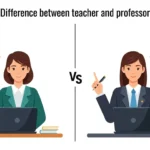
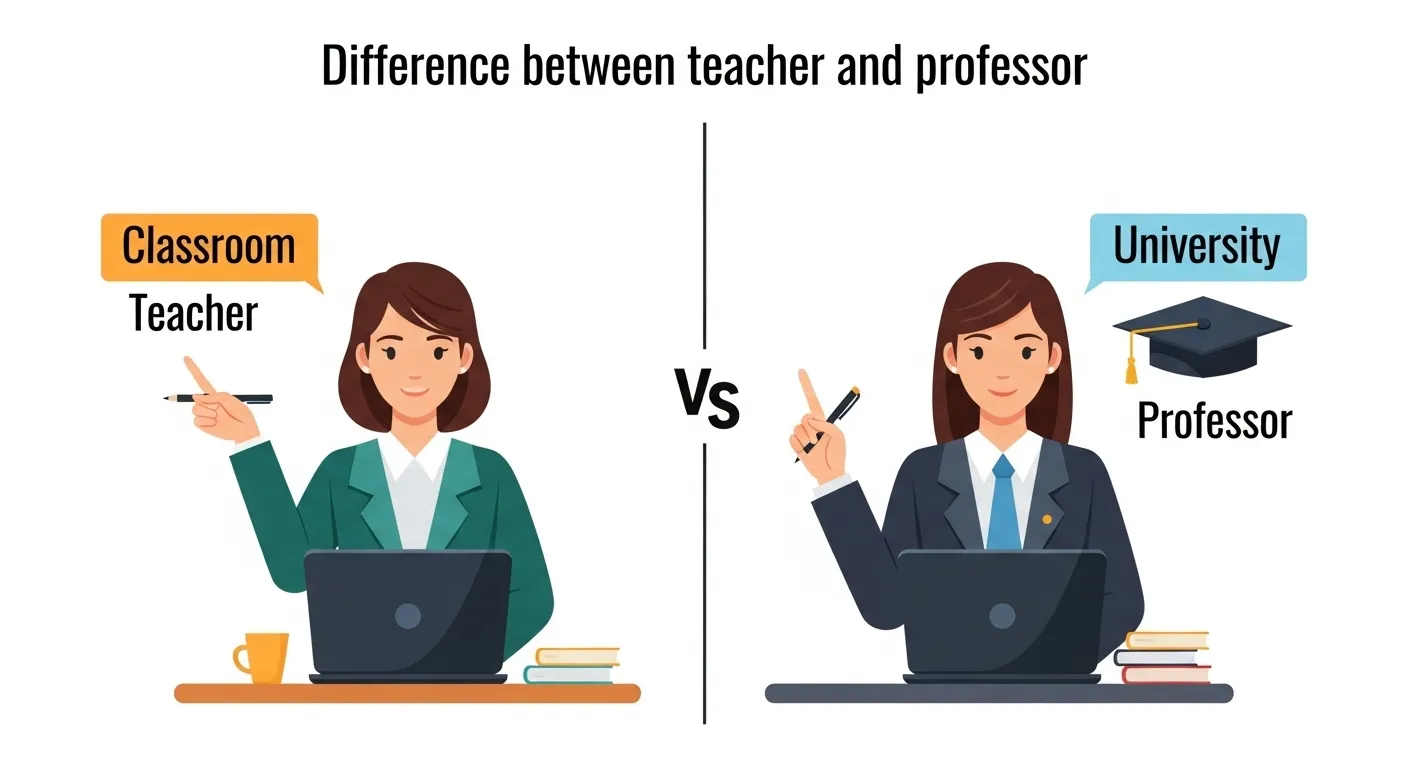
A teacher is someone who teaches at schools or educational institutions, helping students understand basic to intermediate concepts. A professor, on the other hand, is a highly qualified academic who teaches at universities and is deeply involved in research and advanced education.
Understanding the difference between teacher and professor is not just about vocabulary it helps you better understand the education system, career paths, and learning environments. Many learners struggle with this distinction, especially when transitioning from school to higher education.
In this article, we will break down the difference between teacher and professor in the simplest way possible with examples, comparisons, and real-life clarity so you never get confused again.
Key Differences Between Teacher and Professor
- A teacher usually works in schools, while a professor works in universities.
- Teachers focus on basic education, professors focus on advanced and specialized knowledge.
- Teachers may not require a PhD, while professors typically hold a doctoral degree.
- Professors often do research and publish papers, teachers usually do not.
- The learning style differs: guided teaching vs independent learning.
Why This Difference Matters
Understanding the difference between teacher and professor helps students set the right expectations.
If you’re in school, your teacher will guide you step-by-step. But at university, professors expect independent thinking and self-study.
For career planning, this difference is also crucial. Becoming a professor requires years of higher education, research, and specialization, while teaching at school has a different pathway.
Pronunciation (US & UK)
- Teacher
- US: /ˈtiː.tʃɚ/
- UK: /ˈtiː.tʃər/
- Professor
- US: /prəˈfɛs.ɚ/
- UK: /prəˈfes.ər/
👉 Now that you know the basics, let’s dive deeper into the main comparison.
Difference Between Teacher and Professor
1. Level of Education They Teach
A teacher usually teaches at primary or secondary school level.
A professor teaches at university or college level.
- Example 1: A math teacher explains algebra to 8th-grade students.
- Example 2: A professor teaches advanced calculus to university students.
2. Qualification Requirements
Teachers may need a bachelor’s degree and teaching certification.
Professors usually require a PhD or doctoral degree.
- Example 1: A school teacher has a Bachelor of Education (B.Ed).
- Example 2: A professor holds a PhD in Physics.
3. Teaching Style
Teachers guide students closely.
Professors encourage independent thinking and research.
- Example 1: A teacher explains every step in class.
- Example 2: A professor gives a topic and expects students to explore it.
4. Research Work
Teachers mostly focus on teaching.
Professors actively conduct research and publish papers.
- Example 1: A teacher prepares lesson plans daily.
- Example 2: A professor publishes research in journals.
5. Work Environment
Teachers work in schools.
Professors work in universities or colleges.
- Example 1: A teacher works in a high school.
- Example 2: A professor works at a university campus.
6. Student Interaction
Teachers interact more personally with students.
Professors maintain a more formal relationship.
- Example 1: A teacher knows each student personally.
- Example 2: A professor may teach hundreds of students in a lecture hall.
7. Curriculum Control
Teachers follow a fixed curriculum.
Professors may design their own course content.
- Example 1: A teacher follows a school syllabus.
- Example 2: A professor creates their own lecture topics.
8. Job Titles
Teacher is a general term.
Professor is a specific academic rank.
- Example 1: A person is called a science teacher.
- Example 2: A person is called an associate professor.
9. Salary and Status
Professors usually earn higher salaries than teachers.
Their academic status is also higher.
- Example 1: A school teacher earns a standard salary.
- Example 2: A professor earns more due to specialization.
10. Career Path
Teaching can start earlier.
Becoming a professor takes many years of study.
- Example 1: A teacher starts after graduation.
- Example 2: A professor studies for 8–10+ years.
Nature and Behavior
Teacher
Teachers are usually supportive, guiding, and nurturing.
They focus on building foundations and discipline in students.
Professor
Professors are more analytical, research-oriented, and independent.
They focus on deep knowledge and critical thinking.
Why People Get Confused
- Both teach students
- Both work in education
- The terms are used casually in daily language
But the difference between teacher and professor becomes clear when you look at level, qualification, and role.
Comparison Table
| Feature | Teacher | Professor |
|---|---|---|
| Workplace | School | University |
| Qualification | Bachelor’s | PhD |
| Focus | Basic education | Advanced studies |
| Research | Rare | Essential |
| Teaching Style | Guided | Independent |
| Status | General | Academic rank |
Practical Usage
In school settings, a teacher is the best guide because students need structured learning. In universities, a professor is more suitable because students must think independently and explore deeply.
Metaphors and Similes
- A teacher is like a gardener, nurturing young plants.
- A professor is like a scientist, exploring new discoveries.
Connotative Meanings
- Teacher: Positive (supportive, caring)
- Professor: Positive (intelligent, expert), sometimes neutral or formal
Idioms and Proverbs
- “A good teacher is like a candle—it consumes itself to light the way.”
- “When the student is ready, the teacher appears.”
Use in Literature
- Dead Poets Society (1989) – Focus on teaching inspiration
- Educating Rita (1983) – Shows professor-student relationship
- Academic novels often portray professors as thinkers and researchers
Movies Related to Keywords
- Dead Poets Society (1989, USA)
- The Professor (2018, USA)
- Taare Zameen Par (2007, India)
FAQs
1. Is every professor a teacher?
Yes, but not every teacher is a professor. Professors are a specialized type of teacher.
2. Can a teacher become a professor?
Yes, with higher education like a PhD and research experience.
3. Which is more qualified?
A professor is usually more academically qualified.
4. Do professors teach like school teachers?
No, professors focus more on discussion and research.
5. Which job is better?
It depends on your interest—teaching basics or advanced research.
Real-Life Importance
Understanding the difference between teacher and professor helps students adapt better when moving from school to university. It also helps parents guide children and supports better career decisions.
Final Words
Both teachers and professors play powerful roles in shaping minds. One builds the foundation, the other builds expertise. Without teachers, there would be no professors.
Conclusion
The difference between teacher and professor becomes clear when we look at their roles, qualifications, and environments.
A teacher focuses on basic learning and guidance, while a professor focuses on advanced knowledge and research.
Both are essential in education, but they serve different stages of learning.
Understanding this difference helps students adjust expectations and succeed academically.
In simple words: teachers build the base, professors build the future
I am Lynne truss , journalist, and broadcaster best known for her bestselling grammar book Eats, Shoots & Leaves, which highlights the importance of punctuation in clear writing. Her engaging and witty style has made grammar accessible and entertaining for millions of readers worldwide.at wordrar.com, we admire her work for inspiring readers to appreciate the power of precise language and proper grammar.