Imagine a small town where two friends had a fallout. One chooses to seek vengeance, planning carefully over time, while the other reacts immediately, acting on revenge in anger.
This real-life scenario shows how vengeance and revenge, though similar, are very different in intensity, timing, and mindset.
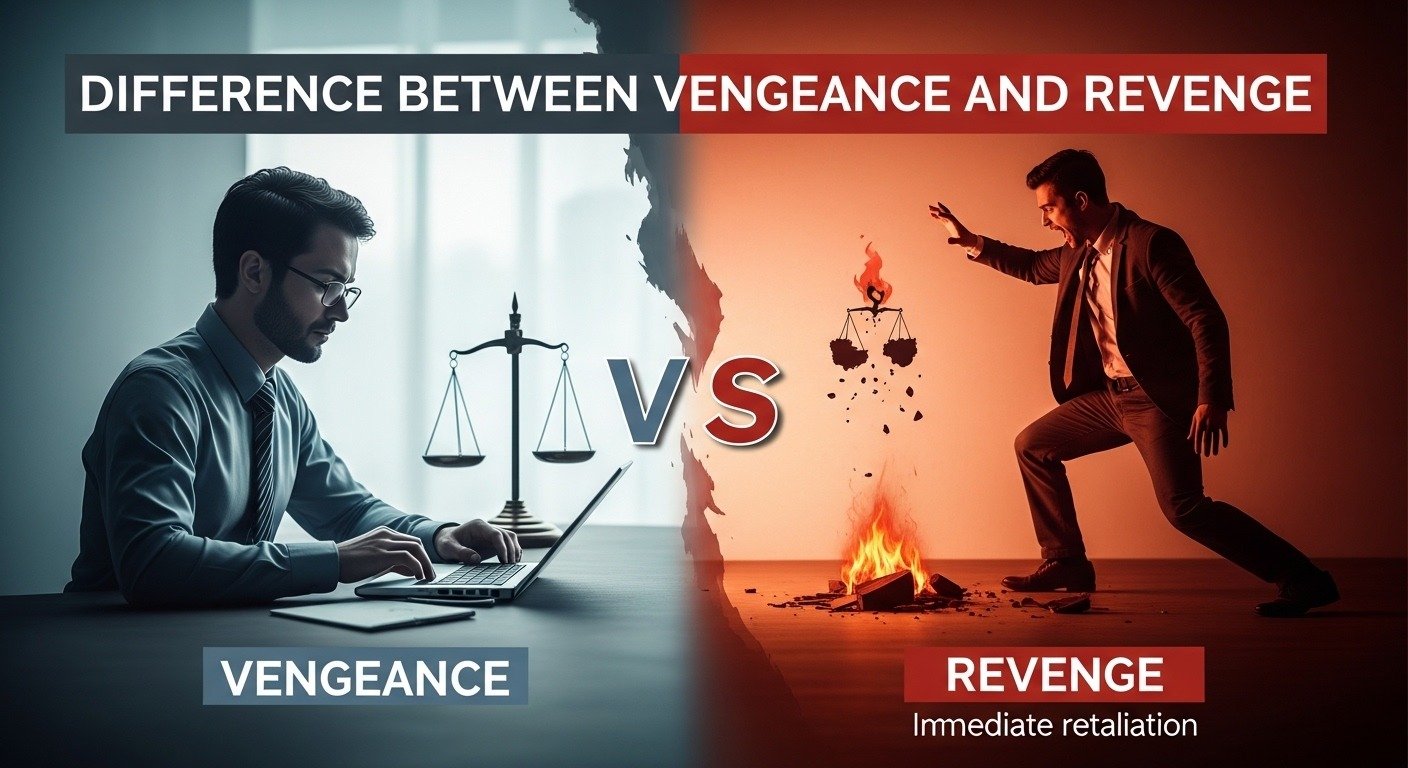
Vengeance and revenge both deal with retaliation, but the difference lies in purpose. Vengeance often has a moral or justice-driven undertone.
Revenge, on the other hand, is more personal and emotional, fueled by resentment. Understanding these differences helps us communicate clearly and reflect on actions in society.
People often confuse vengeance and revenge in conversations, writing, and even films. This blog will clarify their distinct meanings, pronunciation, usage, and cultural relevance, helping learners and experts use them correctly.
Difference Between Vengeance and Revenge
10 Key Differences
- Definition & Meaning
- Vengeance: Punishment in return for a wrong, often seen as just or moral.
- Example 1: The king sought vengeance on the traitor.
- Example 2: Historical wars often involve acts of vengeance.
- Revenge: Personal retaliation driven by anger or hurt.
- Example 1: She plotted revenge on her cheating partner.
- Example 2: Siblings often quarrel seeking revenge for small insults.
- Motivation
- Vengeance: Moral obligation or duty.
- Example: Judges can enact vengeance through fair trials.
- Revenge: Emotional satisfaction.
- Example: Teens might seek revenge for teasing at school.
- Time Factor
- Vengeance: Planned over time; calculated.
- Revenge: Immediate reaction, often impulsive.
- Scope
- Vengeance: Can impact larger groups or society.
- Revenge: Usually personal or small-scale.
- Legality & Ethics
- Vengeance: Sometimes aligns with law and justice.
- Revenge: Often illegal or morally questionable.
- Intensity
- Vengeance: Measured and purposeful.
- Revenge: Intense, emotional, sometimes destructive.
- Outcome
- Vengeance: Restores balance or justice.
- Revenge: May escalate conflict.
- Connotation
- Vengeance: Mostly neutral to positive.
- Revenge: Mostly negative, associated with anger.
- Cultural Portrayal
- Vengeance: Historical epics and tragedies often depict it.
- Revenge: Modern thrillers and dramas highlight it.
- Philosophical View
- Vengeance: Seen as fulfilling duty.
- Revenge: Seen as selfish or reactive.
Nature & Behaviour
- Vengeance: Calculated, disciplined, strategic. Often honorable or justified.
- Revenge: Impulsive, emotional, personal. Often destructive or petty.
Why People Are Confused
- Both involve retaliation, but the intention, planning, and moral undertone differ. Many assume they are interchangeable, but context matters.
Comparison Table: Vengeance vs Revenge
| Aspect | Vengeance | Revenge | Similarity |
| Motivation | Justice or duty | Personal anger | Both involve retaliation |
| Planning | Calculated, long-term | Immediate, impulsive | Both seek to respond to a wrong |
| Connotation | Neutral/positive | Negative | Both are reactions to harm |
| Scope | Society or individual | Individual | Both can affect relationships |
| Outcome | Restores balance | May escalate conflict | Both aim to address grievance |
Which Is Better in What Situation?
Vengeance is better in situations requiring fairness, law, or societal justice. It ensures the act is justified and avoids personal bias.
Revenge may satisfy immediate emotional needs but can escalate conflicts. It’s suitable for personal closure, though often riskier socially.
Use in Metaphors & Similes
- “Her anger was a storm of revenge.”
- “Justice moved like a slow-burning vengeance.”
Connotative Meanings
- Vengeance: Neutral/positive – Example: Vengeance for justice in court cases.
- Revenge: Negative – Example: Revenge poisoned his thoughts.
Idioms & Proverbs
- Revenge is a dish best served cold – used for planning retaliation.
- Vengeance is mine, saith the Lord – emphasizes divine justice.
Literature References
- Hamlet by William Shakespeare (Tragedy, 1600) – Vengeance
- The Count of Monte Cristo by Alexandre Dumas (Adventure, 1844) – Revenge
Movies
- Oldboy (2003, South Korea) – Revenge
- Gladiator (2000, USA) – Vengeance
Frequently Asked Questions
- Are vengeance and revenge the same?
- No, vengeance is justice-driven; revenge is personal.
- Which is morally acceptable?
- Vengeance aligns with justice; revenge may not.
- Can revenge turn into vengeance?
- Yes, if emotion is replaced by careful planning.
- Do both affect society?
- Vengeance often affects society; revenge is usually personal.
- Why are people confused?
- Similar outcome (retaliation) masks the difference in intent and ethics.
How Both Are Useful for Surroundings
- Vengeance can restore social balance and enforce justice.
- Revenge can highlight emotional needs but requires caution.
Final Words
Understanding the difference between vengeance and revenge helps choose actions wisely, avoid misunderstandings, and maintain ethical integrity in society. Both words are powerful but context defines their effect.
Conclusion:
Vengeance and revenge are intriguing yet often misused words. Vengeance implies justice, planning, and balance, while revenge is driven by personal anger and impulsiveness.
Knowing the difference is essential for writers, learners, and society, as it affects communication, moral judgment, and conflict resolution.
In literature, film, and daily life, these terms shape narratives and emotions, reflecting human nature. By distinguishing between the two, one can act responsibly, avoid unnecessary conflict, and understand the deeper ethical and emotional layers of retaliation.
Always remember: vengeance seeks fairness; revenge seeks satisfaction, and the choice impacts both personal and societal harmony.

I am William Strunk Jr an American professor of English and the author of the classic style guide the Elements of Style. He emphasized clarity, brevity, and proper grammar in writing, influencing generations of writers. Learn more about his work and writing tips at wordrar.com.