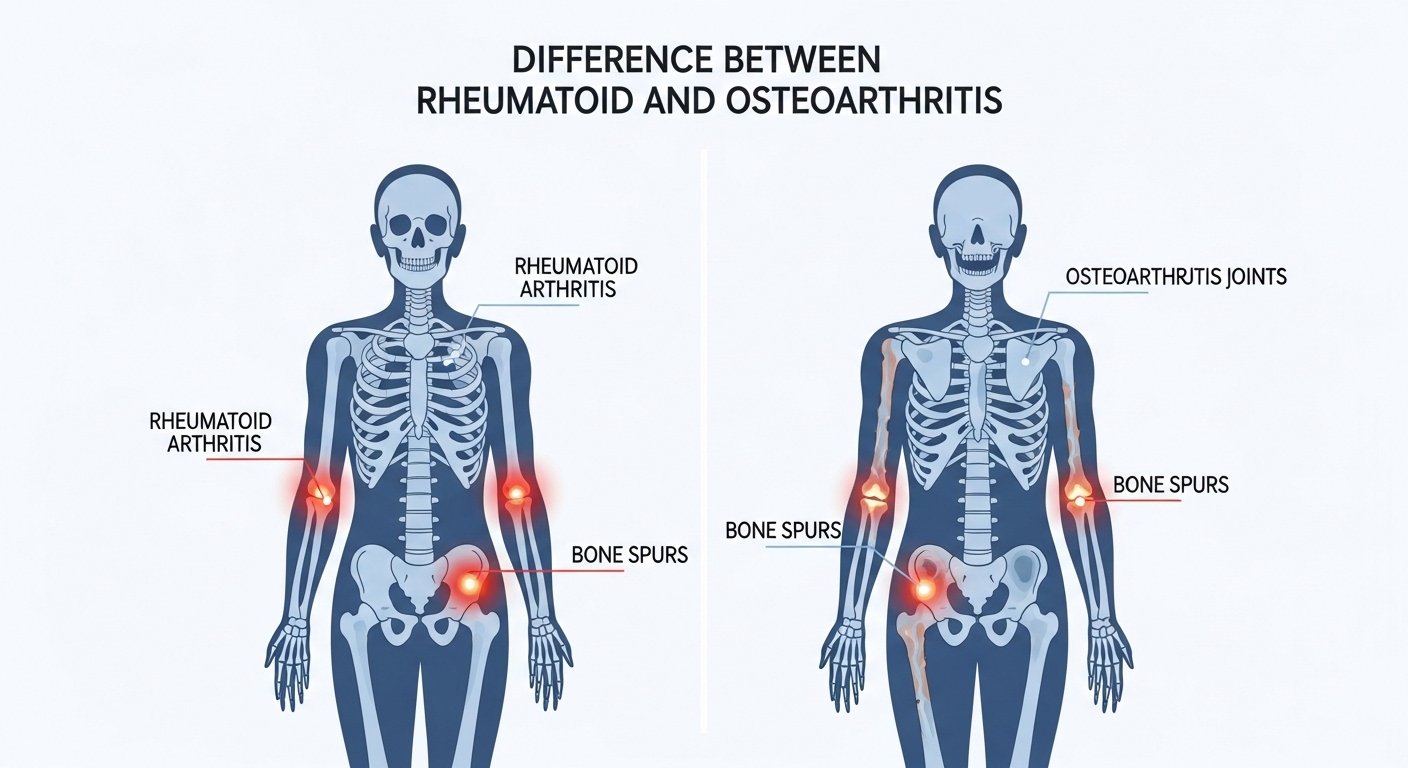
A few months ago, my neighbor’s mother complained of joint pain that would not go away.
At first, she thought it was just age-related stiffness.
But her doctor explained the difference between rheumatoid and osteoarthritis, and everything changed.
One was caused by wear and tear, the other by an autoimmune attack.
Understanding the difference between rheumatoid and osteoarthritis helped her start the right treatment early.
Without knowing this difference, many people suffer longer than they should.
The difference between rheumatoid and osteoarthritis is not just medical jargon.
It affects diagnosis, lifestyle, and even emotional well-being.
In this article, we will clearly explore the difference between rheumatoid and osteoarthritis in simple language.
Because knowledge can reduce pain and confusion.
Key Difference Between the Both
The main difference between rheumatoid and osteoarthritis lies in their cause:
- Rheumatoid arthritis (RA) is an autoimmune disease where the immune system attacks healthy joints.
- Osteoarthritis (OA) is a degenerative joint disease caused by wear and tear over time.
Why Is Their Difference Necessary to Know for Learners and Experts?
Understanding this distinction is crucial for:
- Patients – to seek early treatment and avoid complications.
- Medical students – to correctly diagnose symptoms.
- Healthcare experts – to design proper treatment plans.
- Society – to reduce disability and healthcare burden.
Misdiagnosis can delay proper care, leading to joint deformity or chronic disability.
Pronunciation of Both (US & UK)
- Rheumatoid
- US: /ˈruː.mə.tɔɪd/
- UK: /ˈruː.mə.tɔɪd/
- Osteoarthritis
- US: /ˌɑː.sti.oʊ.ɑːrˈθraɪ.t̬ɪs/
- UK: /ˌɒs.ti.əʊ.ɑːˈθraɪ.tɪs/
Let’s Now Explore the Main Differences in Detail
Difference Between Rheumatoid and Osteoarthritis
1. Cause
- RA: Immune system attacks joints.
- Example 1: A 35-year-old woman develops joint swelling without injury.
- Example 2: Blood tests show autoimmune markers.
- OA: Cartilage wears down with age.
- Example 1: A 65-year-old man has knee pain after years of labor work.
- Example 2: X-rays show cartilage thinning.
2. Age of Onset
- RA: Common between ages 30–50.
- Example: Young adults experience morning stiffness.
- Example: Teenagers may develop juvenile RA.
- OA: Mostly after age 50.
- Example: Elderly people feel joint pain while walking.
- Example: Retired athletes develop knee OA.
3. Joint Pattern
- RA: Affects both sides symmetrically.
- Example: Both wrists swell.
- Example: Both knees hurt equally.
- OA: Often affects one joint.
- Example: Only right knee hurts.
- Example: One hip shows degeneration.
4. Morning Stiffness
- RA: Lasts more than 1 hour.
- Example: Hands stiff until noon.
- Example: Difficulty gripping objects early morning.
- OA: Lasts less than 30 minutes.
- Example: Mild stiffness after waking.
- Example: Improves after light movement.
5. Inflammation
- RA: Severe inflammation.
- Example: Red, warm joints.
- Example: Fatigue and fever.
- OA: Mild or no inflammation.
- Example: Swelling after heavy use.
- Example: Pain without redness.
6. Joint Damage
- RA: Can cause deformity.
- Example: Bent fingers.
- Example: Joint erosion seen in scans.
- OA: Bone spurs develop.
- Example: Enlarged knuckles.
- Example: Reduced joint space.
7. Systemic Effects
- RA: Affects other organs.
- Example: Lung inflammation.
- Example: Eye dryness.
- OA: Limited to joints.
- Example: Knee-only discomfort.
- Example: No organ involvement.
8. Gender
- RA: More common in women.
- Example: Hormonal influence suspected.
- Example: Women 3x more affected.
- OA: Affects both genders equally (slightly more women after 50).
- Example: Post-menopausal women.
- Example: Aging men with joint strain.
9. Diagnosis
- RA: Blood tests detect antibodies.
- Example: Positive rheumatoid factor.
- Example: Elevated ESR levels.
- OA: Diagnosed through imaging.
- Example: X-ray shows cartilage loss.
- Example: MRI shows joint narrowing.
10. Treatment
- RA: Requires immune-modifying drugs.
- Example: DMARDs prescribed.
- Example: Biologic injections.
- OA: Pain relief and lifestyle changes.
- Example: Weight reduction.
- Example: Joint replacement surgery.
Nature and Behaviour of Both
- Rheumatoid arthritis is aggressive and progressive if untreated. It behaves unpredictably and may flare up suddenly.
- Osteoarthritis progresses slowly and is linked to mechanical stress over time.
Why People Are Confused About Their Use?
Both involve joint pain and stiffness, so people assume they are the same.
The term “arthritis” in both names also causes misunderstanding.
Table Showing Difference and Similarity
| Feature | Rheumatoid Arthritis | Osteoarthritis | Similarity |
| Cause | Autoimmune | Wear & tear | Joint damage |
| Age | 30–50 | 50+ | Chronic |
| Inflammation | Severe | Mild | Pain present |
| Symmetry | Symmetrical | Often asymmetrical | Stiffness |
| Organs | Affects organs | Joint only | Reduced mobility |
Which Is Better in What Situation?
Rheumatoid arthritis is not “better,” but early diagnosis can control it effectively. If detected early, immune therapy can prevent severe deformity. Proper monitoring allows patients to live normal lives with medication support.
Osteoarthritis, on the other hand, may be easier to manage through lifestyle changes like exercise, weight control, and physiotherapy. In elderly patients, joint replacement surgery can restore mobility.
Metaphors and Similes
- “Rheumatoid arthritis is like a civil war within the body.”
- “Osteoarthritis is like rust on old hinges.”
Connotative Meanings
- Rheumatoid arthritis – Negative (chronic, aggressive).
- Example: “His struggle felt like rheumatoid arthritis attacking his confidence.”
- Osteoarthritis – Neutral to negative (aging, wear).
- Example: “Time brought osteoarthritis to the old building’s structure.”
Idioms or Proverbs
- “A creaking door hangs longest.”
- Used to describe osteoarthritis patients who continue functioning.
- “The body fights itself.”
- Used metaphorically for rheumatoid arthritis.
Works in Literature
- “The Anatomy of Illness” – Nonfiction, Norman Cousins, 1979
- “Joint Pain and Arthritis” – Medical Guide, Various Authors
Movies Based on Keywords
- “Unrest” (2017, USA) – Focuses on autoimmune disease themes
- “Still Alice” (2014, USA) – Though about Alzheimer’s, shows chronic illness struggles
Frequently Asked Questions
1. Is rheumatoid arthritis curable?
No, but it can be managed effectively.
2. Is osteoarthritis caused by age only?
Mostly age, but also injury and obesity.
3. Which is more painful?
RA can be more painful due to inflammation.
4. Can both occur together?
Yes, though rare.
5. Which needs urgent treatment?
Rheumatoid arthritis needs early medical intervention.
How Both Are Useful for Surroundings
Studying these diseases helps improve healthcare systems, medical research, and awareness programs. Early diagnosis reduces disability rates in society.
Final Words for Both
Rheumatoid arthritis demands immediate attention and immune control.
Osteoarthritis requires care, patience, and lifestyle balance.
Conclusion
Joint pain should never be ignored.
Understanding the difference between rheumatoid and osteoarthritis can change lives.
One attacks from within.
The other wears down slowly over time.
Early recognition means better treatment, less suffering, and improved quality of life.
The difference between rheumatoid and osteoarthritis is not just academic knowledge.
It is practical wisdom for healthier living.
Read More:
- Difference Between Corporation and Incorporation:(Clear Guide)
- Difference Between Okay and OK:(Simple Guide) for 2026
- Difference Between Degree and Diploma:(Which One is Right for You?)

I am William Strunk Jr an American professor of English and the author of the classic style guide the Elements of Style. He emphasized clarity, brevity, and proper grammar in writing, influencing generations of writers. Learn more about his work and writing tips at wordrar.com.