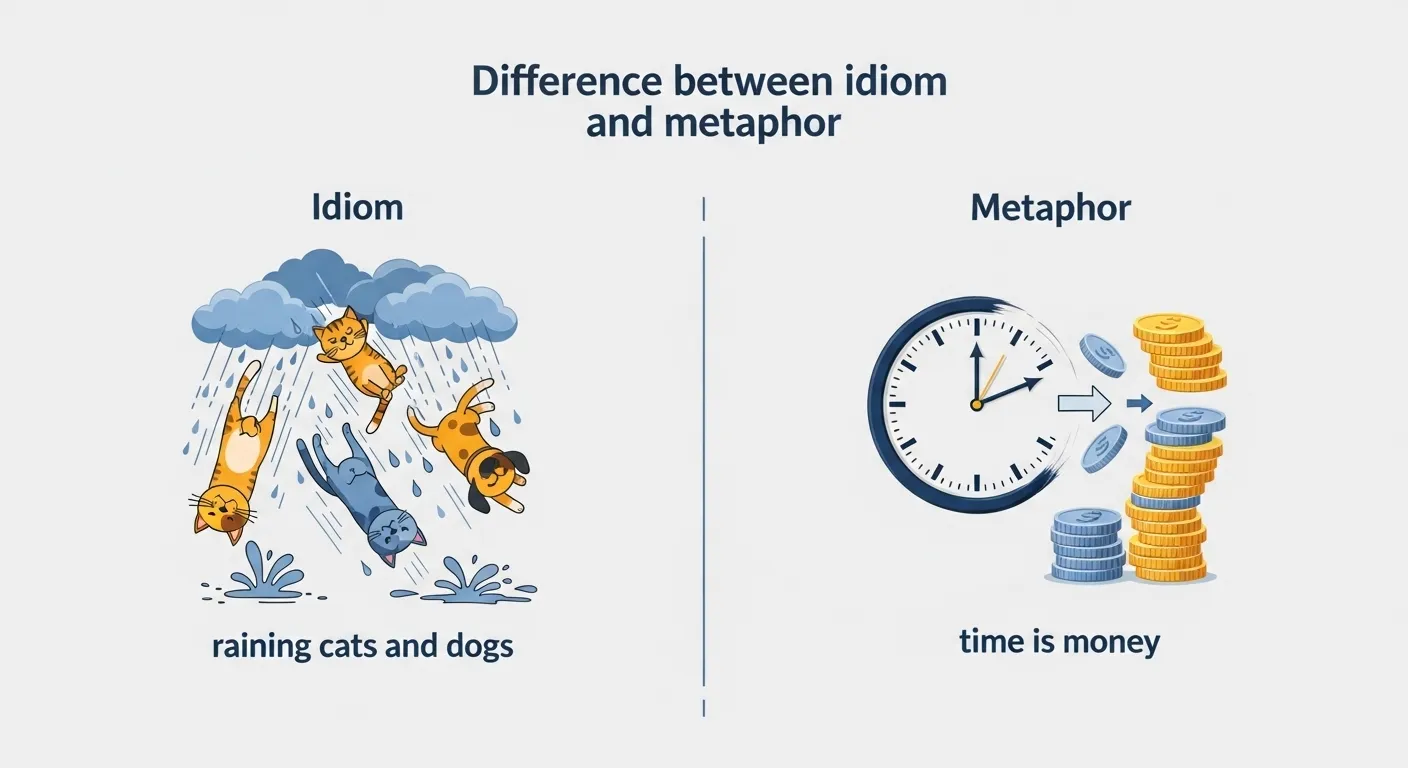
One day in a classroom, a student said, “It’s raining cats and dogs,” and another looked outside in shock.
That moment perfectly explains the difference between idiom and metaphor in real life.
An idiom is a phrase whose meaning is not literal, while a metaphor directly compares two things without using “like” or “as.”
Both are powerful tools in English, yet they confuse learners everywhere.
Understanding the difference between idiom and metaphor helps you speak more naturally.
It also improves writing, storytelling, and even professional communication.
Many learners mix them up because both go beyond literal meaning.
But their purpose and structure are quite different in usage.
So, if you’ve ever struggled with the difference between idiom and metaphor, this guide will make it simple and clear.
Key Difference Between the Both
The main difference is that an idiom is a fixed expression with a hidden meaning, while a metaphor is a creative comparison used to describe something vividly.
Why Is Their Difference Necessary to Know?
Knowing the difference between idiom and metaphor is essential because:
- It improves communication clarity
- Helps in academic writing and exams
- Builds strong storytelling skills
- Enhances cultural understanding
- Avoids misinterpretation in conversations
In society, people use idioms in daily speech, while metaphors appear in literature, speeches, and media. Mastering both gives you confidence and fluency.
Pronunciation (US & UK)
- Idiom
- US: /ˈɪdiəm/
- UK: /ˈɪdiəm/
- Metaphor
- US: /ˈmetəfɔːr/
- UK: /ˈmetəfə/
Hook to Main Section:
Now that you understand the basics, let’s dive deeper into the difference between idiom and metaphor with clear, practical comparisons.
Difference Between Idiom and Metaphor
1. Definition
- Idiom: A phrase with a non-literal meaning
- Example 1: “Break the ice” = start a conversation
- Example 2: “Spill the beans” = reveal a secret
- Metaphor: A direct comparison
- Example 1: “Time is money”
- Example 2: “He is a lion in battle”
2. Meaning Type
- Idiom: Hidden meaning
- “Hit the sack” = go to sleep
- “Under the weather” = feeling sick
- Metaphor: Implied comparison
- “Life is a journey”
- “Her voice is music”
3. Flexibility
- Idiom: Fixed phrase
- Cannot change words
- “Kick the bucket” (cannot modify)
- Metaphor: Flexible
- Can be created freely
- “He is a rock” / “She is sunshine”
4. Usage Context
- Idiom: Everyday conversation
- “Piece of cake” = easy
- “Costs an arm and a leg” = expensive
- Metaphor: Literature & speeches
- “The world is a stage”
- “Hope is light”
5. Literal vs Figurative
- Idiom: Completely figurative
- “Burn the midnight oil” = work late
- “Bite the bullet” = face difficulty
- Metaphor: Figurative but meaningful comparison
- “He is a machine”
- “Ideas are seeds”
6. Creativity Level
- Idiom: Memorized expressions
- “Once in a blue moon”
- “Let the cat out of the bag”
- Metaphor: Creative expression
- “Dreams are wings”
- “Fear is a shadow”
7. Origin
- Idiom: Cultural origin
- “Raining cats and dogs”
- “Cold feet”
- Metaphor: Literary or personal
- “Knowledge is power”
- “Love is fire”
8. Understanding Difficulty
- Idiom: Hard for beginners
- Needs memorization
- “Pull someone’s leg”
- Metaphor: Easier to interpret
- Based on logic
- “He is a snake”
9. Purpose
- Idiom: Express ideas quickly
- “In hot water” = trouble
- “On cloud nine” = happy
- Metaphor: Create imagery
- “The classroom was a zoo”
- “Her eyes were stars”
10. Structure
- Idiom: Phrase or sentence
- “Call it a day”
- “Back to square one”
- Metaphor: Sentence or clause
- “He is a shining star”
- “Time is a thief”
Nature and Behaviour
- Idiom: Fixed, cultural, and memorized
- Metaphor: Flexible, creative, and expressive
Why People Are Confused?
People confuse them because both are non-literal.
However, idioms are set phrases, while metaphors are comparisons created freely.
Difference & Similarity Table
| Feature | Idiom | Metaphor | Similarity |
|---|---|---|---|
| Meaning | Non-literal | Figurative comparison | Both non-literal |
| Structure | Fixed | Flexible | Used in language |
| Usage | Daily speech | Literature & speech | Enhance communication |
| Creativity | Low | High | Add depth to language |
Which Is Better in What Situation?
Idioms are better in daily conversations.
They make speech sound natural and fluent. For example, saying “It’s a piece of cake” is more engaging than saying “It’s easy.” Idioms are perfect for informal settings and social communication.
Metaphors are better in writing and speeches.
They add depth, emotion, and imagination. Writers, poets, and speakers use metaphors to create vivid images and connect with audiences emotionally.
How Keywords Are Used in Metaphors and Similes
- Metaphor: “Life is a game”
- Simile: “Life is like a game”
Idioms do not usually appear in similes, but metaphors are closely related.
Connotative Meaning
- Idiom: Neutral (depends on phrase)
- “Break the ice” (positive)
- “In hot water” (negative)
- Metaphor: Positive, negative, or neutral
- “Light of hope” (positive)
- “Dark cloud” (negative)
Idioms / Proverbs Related
- “Actions speak louder than words”
- “A blessing in disguise”
- “The early bird catches the worm”
Examples:
- His success was a blessing in disguise.
- She woke early because the early bird catches the worm.
Works in Literature
- “Romeo and Juliet” – Tragedy, William Shakespeare, 1597
- “The Great Gatsby” – Novel, F. Scott Fitzgerald, 1925
- “Animal Farm” – Allegory, George Orwell, 1945
Movies Related
- Dead Poets Society (1989, USA)
- The Great Gatsby (2013, USA)
- Life of Pi (2012, USA/India)
FAQs
1. What is the main difference between idiom and metaphor?
Idioms are fixed phrases, metaphors are comparisons.
2. Are idioms and metaphors both figurative?
Yes, both are non-literal expressions.
3. Which is easier to learn?
Metaphors are easier because they are logical.
4. Can idioms be metaphors?
No, idioms are fixed; metaphors are flexible.
5. Why are they important?
They improve communication and creativity.
How Both Are Useful for Surroundings
Idioms make conversations lively and natural, while metaphors make communication deep and expressive. Together, they enrich language in everyday life, education, and media.
Final Words
Both idioms and metaphors are essential tools.
One adds familiarity. The other adds imagination.
Conclusion:
Understanding the difference between idiom and metaphor is a powerful step toward mastering English.
While idioms are fixed expressions rooted in culture, metaphors are creative comparisons that bring language to life.
Both play unique roles. Both are equally important.
Idioms help you sound natural in conversations, while metaphors help you express ideas with depth and emotion.
If you learn to use both correctly, your communication becomes stronger, clearer, and more engaging.
If you are a student, writer, or professional, mastering these tools will boost your confidence.
In simple words: idioms make you fluent, metaphors make you expressive.
And together, they make your language truly powerful.

I am Steven Pinker is a Canadian-American cognitive psychologist, linguist, and popular science author known for his work on language, mind, and human nature.He is the author of influential books like The Language Instinct and The Sense of Style, where he explains grammar and usage with scientific clarity.At wordrar.com, his ideas continue to inspire readers who want to understand grammar, comparison, and clear communication more deeply.