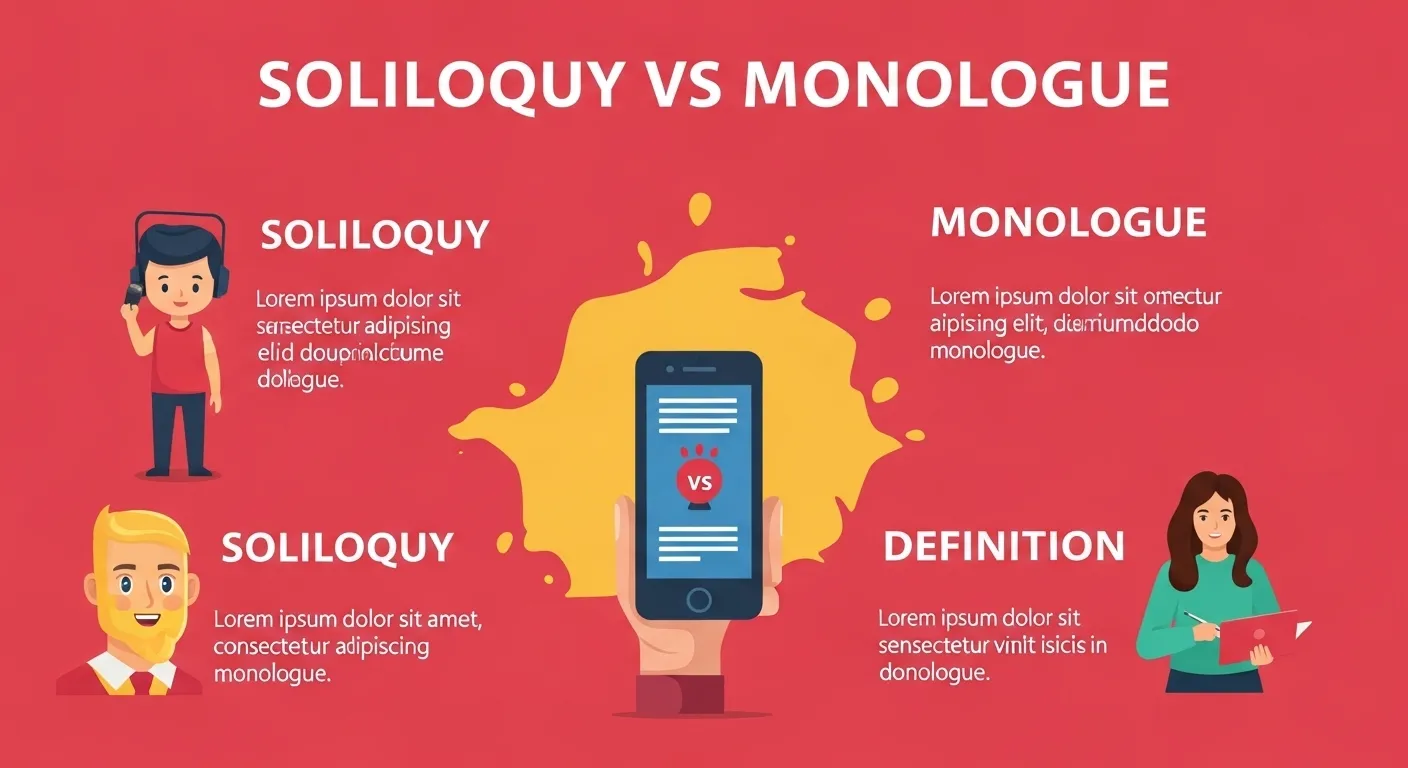
Imagine standing alone on a stage, speaking your deepest thoughts, pouring out your emotions for the audience to witness. This is the essence of a Soliloquy. In contrast, a monologue happens when a character speaks at length to others, expressing their ideas or feelings openly.
In everyday life, we see these patterns too. When someone thinks aloud in private, it mirrors a soliloquy.
But when a person gives a speech or explains their thoughts to a group, it’s like a monologue. Both are powerful tools for expression and reflection, helping learners and enthusiasts understand human behavior.
Understanding the difference between Soliloquy and Monologue is crucial for students, writers, and actors. It sharpens communication skills and enhances appreciation for literature and drama.
Both soliloquy and monologue allow characters to reveal inner conflicts, but their settings, purposes, and audience differ. Recognizing these distinctions can help in interpreting plays, movies, and novels accurately.
By the end of this guide, you’ll clearly understand the difference between Soliloquy and Monologue, their pronunciations, examples, and their relevance in literature, society, and daily life.
Pronunciation:
- Soliloquy – US: /səˈlɪl.ə.kwi/ | UK: /səˈlɪl.ə.kwi/
- Monologue – US: /ˈmɑː.nə.lɔːɡ/ | UK: /ˈmɒn.ə.lɒɡ/
Difference Between Soliloquy and Monologue
10 Key Differences
- Definition
- Soliloquy: A speech by a character alone, revealing inner thoughts.
- Example: Hamlet pondering life in Hamlet (Shakespeare, 1603).
- Monologue: A long speech directed at other characters or the audience.
- Example: Mark Antony addressing the crowd in Julius Caesar (Shakespeare, 1599).
- Audience
- Soliloquy: No direct audience; introspective.
- Example: Juliet thinking about Romeo (Romeo & Juliet).
- Monologue: Has a clear audience, either other characters or the audience.
- Example: Lady Macbeth persuading Macbeth (Macbeth).
- Soliloquy: No direct audience; introspective.
- Purpose
- Soliloquy: Reveals internal thoughts.
- Monologue: Explains, persuades, or entertains others.
- Length
- Soliloquy: Usually short and focused.
- Monologue: Can be long, spanning multiple minutes or scenes.
- Emotion
- Soliloquy: Highly emotional and personal.
- Monologue: Controlled, can be persuasive or narrative.
- Setting
- Soliloquy: Often in solitude.
- Monologue: Can occur in the presence of others.
- Interaction
- Soliloquy: No interaction; self-reflective.
- Monologue: May provoke responses or reactions from others.
- Frequency in Drama
- Soliloquy: Less frequent, more impactful.
- Monologue: Common in plays, movies, and speeches.
- Nature
- Soliloquy: Philosophical or introspective.
- Monologue: Narrative, argumentative, or descriptive.
- Examples in Everyday Life
- Soliloquy: Thinking aloud alone while solving a problem.
- Monologue: Giving a motivational speech or lecture.
Nature and Behaviour
- Soliloquy: Thoughtful, reflective, revealing inner struggles.
- Monologue: Expressive, informative, often directed to others.
Why People Are Confused
Many confuse them because both involve extended speech. But the difference lies in audience and intention. Soliloquy is internal; monologue is external.
Comparison Table
| Feature | Soliloquy | Monologue | Similarity |
| Audience | Alone, no one hears | Directed to others | Both reveal character thoughts |
| Purpose | Inner reflection | Persuasion or storytelling | Both are long speeches |
| Emotion | Personal, intense | Controlled, persuasive | Both show character emotions |
| Frequency | Rare | Common | Both used in literature & drama |
| Setting | Solitude | Presence of others | Both appear in plays & movies |
Which Is Better in What Situation?
A soliloquy is better when the writer wants to reveal hidden feelings or a character’s inner conflict.
A monologue suits situations requiring persuasion, storytelling, or explaining events to others.
Use in Metaphors and Similes
- Soliloquy: “Like a mirror to the soul,” it reflects private thoughts.
- Monologue: “As clear as a trumpet,” projecting ideas to others.
Connotative Meaning
- Soliloquy: Neutral to positive; shows introspection.
- Monologue: Neutral; can be positive (persuasive) or negative (boring/long-winded).
Idioms/Proverbs
- “Talking to oneself” → soliloquy.
- “Stealing the show” → monologue (when someone dominates a conversation).
Works in Literature
- Hamlet – Soliloquy – William Shakespeare – 1603
- Julius Caesar – Monologue – William Shakespeare – 1599
- Macbeth – Both – William Shakespeare – 1606
Movies Based on Keywords
- Hamlet (1996, UK) – Soliloquy-focused
- My Dinner with Andre (1981, US) – Monologue-heavy
- Macbeth (2015, UK) – Both
FAQs
- What is a soliloquy? – A speech where a character speaks alone to reveal inner thoughts.
- What is a monologue? – A long speech directed to others in a play or film.
- Can soliloquy and monologue occur together? – Yes, some plays feature both.
- Why are they important? – They reveal character, emotion, and intention.
- How to identify them? – Check audience presence and purpose of speech.
How Both Are Useful in Surroundings
Soliloquy helps understand self-reflection in personal growth. Monologue teaches communication, persuasion, and public speaking skills.
Final Words
Both soliloquy and monologue are essential tools for writers, actors, and learners. They bring characters to life and enhance understanding of human emotions.
Conclusion
Understanding the difference between soliloquy and monologue helps learners and enthusiasts appreciate drama, literature, and communication.
Soliloquy reveals inner thoughts with emotional depth, while monologue communicates directly to others, persuading or narrating events.
Recognizing their audience, purpose, and style improves interpretation and creative expression. Both forms are timeless, appearing in plays, films, and real-life speeches, making them valuable learning tools.
For students and experts, mastering these differences enriches performance, writing, and public speaking skills, offering insight into human psychology and social interactions.If reflecting silently or speaking boldly, these tools shape storytelling and expression profoundly.
Read More:
- Difference Between WordPress.com & WordPress.org:(Complete Guide)
- Productivity vs Efficiency:(Understand the Real Difference)
- Difference Between Gratitude and Thankfulness:(True Meaning)
I am Lynne truss , journalist, and broadcaster best known for her bestselling grammar book Eats, Shoots & Leaves, which highlights the importance of punctuation in clear writing. Her engaging and witty style has made grammar accessible and entertaining for millions of readers worldwide.at wordrar.com, we admire her work for inspiring readers to appreciate the power of precise language and proper grammar.