In a busy emergency room, a monitor suddenly begins to beep faster. The doctor glances at the ECG and sees a rapid heart rhythm. Is it dangerous ventricular activity or a less severe rapid rhythm from the upper heart? The answer depends on the difference between VTach and SVT.
A young athlete once arrived at the hospital with a very fast heartbeat after intense exercise. The ECG initially looked alarming, but doctors carefully analyzed it to determine it was Ventricular Tachycardia or Supraventricular Tachycardia.
Understanding the difference between VTach and SVT is critical because both conditions cause rapid heart rhythms, yet their risk levels and treatments vary greatly.
For medical students, nurses, and cardiologists, recognizing the difference between VTach and SVT can literally save lives. A wrong assumption may lead to delayed treatment or unnecessary panic.
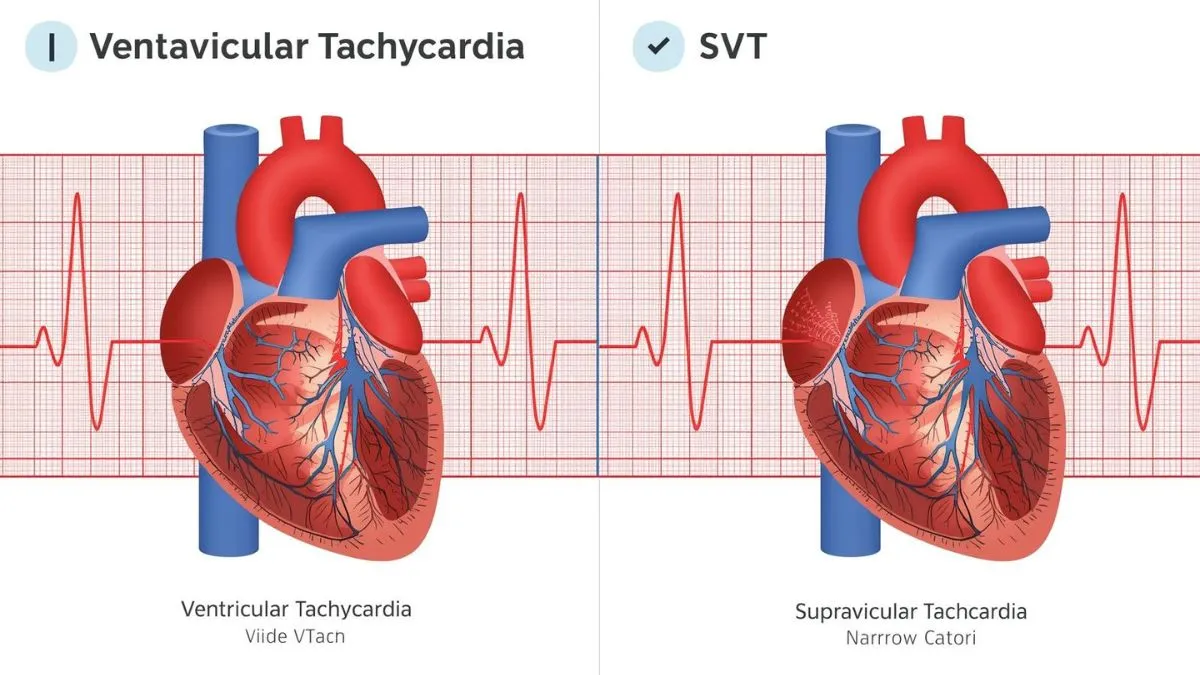
In simple terms, the difference between VTach and SVT lies in where the abnormal rhythm begins in the heart—either in the ventricles (lower chambers) or the atria/upper pathways.
Key Difference Between the Both
The core distinction is the origin of the abnormal electrical signal.
- VTach starts in the ventricles, the heart’s lower pumping chambers.
- SVT begins above the ventricles, usually in the atria or AV node.
Because the ventricles control blood circulation to the body, VTach is usually more dangerous, while SVT is often less life-threatening but still uncomfortable.
Why Their Difference Is Necessary to Know for Learners and Experts
Understanding this distinction helps society in several ways:
- Patient safety: Doctors must identify rhythms quickly to choose the right treatment.
- Emergency response: VTach can lead to cardiac arrest, requiring immediate action.
- Medical education: Students learn ECG interpretation and arrhythmia management.
- Public awareness: People with palpitations can seek help earlier.
Knowing the difference helps healthcare professionals prevent fatal outcomes and improve patient care.
Pronunciation (US & UK)
| Term | US Pronunciation | UK Pronunciation |
| VTach | /ˈviː tæk/ | /ˈviː tæk/ |
| SVT | /ˌes viː ˈtiː/ | /ˌes viː ˈtiː/ |
Now that the basic meaning is clear, let’s explore the deeper difference between these two heart rhythm disorders.
Difference Between VTach and SVT
1. Origin of the Rhythm
VTach: Starts in the ventricles.
Example 1: A patient with heart disease develops ventricular rhythm at 180 bpm.
Example 2: Post-heart-attack scarring triggers abnormal signals.
SVT: Starts above the ventricles.
Example 1: Electrical loop in the atria causes rapid rhythm.
Example 2: Stress triggers sudden atrial tachycardia.
2. Severity Level
VTach: Often life-threatening.
Example 1: May progress to ventricular fibrillation.
Example 2: Can reduce blood pressure suddenly.
SVT: Usually less dangerous.
Example 1: Causes palpitations but stable blood pressure.
Example 2: Many patients recover with simple treatments.
3. Heart Rate Pattern
VTach: Usually 120–250 beats per minute.
Example 1: ECG shows wide complex tachycardia.
Example 2: Rate stays consistently high.
SVT: Typically 150–220 beats per minute.
Example 1: Rapid narrow complex rhythm.
Example 2: Starts and stops suddenly.
4. ECG Appearance
VTach: Wide QRS complex.
Example 1: Ventricular signals spread slowly.
Example 2: Distorted waveform on ECG.
SVT: Narrow QRS complex.
Example 1: Electrical pathway remains normal.
Example 2: Clear but rapid waveform.
5. Common Causes
VTach: Often linked to heart disease.
Example 1: Previous heart attack.
Example 2: Cardiomyopathy.
SVT: Often triggered by lifestyle or electrical loops.
Example 1: Caffeine intake.
Example 2: Stress or anxiety.
6. Symptoms
VTach: Severe symptoms possible.
Example 1: Dizziness or fainting.
Example 2: Chest pain.
SVT: Usually milder symptoms.
Example 1: Rapid heartbeat feeling.
Example 2: Shortness of breath.
7. Risk of Cardiac Arrest
VTach: High risk.
Example 1: Can deteriorate quickly.
Example 2: Requires emergency care.
SVT: Low risk.
Example 1: Usually manageable.
Example 2: Rarely leads to cardiac arrest.
8. Treatment
VTach: Often needs urgent intervention.
Example 1: Defibrillation.
Example 2: Anti-arrhythmic drugs.
SVT: Often treated with simple techniques.
Example 1: Vagal maneuvers.
Example 2: Medications like adenosine.
9. Patient Population
VTach: More common in older patients with heart disease.
Example 1: Coronary artery disease patients.
Example 2: Post-surgery cardiac patients.
SVT: Can occur in young healthy individuals.
Example 1: Teenagers with arrhythmia episodes.
Example 2: Athletes under stress.
10. Prognosis
VTach: Can be fatal without treatment.
Example 1: Untreated episodes worsen quickly.
Example 2: Requires long-term cardiac care.
SVT: Usually manageable and treatable.
Example 1: Episodes controlled with medication.
Example 2: Catheter ablation can cure it.
Nature and Behaviour of Both
VTach:
Aggressive and unstable rhythm originating in ventricles. It often appears suddenly and may disrupt normal blood circulation.
SVT:
More stable rhythm originating above the ventricles. Episodes are often temporary and reversible.
Why People Are Confused About Their Use
- Both involve rapid heart rates.
- Symptoms like palpitations and dizziness overlap.
- ECG interpretation requires training.
- Medical abbreviations VTach and SVT look similar.
Difference and Similarity Table
| Feature | VTach | SVT | Similarity |
| Origin | Ventricles | Above ventricles | Both are arrhythmias |
| ECG | Wide QRS | Narrow QRS | Both show rapid rhythm |
| Severity | High | Moderate/low | Both require diagnosis |
| Risk | Cardiac arrest possible | Rarely life-threatening | Both affect heart rhythm |
| Treatment | Emergency care | Medication or maneuvers | Both manageable medically |
Which Is Better in What Situation?
SVT Situation (100 words)
SVT is generally less dangerous than VTach. Patients experiencing SVT often remain conscious and stable. Simple treatments like vagal maneuvers or medications can stop the episode quickly. In many cases, SVT can be permanently treated with catheter ablation. For individuals without structural heart disease, SVT may be uncomfortable but rarely fatal.
VTach Situation (100 words)
VTach is never considered “better,” but early detection improves outcomes. In emergency settings, rapid medical treatment can prevent serious complications. Implantable cardioverter-defibrillators (ICDs) and medications help manage long-term risk. Recognizing VTach quickly ensures life-saving interventions are given promptly.
Use in Metaphors and Similes
Though medical terms rarely appear in figurative language, they can be used metaphorically:
- “His thoughts raced like an SVT episode, fast but controlled.”
- “The crisis hit the company like VTach, sudden and dangerous.”
Connotative Meaning
VTach
- Connotation: Negative / dangerous
Example: “The patient’s condition worsened when VTach appeared.”
SVT
- Connotation: Neutral to mildly negative
Example: “The athlete experienced SVT during training.”
Idioms or Proverbs
There are no traditional idioms directly linked to VTach or SVT. However, heart-related sayings are used metaphorically.
Examples:
- “Listen to your heart.”
- “A racing heart tells a story.”
Works in Literature Mentioning the Terms
- Cardiac Electrophysiology – Medical textbook (Cardiology, Douglas Zipes, 1990)
- Rapid Interpretation of ECGs – Medical guide (Dale Dubin, 1972)
Movies Referencing the Conditions
Direct movies about VTach or SVT are rare, but medical dramas include such scenes:
- Flatliners (1990, USA) – cardiac rhythm emergencies shown
- Something the Lord Made (2004, USA) – cardiac surgery themes
Frequently Asked Questions
1. What is the main difference between VTach and SVT?
VTach originates in the ventricles, while SVT starts above them.
2. Which is more dangerous?
VTach is generally more dangerous.
3. Can SVT turn into VTach?
Usually no, but both require medical evaluation.
4. How are they diagnosed?
Doctors diagnose them using ECG monitoring.
5. Can lifestyle changes help?
Yes, reducing caffeine, stress, and smoking may reduce episodes.
How Both Are Useful for Surroundings
Understanding these conditions helps:
- Improve emergency medical care
- Train healthcare professionals
- Increase public awareness about heart health
Knowledge about arrhythmias helps communities respond quickly to cardiac emergencies.
Final Words for Both
VTach and SVT are both rapid heart rhythm disorders, yet their severity and treatment differ significantly. Recognizing their signs allows healthcare professionals to act quickly.
Conclusion:
In modern cardiology, understanding the difference between VTach and SVT is essential for both medical learners and experienced professionals. These two arrhythmias may appear similar because they both produce fast heartbeats, yet their origins and consequences are very different.
VTach originates in the ventricles, making it potentially life-threatening and often requiring emergency care. SVT, on the other hand, begins above the ventricles and is usually less severe, though still uncomfortable for patients.
For healthcare providers, correctly identifying these rhythms through ECG interpretation and clinical assessment can save lives. Early recognition ensures that patients receive the right treatment at the right time.
Knowledge truly becomes a life-saving tool.
Understanding these heart rhythms not only improves medical practice but also raises awareness about the importance of cardiac health and timely intervention.

I am Steven Pinker is a Canadian-American cognitive psychologist, linguist, and popular science author known for his work on language, mind, and human nature.He is the author of influential books like The Language Instinct and The Sense of Style, where he explains grammar and usage with scientific clarity.At wordrar.com, his ideas continue to inspire readers who want to understand grammar, comparison, and clear communication more deeply.