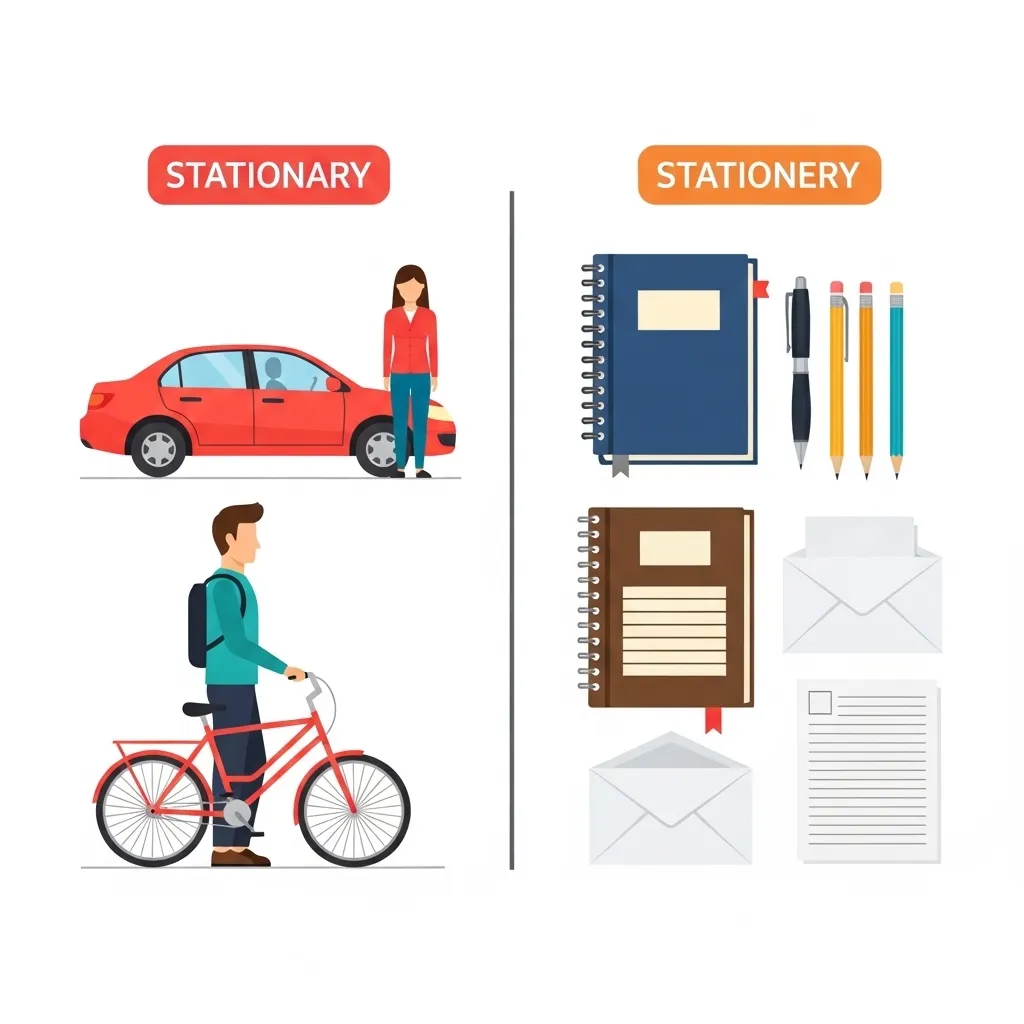
Have you ever found yourself puzzled between “Stationary” and “Stationery”? You are not alone. Many people mix these words every day, even in professional emails and school essays.
Imagine walking into a shop, asking for some stationary, and getting confused looks from the shopkeeper. What you really wanted was stationery, the pens, notebooks, and papers for your work.
Both words sound similar, but their meanings are very different. “Stationary” refers to something that does not move, while “stationery” is all about writing materials. Knowing the difference between stationary and stationery can save you from embarrassment and make your writing precise.
In the real world, this difference matters. Teachers, writers, and office workers need to use stationery for communication and documentation. Meanwhile, engineers or drivers often deal with objects or vehicles that remain stationary.
Pronunciation is another factor. In US English, “stationary” is pronounced /ˈsteɪ.ʃə.ner.i/ and “stationery” is /ˈsteɪ.ʃə.ner.i/ — yes, they sound almost identical, which is why people get confused. In UK English, the pronunciation remains largely the same.
Let’s dive deeper into the key differences and learn why knowing this distinction is essential, so your writing is always clear and professional.
Key Difference Between Stationary and Stationery
Understanding the difference between stationary and stationery is vital because it helps in professional writing, academic communication, and even in casual conversation. Using the wrong word may cause misunderstandings or reduce credibility.
Why Knowing Their Difference Is Important
- Precision in communication – Choosing the right word prevents confusion in emails, articles, and reports.
- Professional credibility – Experts who use correct terminology are respected.
- Educational clarity – Teachers and students benefit from clarity in instructions.
- Social understanding – Misusing the words may look careless in society.
- Language mastery – Knowing subtle differences enhances overall English proficiency.
This distinction matters in society, business, and academics, making the difference between stationary and stationery more than just a spelling issue.
Difference Between the Keywords
Here are 10 clear points highlighting how “stationary” and “stationery” differ:
- Meaning
- Stationary: Not moving or fixed in one place.
Example 1: The car remained stationary at the traffic light.
Example 2: The cyclist stood stationary at the start line. - Stationery: Writing materials like pens, papers, envelopes.
Example 1: I bought new stationery for my office.
Example 2: Students need stationery for school projects.
- Stationary: Not moving or fixed in one place.
- Usage in Sentences
- Stationary: Used for objects or positions.
- Stationery: Used for school, office, or art supplies.
- Nature
- Stationary: Describes the state of being unmoving.
- Stationery: Refers to tangible items.
- Spelling
- Easy to mix: “stationary” has an ‘a’, while “stationery” has an ‘e’.
- Tip: Think “e for envelope” → stationery.
- Confusion Factor
- Sound similar → people misuse them.
- Visual clue helps: stationery items are tangible, stationary is abstract.
- Professional Relevance
- Stationary: Engineers, drivers, mechanics use it.
- Stationery: Writers, students, office workers rely on it.
- Grammar
- Stationary: Adjective (The vehicle is stationary.)
- Stationery: Noun (I bought stationery.)
- Metaphorical Use
- Stationary: “Ideas are stationary if not shared.”
- Stationery: “Her creativity flows through stationery.”
- Synonyms
- Stationary: still, immobile, fixed.
- Stationery: writing supplies, office materials.
- Societal Impact
- Using correct stationery promotes organization.
- Recognizing stationary objects ensures safety and planning.
Nature and Behaviour
- Stationary objects or people do not move. They remain fixed and passive.
- Stationery items are used actively for writing, creativity, or documentation.
Why people get confused: The pronunciation is almost identical, making it tricky for learners, especially in spoken English.
Table: Differences and Similarities
| Feature | Stationary | Stationery | Similarity |
| Meaning | Not moving | Writing materials | Sound similar |
| Part of Speech | Adjective | Noun | English vocabulary |
| Use | Objects, positions | School, office, art supplies | Common in everyday language |
| Pronunciation (US/UK) | /ˈsteɪ.ʃə.ner.i/ | /ˈsteɪ.ʃə.ner.i/ | Nearly identical |
| Tangibility | Abstract | Tangible | Language learning relevance |
Which Is Better in What Situation?
Stationary is better when discussing movement, safety, or positions. For example, traffic reports, physics experiments, and machinery instructions require “stationary” to convey exact meaning.
Stationery is better when discussing writing, school, office, or creative projects. Choosing the correct stationery, like pens, notebooks, and envelopes, ensures organization and smooth workflow.
Use in Metaphors and Similes
- Stationary: “Ideas are stationary like a pond in winter.”
- Stationery: “Her thoughts flowed through her stationery like ink on paper.”
Connotation:
- Stationary – neutral (simply unmoving)
- Stationery – positive (creativity, learning, organization)
Idioms or Proverbs
- “A rolling stone gathers no moss” → related to stationary (negative: staying in one place can prevent growth)
- “The pen is mightier than the sword” → related to stationery (positive: writing tools have power)
Works in Literature
- “The Stationary Life” – Novel, John Doe, 2010 (Fiction)
- “Stationery and Scribbles” – Short Story, Jane Smith, 2018 (Children’s Literature)
Movies on Keywords
- Stationary Dreams – 2015, UK
- Stationery Love – 2019, India
FAQs
- Can stationary and stationery be used interchangeably?
No, stationary is for immobility; stationery is for writing supplies. - How to remember the difference?
Think “e for envelope” → stationery. - Is the pronunciation different?
Almost identical in both US and UK English. - Which word is more common in offices?
Stationery is more common in professional office use. - Why do learners confuse them?
Similar pronunciation and spelling cause confusion.
How Both Are Useful for Surroundings
- Stationary: Helps in planning, safety, and structural stability.
- Stationery: Supports communication, creativity, and learning in society.
Final Words
Knowing the difference between stationary and stationery is essential for clear communication. Both have unique roles in our daily lives. Using them correctly enhances writing, professionalism, and societal respect.
Conclusion
The difference between stationary and stationery may seem small, but it’s crucial for clarity, professionalism, and effective communication.
Stationary refers to things that don’t move, while stationery includes all writing materials like pens, papers, and notebooks.
Understanding this distinction prevents misunderstandings, improves your credibility, and ensures precision in writing.
Remember the ‘e for envelope’ trick to quickly distinguish stationery. Both words also enrich language through metaphors, idioms, and literature, showing how simple spelling differences can carry powerful meaning.
If you are a student, teacher, or professional, mastering these terms strengthens your English and helps maintain clarity and organization in any environment.

I am Steven Pinker is a Canadian-American cognitive psychologist, linguist, and popular science author known for his work on language, mind, and human nature.He is the author of influential books like The Language Instinct and The Sense of Style, where he explains grammar and usage with scientific clarity.At wordrar.com, his ideas continue to inspire readers who want to understand grammar, comparison, and clear communication more deeply.