A small business owner once decided to launch an online store quickly. He signed up for a platform, clicked a few buttons, and his site was live within minutes.
Meanwhile, his friend, a developer, spent days setting up a custom website with complete control. Both were using WordPress, yet their experiences were very different.
This is where the difference between WordPress.com and WordPress.org becomes important. One is a hosted, all-in-one solution, while the other is a self-hosted, flexible platform. Choosing the right one can shape your entire online journey.
For beginners, the difference between WordPress.com and WordPress.org can feel confusing at first. Both share the same name, but their features, control, and costs vary significantly.
Even professionals often revisit the difference between WordPress.com and WordPress.org when scaling projects or changing strategies. The choice affects customization, ownership, and growth potential.
Understanding the difference between WordPress.com and WordPress.org is not just technical—it’s practical. It helps you decide whether you want simplicity or full control.
Key Difference Between the Both
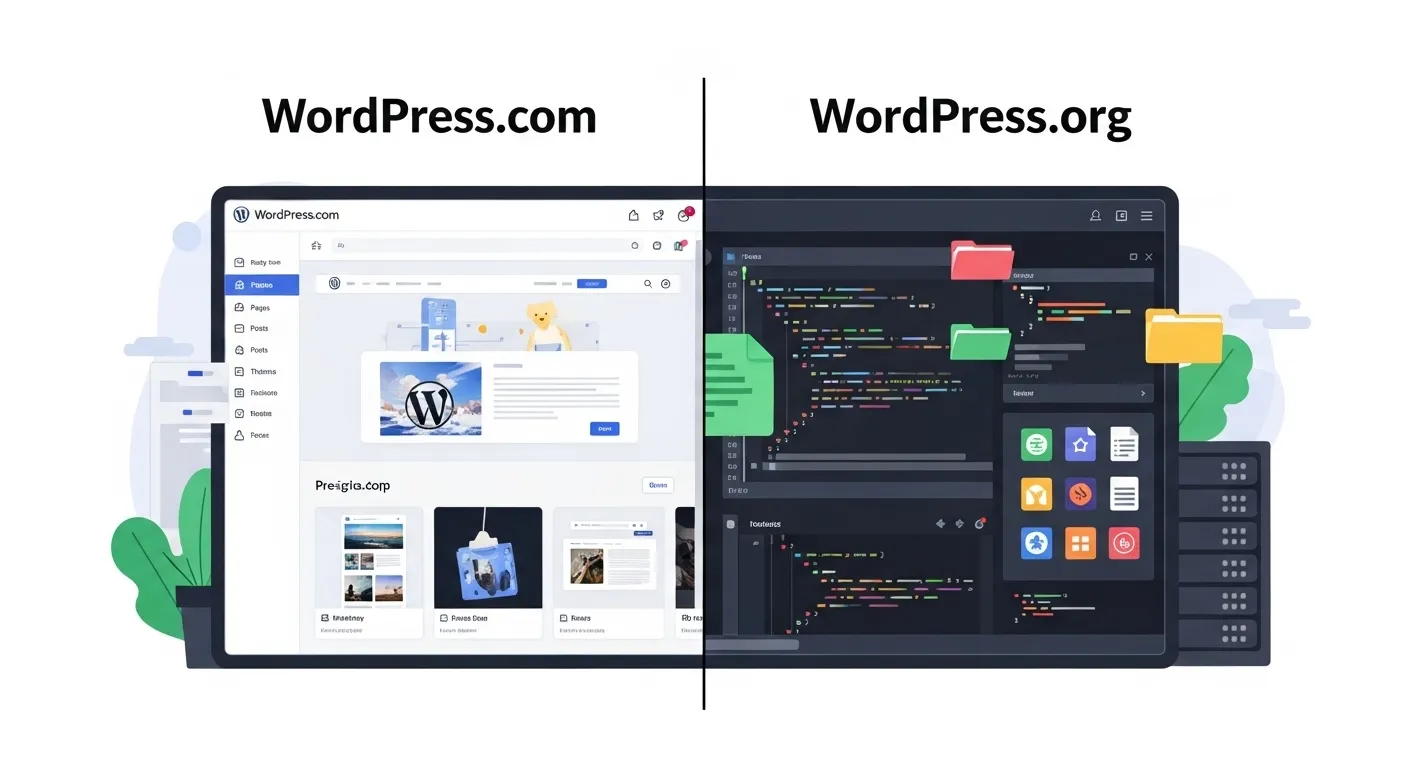
The main difference lies in hosting and control:
- WordPress.com is a hosted platform where everything is managed for you.
- WordPress.org is self-hosted, giving you full control but requiring setup and maintenance.
Why Is Their Difference Necessary to Know?
Understanding this difference is essential for both learners and experts. Beginners can avoid wasting time and money by choosing the right platform early, while professionals can select the best solution for scalability and performance.
In today’s digital world, websites power businesses, education, and communication. Knowing the difference between WordPress.com and WordPress.org helps individuals make smarter decisions, contributing to a more efficient and innovative online ecosystem.
Pronunciation (US & UK)
- WordPress.com
- US: /ˈwɝːd.prɛs dɑːt kɑːm/
- UK: /ˈwɜːd.prɛs dɒt kɒm/
- WordPress.org
- US: /ˈwɝːd.prɛs dɔːt ɔːrɡ/
- UK: /ˈwɜːd.prɛs dɒt ɔːɡ/
Difference Between WordPress.com and WordPress.org
1. Hosting
WordPress.com provides built-in hosting, while WordPress.org requires you to arrange hosting separately.
- Example 1: A blogger uses WordPress.com and never worries about servers.
- Example 2: A developer buys hosting and installs WordPress.org manually.
2. Ease of Use
WordPress.com is beginner-friendly, whereas WordPress.org requires technical knowledge.
- Example 1: A student launches a blog in minutes on WordPress.com.
- Example 2: A freelancer configures databases on WordPress.org.
3. Customization
WordPress.org offers full customization, unlike WordPress.com’s limited options.
- Example 1: Custom plugins installed on WordPress.org.
- Example 2: Limited theme editing on free WordPress.com plans.
4. Cost
WordPress.com has free and premium plans, while WordPress.org involves hosting and domain costs.
- Example 1: Free blog on WordPress.com.
- Example 2: Paid hosting for WordPress.org site.
5. Monetization
WordPress.org allows complete monetization freedom.
- Example 1: Ads and affiliate links freely used on WordPress.org.
- Example 2: Restricted ads on WordPress.com free plan.
6. Ownership
With WordPress.org, you own your website fully.
- Example 1: Site data controlled by user on WordPress.org.
- Example 2: WordPress.com controls certain aspects of your site.
7. Plugins
WordPress.org supports thousands of plugins.
- Example 1: SEO plugin installed on WordPress.org.
- Example 2: Plugin access limited on WordPress.com.
8. Maintenance
WordPress.com handles updates automatically.
- Example 1: No manual updates needed on WordPress.com.
- Example 2: User updates plugins on WordPress.org.
9. Flexibility
WordPress.org is highly flexible.
- Example 1: Custom-coded themes on WordPress.org.
- Example 2: Predefined themes on WordPress.com.
10. Security
WordPress.com manages security, while WordPress.org requires user responsibility.
- Example 1: Automatic backups on WordPress.com.
- Example 2: Manual security plugins on WordPress.org.
Nature and Behaviour
- WordPress.com: Simple, managed, beginner-oriented, restrictive.
- WordPress.org: Powerful, flexible, developer-friendly, independent.
Why People Are Confused
People get confused because both share the same name and interface. However, their functionality and control levels differ greatly, leading to misunderstanding.
Table: Difference and Similarity
| Feature | WordPress.com | WordPress.org | Similarity |
|---|---|---|---|
| Hosting | Included | Self-hosted | Both create websites |
| Ease | Easy | Moderate | User-friendly interface |
| Control | Limited | Full | Content management |
| Cost | Free/Paid | Paid hosting | Scalable |
| Plugins | Limited | Unlimited | Extendable features |
Which Is Better in What Situation?
WordPress.com is better for beginners, hobby bloggers, and small businesses who want a quick and hassle-free setup. It removes technical burdens, allowing users to focus on content creation rather than maintenance.
WordPress.org, on the other hand, is ideal for professionals, developers, and growing businesses. It offers complete control, customization, and scalability, making it perfect for complex projects and long-term growth.
Metaphors and Similes
- WordPress.com is like a ready-made apartment.
- WordPress.org is like building your own house from scratch.
Connotative Meaning
- WordPress.com: Neutral to positive (simplicity, ease)
- Example: “She chose WordPress.com for its simplicity.”
- WordPress.org: Positive (freedom, control)
- Example: “He switched to WordPress.org for full control.”
Idioms / Proverbs
- “Don’t bite off more than you can chew”
- Example: Beginners should not jump directly into WordPress.org.
- “The sky’s the limit”
- Example: With WordPress.org, the sky’s the limit for customization.
Works in Literature
- The Internet Galaxy – Manuel Castells (Non-fiction, 2001)
- Blogging Heroes – Michael A. Banks (Tech, 2008)
Movies Related to Digital Platforms
- The Social Network (2010, USA)
- Startup.com (2001, USA)
FAQs
1. Is WordPress.com free?
Yes, but with limitations on features and customization.
2. Do I need coding for WordPress.org?
Basic knowledge helps, but it’s not mandatory.
3. Which is better for SEO?
WordPress.org offers more advanced SEO control.
4. Can I switch later?
Yes, you can migrate from WordPress.com to WordPress.org.
5. Which is safer?
WordPress.com is safer by default, while WordPress.org depends on user management.
How Both Are Useful for Surroundings
Both platforms help individuals and businesses share knowledge, promote services, and build communities online. They support education, marketing, and communication globally.
Final Words
WordPress.com offers ease and convenience, while WordPress.org provides power and freedom. Choosing between them depends on your goals and technical comfort.
Conclusion:
Choosing between WordPress.com and WordPress.org is a crucial decision for anyone entering the digital world. While both platforms share the same foundation, their approach, flexibility, and control differ significantly.
For beginners, WordPress.com is a safe and simple starting point, offering ease of use and minimal technical responsibility. On the other hand, WordPress.org empowers users with full ownership and customization, making it ideal for long-term growth and professional projects.
The difference between WordPress.com and WordPress.org ultimately comes down to your needs If you prefer simplicity or complete control. By understanding these differences clearly, you can make a smarter choice that aligns with your goals.
In the end, both platforms are powerful in their own ways, and selecting the right one can set the foundation for your online success.

I am Lynne truss , journalist, and broadcaster best known for her bestselling grammar book Eats, Shoots & Leaves, which highlights the importance of punctuation in clear writing. Her engaging and witty style has made grammar accessible and entertaining for millions of readers worldwide.at wordrar.com, we admire her work for inspiring readers to appreciate the power of precise language and proper grammar.