Last week, I noticed a café sign that read “Drive Thru Open”, while my niece’s homework said, “Walk through the tunnel.”
Both looked correct. Yet they were different.
That moment perfectly explains the difference between through and thru.
One is formal and traditional. The other is modern and simplified.
In everyday life, we often see “thru” on road signs and advertisements.
But in books, exams, and professional emails, “through” dominates.
Understanding the difference between through and thru is more than spelling.
It’s about context, tone, and correctness.
If you want to avoid mistakes in writing or branding, learning the difference between through and thru will sharpen your language skills instantly.
Key Difference Between the Both
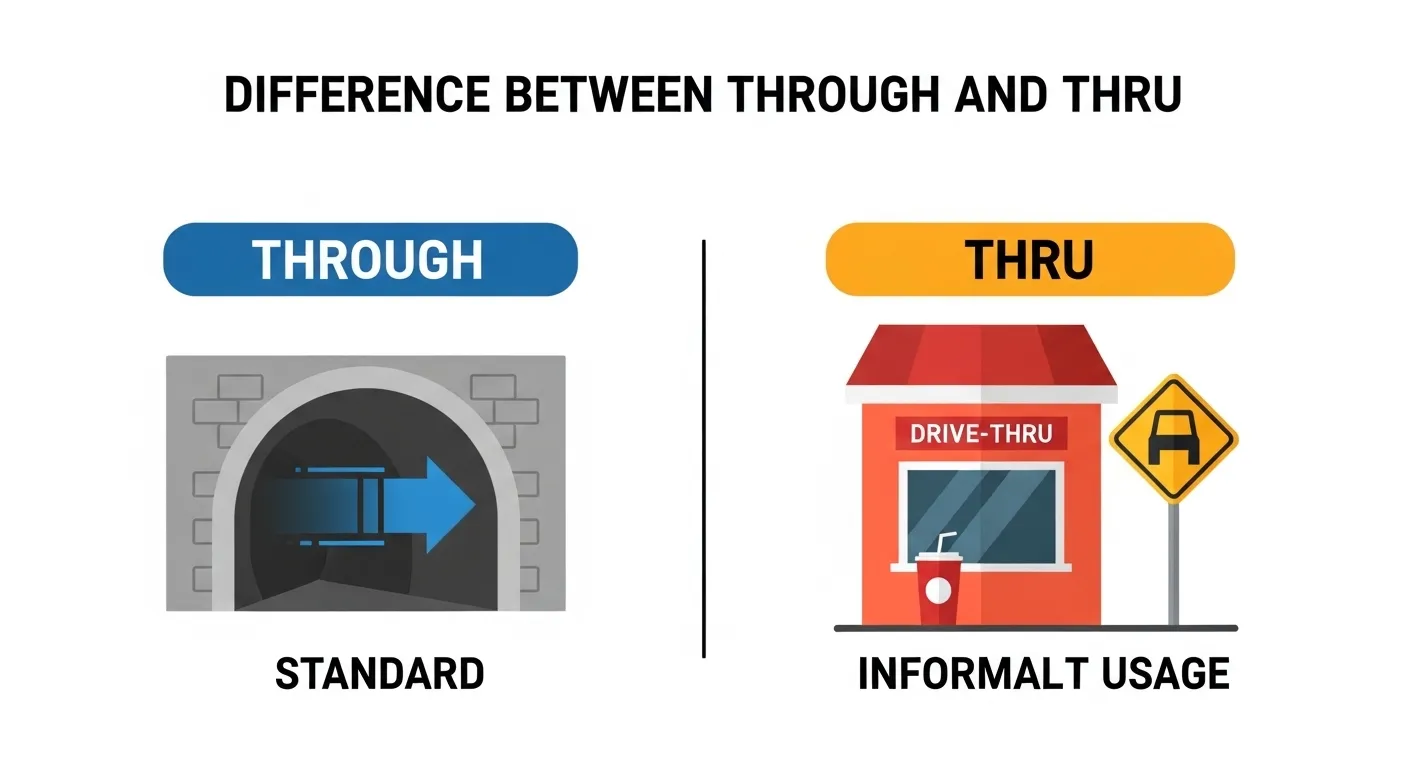
The main difference between through and thru is that “through” is the standard, formal English spelling, while “thru” is an informal or simplified version mostly used in signs, ads, and casual writing.
Why Is Their Difference Necessary to Know for Learners and Experts?
Knowing the difference between through and thru protects your credibility.
Students need it for academic writing.
Professionals need it for formal communication.
In society, correct spelling reflects education, clarity, and professionalism. While “thru” may look trendy, using it incorrectly in reports or research papers can damage authority. Understanding their difference ensures you choose the right tone for the right audience.
Pronunciation (US & UK)
Both words are pronounced the same.
- Through (US): /θruː/
- Through (UK): /θruː/
- Thru (US & UK): /θruː/
There is no pronunciation difference.
Now that you understand the basics, let’s go deeper into the full difference between through and thru in detail.
Difference Between Through and Thru (10 Detailed Points)
1. Formality
Through is formal.
Thru is informal.
- Example 1: She walked through the park.
- Example 2: The drive-thru is open late.
2. Usage in Academic Writing
Through is accepted in schools and universities.
Thru is usually marked incorrect.
- Example 1: The data was collected through surveys.
- Example 2: ❌ Research conducted thru interviews.
3. Usage in Advertising
Through sounds traditional.
Thru is catchy and short.
- Example 1: Available through our website.
- Example 2: Order at the drive-thru.
4. Historical Origin
Through comes from Old English “þurh.”
Thru is a 20th-century simplified spelling.
- Example 1: Classical literature uses through.
- Example 2: Fast-food chains popularized thru.
5. Dictionary Recognition
Through is fully recognized.
Thru is labeled informal.
- Example 1: Found in every major dictionary as standard.
- Example 2: Marked as informal spelling.
6. Use in Road Signs
Governments prefer short spellings for space.
Thus, thru appears on signs.
- Example 1: No thru traffic.
- Example 2: Drive-thru pharmacy.
7. Use in Emails
Professional emails require through.
Casual texts may use thru.
- Example 1: I will be available through Friday.
- Example 2: Let’s talk thru WhatsApp.
8. Tone
Through sounds serious.
Thru sounds relaxed.
- Example 1: The bill passed through Parliament.
- Example 2: We made it thru the storm!
9. Acceptance in Exams
Through is correct.
Thru may lose marks.
- Example 1: He passed through the gate.
- Example 2: ❌ He passed thru the gate.
10. Length
Through has seven letters.
Thru has four letters.
- Example 1: Long-form writing prefers through.
- Example 2: Text messages prefer thru.
Nature and Behaviour of Both
Through behaves as a preposition, adjective, and adverb. It is grammatically flexible and widely accepted.
Thru behaves similarly in meaning but is limited socially. It appears mainly in informal contexts.
Why Are People Confused?
- Same pronunciation
- Same meaning
- Common use in signage
- Influence of texting culture
- Visual similarity
Table: Difference and Similarity
| Feature | Through | Thru | Similarity |
| Meaning | Movement in one side out another | Same | Same meaning |
| Formality | Formal | Informal | Used in English |
| Pronunciation | /θruː/ | /θruː/ | Same sound |
| Academic Use | Accepted | Not accepted | Both understood |
| Advertising | Less common | Very common | Used publicly |
Which Is Better in What Situation?
Through (Best for Formal Situations)
In formal writing, academic essays, business emails, and professional documents, through is always the better choice. It reflects education, seriousness, and correctness. Using “through” in research papers or official communication maintains credibility and prevents misunderstandings. Teachers, editors, and employers expect standard spelling. Therefore, whenever your writing is meant to be evaluated or published, “through” is the safer and more professional option.
Thru (Best for Informal Situations)
“Thru” works best in informal communication, advertisements, branding, and signage. It is short, eye-catching, and easy to read from a distance. Businesses use it for drive-thru services because space is limited and quick recognition matters. In casual texting or creative marketing, “thru” gives a modern and relaxed tone. However, it should be avoided in serious or academic contexts.
Use in Metaphors and Similes
- She fought through the pain like a warrior.
- He pushed through challenges as water flows through rocks.
“Thru” is rarely used in literary metaphors.
Connotative Meaning
Through
- Positive: “She made it through hard times.”
- Neutral: “Walk through the door.”
Thru
- Neutral: “Drive-thru service.”
- Slightly casual/negative in formal writing: “Report sent thru email.”
Idioms and Proverbs
- Through thick and thin – They stayed friends through thick and thin.
- Go through the roof – Prices went through the roof.
- Through and through – He is honest through and through.
(No major idioms use “thru.”)
Works in Literature
- “Through the Looking-Glass” – Genre: Fantasy; Writer: Lewis Carroll; Year: 1871
- “Through the Tunnel” – Genre: Short Story; Writer: Doris Lessing; Year: 1955
Movies Based on the Word
- Through My Window – 2022, Spain
- Through the Never – 2013, USA
Frequently Asked Questions
1. Is “thru” correct English?
Yes, but it is informal.
2. Can I use “thru” in exams?
No, use “through.”
3. Do both mean the same?
Yes, their meaning is identical.
4. Why do restaurants use “thru”?
For short, visible signage.
5. Is pronunciation different?
No, both sound the same.
How Both Are Useful for Surroundings
“Through” maintains clarity and professionalism in education and official communication. “Thru” helps in branding, signage, and quick reading environments like highways. Both serve society in different contexts.
Final Words for Both
Through is timeless.
Thru is modern and practical.
Understanding their place helps you become a smarter writer.
Conclusion
In summary, the difference between through and thru lies not in meaning or pronunciation, but in formality, acceptance, and context. Both words share identical sounds and similar definitions, yet society treats them differently.
“Through” stands as the traditional and academically approved spelling. It appears in literature, education, and professional writing. On the other hand, “thru” represents convenience and modern simplicity, commonly found in advertisements and road signs.
Confusion arises because they look different but sound the same. However, choosing the correct one depends entirely on your audience. In formal writing, always prefer “through.” In marketing or casual communication, “thru” may be acceptable.
Language evolves.
But standards still matter.
When you understand the difference between through and thru, you gain control over tone, clarity, and credibility. That awareness strengthens your communication skills and ensures you use the right word at the right time.

I am William Strunk Jr an American professor of English and the author of the classic style guide the Elements of Style. He emphasized clarity, brevity, and proper grammar in writing, influencing generations of writers. Learn more about his work and writing tips at wordrar.com.