A small business owner once placed a bulk order for products but forgot to track the paperwork properly. Later, when the supplier asked for payment, confusion arose between the purchase order (PO) and the invoice. This is where understanding the difference between PO and invoice becomes essential.
A purchase order is created before buying, while an invoice comes after the sale. Yet many beginners mix them up, causing delays and errors. Knowing the difference between PO and invoice helps avoid such costly mistakes.
In real-world business, both documents play a key role. One confirms the order, and the other demands payment. The difference between PO and invoice ensures smooth communication between buyer and seller.
Without clarity, businesses may face disputes or even financial losses. That’s why learning the difference between PO and invoice is important for both beginners and professionals.
Understanding these terms builds trust, improves workflow, and keeps financial records accurate. Clear documentation means clear business.
Key Difference Between the Both
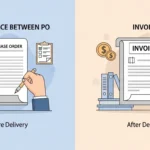
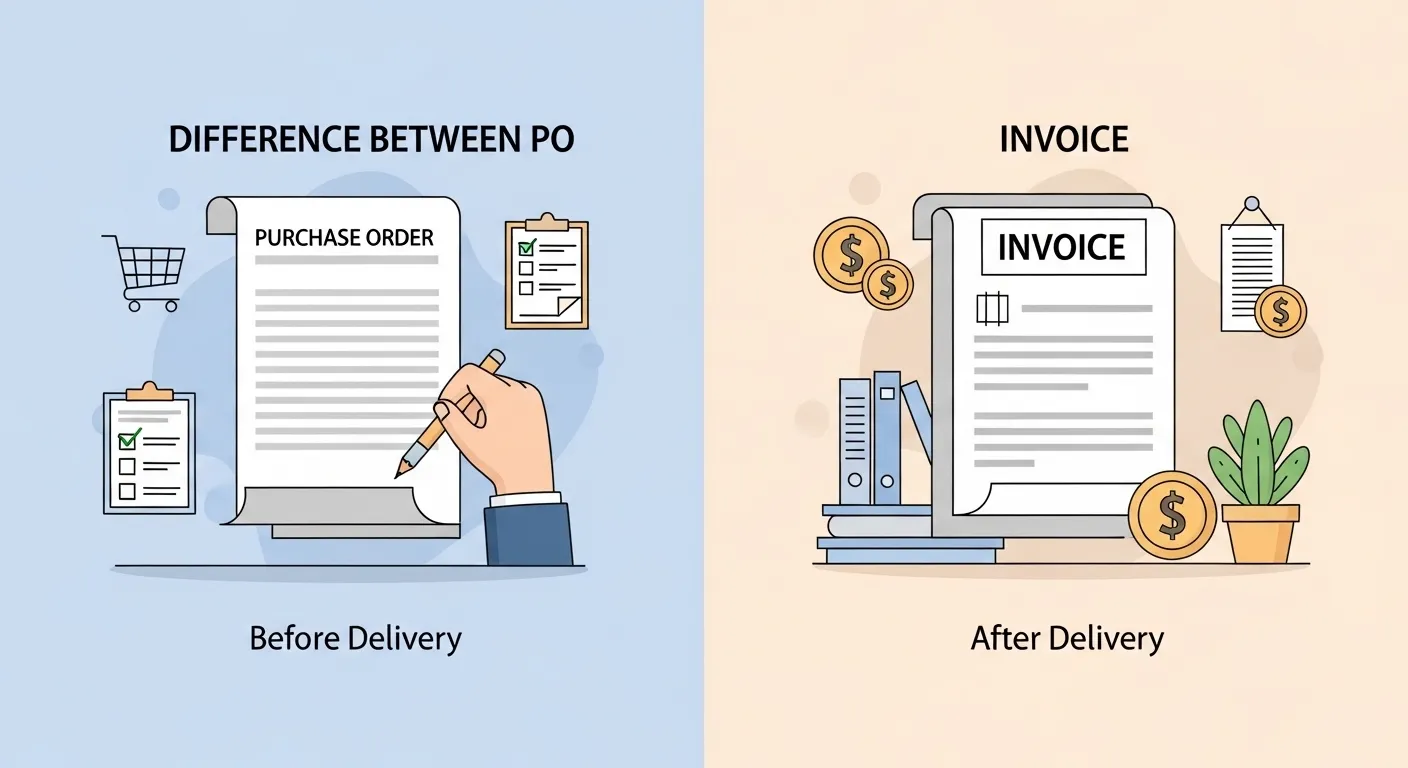
The core difference between PO and invoice lies in their timing and purpose. A PO is sent by the buyer to request goods or services, while an invoice is sent by the seller to request payment after delivery.
Why Is Their Difference Necessary to Know?
Understanding the difference between PO and invoice is crucial for both learners and experts because:
- It ensures accurate financial tracking
- Helps prevent fraud and duplication
- Improves business transparency
- Strengthens professional communication
- Plays a vital role in accounting and auditing systems
In society, businesses rely on these documents to maintain trust and efficiency. Without them, transactions would become chaotic.
Pronunciation (US & UK)
- Purchase Order (PO)
- US: /ˈpɝː.tʃəs ˈɔːr.dɚ/
- UK: /ˈpɜː.tʃəs ˈɔː.də/
- Invoice
- US: /ˈɪn.vɔɪs/
- UK: /ˈɪn.vɔɪs/
Now that you understand the basics, let’s explore the detailed differences between these two essential business documents.
Difference Between PO and Invoice
1. Purpose
- PO: Used to place an order
- Example 1: A shop orders 100 chairs
- Example 2: A company requests office supplies
- Invoice: Used to request payment
- Example 1: Supplier asks payment after delivery
- Example 2: Freelancer bills a client
2. Issued By
- PO: Created by the buyer
- Example 1: Retailer sends PO to wholesaler
- Example 2: Company orders software
- Invoice: Created by the seller
- Example 1: Vendor sends invoice
- Example 2: Service provider bills client
3. Timing
- PO: Sent before purchase
- Example 1: Before shipment
- Example 2: Before agreement finalization
- Invoice: Sent after delivery
- Example 1: After goods received
- Example 2: After service completion
4. Legal Role
- PO: Acts as a contract offer
- Example 1: Defines order terms
- Example 2: Sets expectations
- Invoice: Acts as a payment request
- Example 1: Includes payable amount
- Example 2: Specifies due date
5. Content
- PO: Includes quantity, price, items
- Example 1: 50 laptops
- Example 2: 200 notebooks
- Invoice: Includes total cost, tax, due date
- Example 1: Total bill amount
- Example 2: Payment deadline
6. Financial Impact
- PO: No direct financial transaction
- Example 1: Planning stage
- Example 2: Budget approval
- Invoice: Triggers payment obligation
- Example 1: Payment required
- Example 2: Accounts payable entry
7. Approval Process
- PO: Needs internal approval
- Example 1: Manager approval
- Example 2: Finance department check
- Invoice: Needs payment processing
- Example 1: Payment authorization
- Example 2: Bank transfer
8. Document Flow
- PO: Starts the procurement process
- Example 1: Order placement
- Example 2: Vendor selection
- Invoice: Ends the transaction cycle
- Example 1: Payment completion
- Example 2: Record closure
9. Numbering System
- PO: Has PO number
- Example 1: PO#1234
- Example 2: PO#5678
- Invoice: Has invoice number
- Example 1: INV#001
- Example 2: INV#002
10. Risk Management
- PO: Prevents unauthorized purchases
- Example 1: Controlled buying
- Example 2: Budget tracking
- Invoice: Prevents non-payment issues
- Example 1: Legal proof
- Example 2: Payment reminder
Nature and Behaviour
- PO: Proactive, planning-focused, and preventive. It controls spending before it happens.
- Invoice: Reactive, result-focused, and confirmatory. It ensures payment after work is done.
Why People Are Confused?
People confuse them because both contain similar details like price, items, and parties involved. Also, both are part of the same transaction process, making the difference between PO and invoice less obvious to beginners.
Difference and Similarity Table
| Feature | Purchase Order (PO) | Invoice | Similarity |
|---|---|---|---|
| Purpose | Order request | Payment request | Both involve transaction |
| Issuer | Buyer | Seller | Both are official documents |
| Timing | Before purchase | After purchase | Used in same process |
| Role | Planning | Billing | Financial records |
| Content | Items & quantity | Cost & payment | Include details |
Which Is Better in What Situation?
A purchase order is better when you want control and clarity before making a purchase. It helps businesses avoid overspending and ensures all terms are agreed upon in advance. It is ideal for large orders, corporate buying, and structured procurement systems.
An invoice is better when the transaction is completed, and payment needs to be collected. It ensures that the seller gets paid on time and maintains financial records. It is essential for freelancers, vendors, and service providers who need proof of payment requests.
Metaphors and Similes
- PO: “A purchase order is like a blueprint before building a house.”
- Invoice: “An invoice is like a bill after a meal.”
Connotative Meaning
- PO: Neutral to positive
- Example: “A PO shows planning and professionalism.”
- Invoice: Neutral
- Example: “An invoice signals responsibility to pay.”
Idioms / Proverbs
- “Put it in writing” → Like a PO
- Example: Always send a PO to avoid confusion
- “Pay the piper” → Like an invoice
- Example: After service, you must pay the invoice
Works in Literature
- “Accounting Principles” (Business, Jerry J. Weygandt, 2019)
- “Financial Accounting” (Education, Robert Libby, 2020)
Movies Related to Business & Finance
- “The Accountant” (2016, USA)
- “Wall Street” (1987, USA)
FAQs
1. What is the main difference between PO and invoice?
PO is for ordering, invoice is for payment.
2. Can a transaction happen without a PO?
Yes, but it’s less controlled and riskier.
3. Is an invoice legally binding?
Yes, it acts as a payment request document.
4. Who creates a PO?
The buyer creates it.
5. Why are both important?
They ensure smooth and transparent transactions.
How Both Are Useful for Surroundings
Both documents help businesses maintain order, transparency, and trust. They reduce confusion, improve financial systems, and ensure smooth economic activities in society.
Final Words
PO builds the deal. Invoice completes it. Both are essential pillars of business transactions.
Conclusion:
Understanding the difference between PO and invoice is not just an academic concept—it is a practical necessity in today’s business world. A purchase order ensures that every transaction begins with clarity, agreement, and proper authorization. On the other hand, an invoice guarantees that the transaction ends with accountability and payment.
Both documents work together like two sides of a coin. Without a PO, businesses may face uncontrolled spending, and without an invoice, sellers may struggle to receive payments. This balance is what keeps financial systems stable and trustworthy.
For learners, mastering these basics builds a strong foundation in accounting and business management. For professionals, it enhances efficiency and prevents costly errors. Clear documentation leads to clear success.
In short, knowing when and how to use each document ensures smooth operations, better communication, and long-term business growth.

I am William Strunk Jr an American professor of English and the author of the classic style guide the Elements of Style. He emphasized clarity, brevity, and proper grammar in writing, influencing generations of writers. Learn more about his work and writing tips at wordrar.com.