Imagine a young athlete who loved running every morning. One day, after a serious accident, doctors explained that he had become paraplegic, meaning he lost movement in the lower part of his body. Life changed overnight, but with determination, he learned to adapt and live fully.
In another hospital room, a different patient faced a more severe condition. The doctors told her she was quadriplegic, meaning both arms and legs were affected due to spinal cord damage. Everyday activities suddenly required assistance and special care.
These two medical conditions sound similar, and many people confuse them. However, the difference between paraplegic and quadriplegic lies mainly in which parts of the body are paralyzed.
Understanding the difference between paraplegic and quadriplegic helps doctors, students, and caregivers provide proper support and treatment.
In this article, we will explore the difference between paraplegic and quadriplegic, their causes, characteristics, and why knowing the difference between paraplegic and quadriplegic is important in society.
Key Difference Between the Both
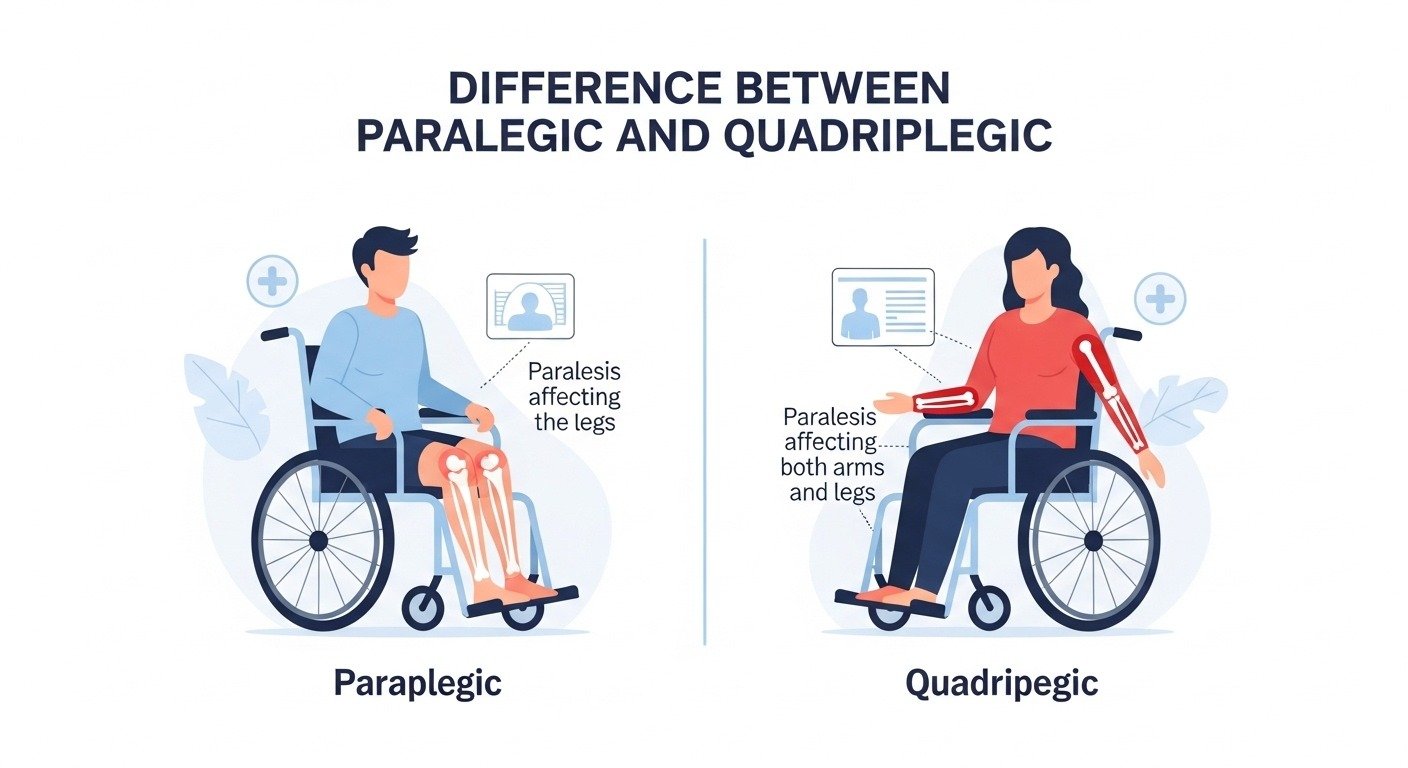
The main difference between paraplegic and quadriplegic is the extent of paralysis.
- Paraplegic: Paralysis affects the lower half of the body, usually both legs.
- Quadriplegic (Tetraplegic): Paralysis affects all four limbs (arms and legs) and sometimes the torso.
Why Is Their Difference Necessary to Know for Learners and Experts?
Understanding the difference between paraplegic and quadriplegic is important for many reasons.
First, it helps medical students and healthcare professionals diagnose injuries correctly. Proper identification ensures accurate treatment and rehabilitation programs.
Second, knowing the difference increases awareness and empathy in society. People can better understand the challenges faced by individuals with spinal cord injuries.
Third, educators and researchers benefit from understanding the difference between paraplegic and quadriplegic, as it helps in developing better assistive technologies and support systems.
Finally, knowledge about these conditions helps caregivers provide appropriate care, accessibility, and emotional support.
Pronunciation of Both
Paraplegic
- US: /ˌpærəˈpliːdʒɪk/
- UK: /ˌparəˈpliːdʒɪk/
Quadriplegic
- US: /ˌkwɑːdrəˈpliːdʒɪk/
- UK: /ˌkwɒdrəˈpliːdʒɪk/
Linking Hook
Now that we understand the basic idea, let’s explore the difference between paraplegic and quadriplegic in detail through clear and practical comparisons.
Difference Between Paraplegic and Quadriplegic
1. Area of Paralysis
Paraplegic:
Paralysis affects the lower body, especially the legs.
Examples:
- A person can still move their arms but cannot walk.
- Someone may use a wheelchair but can feed themselves.
Quadriplegic:
Paralysis affects both arms and legs.
Examples:
- A patient may not be able to move arms or legs.
- Daily activities like eating or writing may require assistance.
2. Level of Spinal Cord Injury
Paraplegic:
Usually caused by injury to the thoracic or lumbar spine.
Examples:
- Injury during a car accident affecting the lower spine.
- Sports injury damaging the mid-back region.
Quadriplegic:
Caused by injury to the cervical (neck) spine.
Examples:
- Neck injury from diving accidents.
- Severe trauma to the upper spinal cord.
3. Limb Function
Paraplegic:
Arms remain functional.
Examples:
- The person can push a wheelchair independently.
- They can write, cook, and work on a computer.
Quadriplegic:
Arms may also be partially or fully paralyzed.
Examples:
- Limited ability to grip objects.
- Need for assistive devices to operate technology.
4. Independence Level
Paraplegic:
Many individuals maintain high independence.
Examples:
- Driving modified vehicles.
- Living independently.
Quadriplegic:
Often require more daily assistance.
Examples:
- Help with dressing.
- Assistance with eating.
5. Mobility
Paraplegic:
Wheelchairs or mobility aids are common.
Examples:
- Sports wheelchairs for basketball.
- Electric wheelchairs for long travel.
Quadriplegic:
Often require electric wheelchairs with controls.
Examples:
- Head-controlled wheelchair.
- Voice-operated mobility devices.
6. Muscle Control
Paraplegic:
Upper body muscles remain strong.
Examples:
- Can lift objects with arms.
- Can exercise upper body.
Quadriplegic:
Muscle control may be limited in the upper body.
Examples:
- Difficulty lifting objects.
- Limited shoulder or arm movement.
7. Medical Complexity
Paraplegic:
Usually fewer complications.
Examples:
- Focus on leg rehabilitation.
- Lower risk of respiratory issues.
Quadriplegic:
More medical challenges.
Examples:
- Breathing assistance may be needed.
- Higher risk of infections.
8. Assistive Technology
Paraplegic:
Simple assistive tools often help.
Examples:
- Wheelchairs.
- Hand-operated vehicles.
Quadriplegic:
More advanced technology may be needed.
Examples:
- Eye-controlled devices.
- Speech-controlled computers.
9. Rehabilitation Process
Paraplegic:
Focuses on strengthening upper body.
Examples:
- Physical therapy for arms.
- Wheelchair training.
Quadriplegic:
Rehabilitation is more complex.
Examples:
- Occupational therapy.
- Assistive communication training.
10. Daily Lifestyle Impact
Paraplegic:
Daily activities may still be manageable.
Examples:
- Working in offices.
- Participating in adaptive sports.
Quadriplegic:
Daily tasks often require support.
Examples:
- Personal care assistance.
- Medical supervision.
Nature and Behaviour of Both
Paraplegic individuals often maintain strong upper body mobility. Many adapt quickly, participate in sports, and live independently.
Quadriplegic individuals face more physical limitations. However, with support, therapy, and technology, many lead meaningful and productive lives.
Why People Are Confused About Their Use?
People confuse these terms because both describe paralysis caused by spinal cord injuries. The words also sound similar and share the same suffix “plegic”, meaning paralysis.
Another reason is that both conditions involve mobility impairment, which makes the differences less obvious to the general public.
Table: Difference and Similarity
| Feature | Paraplegic | Quadriplegic | Similarity |
| Area affected | Lower body | Arms and legs | Both involve paralysis |
| Cause | Lower spinal injury | Neck spinal injury | Often from accidents |
| Arm movement | Usually normal | Limited or none | Need rehabilitation |
| Independence | Higher | Lower | Require support |
| Mobility aid | Wheelchair | Advanced wheelchair | Mobility assistance |
Which Is Better in What Situation?
It is not correct to say that one condition is “better.” However, in terms of physical independence, individuals who are paraplegic often have greater mobility and control because their arms remain functional.
Quadriplegic individuals face more severe physical limitations, but modern technology, rehabilitation programs, and social support help them live fulfilling lives. The focus should always be on improving accessibility, healthcare, and quality of life rather than comparing which condition is better.
Metaphors and Similes
Sometimes these words are used metaphorically.
Examples:
- “The project became paraplegic, unable to move forward.”
- “Without leadership, the organization felt quadriplegic, completely immobilized.”
Connotative Meaning
Paraplegic
Neutral/medical meaning.
Example: A paraplegic athlete competed in the marathon.
Quadriplegic
Neutral but often associated with severe disability.
Example: A quadriplegic patient used voice technology to communicate.
Idioms or Proverbs Related
These words are rarely used in idioms, but related expressions include:
“Stand on your own two feet.”
Example: After rehabilitation, he learned to stand on his own two feet again.
“Where there is a will, there is a way.”
Example: Many people with spinal injuries prove that where there is a will, there is a way.
Works in Literature
- “Still Me” – Jojo Moyes (Romance Novel, 2018)
- “Me Before You” – Jojo Moyes (Romance Drama, 2012)
- “The Diving Bell and the Butterfly” – Jean-Dominique Bauby (Memoir, 1997)
Movies Related to These Conditions
- Me Before You (2016, United Kingdom/USA)
- The Diving Bell and the Butterfly (2007, France)
- Million Dollar Baby (2004, USA)
Frequently Asked Questions
1. What is the main difference between paraplegic and quadriplegic?
Paraplegic affects the lower body, while quadriplegic affects both arms and legs.
2. What causes paraplegia?
Usually spinal cord injury in the lower back region.
3. What causes quadriplegia?
Injury to the cervical spine in the neck.
4. Can people with paraplegia live independently?
Yes, many people live independently using mobility aids and rehabilitation.
5. Is quadriplegia permanent?
In many cases it is permanent, though therapy can improve function.
How Both Are Useful for Surroundings
People living with these conditions often become powerful advocates for accessibility and inclusion. Their experiences help society design better infrastructure, technology, and healthcare systems.
Many individuals also inspire others through sports, motivational speaking, and community work.
Final Words for Both
Both terms describe serious medical conditions, but they also represent strength, resilience, and human adaptability.
Understanding their difference encourages awareness, compassion, and better healthcare solutions.
Conclusion:
Understanding the difference between paraplegic and quadriplegic is essential for medical knowledge, social awareness, and empathy. While both conditions involve paralysis caused by spinal cord injuries, the extent of body involvement is different. In paraplegia, paralysis affects the lower body, whereas quadriplegia affects all four limbs and sometimes the torso.
These conditions significantly impact a person’s lifestyle, but they do not define a person’s potential. Many individuals with spinal injuries continue to live inspiring and productive lives through determination, medical support, and assistive technology.
It is also important to remember that awareness helps create inclusive societies. When people understand the difference between paraplegic and quadriplegic, they become more supportive of accessibility initiatives, rehabilitation programs, and disability rights.
Knowledge of these terms is valuable not only for medical professionals and students but also for educators, caregivers, and the general public.
In the end, the real message goes beyond medical definitions. Human resilience is stronger than physical limitations.
With the right support, technology, and compassion, individuals facing these challenges can thrive and contribute meaningfully to society.

I am Lynne truss , journalist, and broadcaster best known for her bestselling grammar book Eats, Shoots & Leaves, which highlights the importance of punctuation in clear writing. Her engaging and witty style has made grammar accessible and entertaining for millions of readers worldwide.at wordrar.com, we admire her work for inspiring readers to appreciate the power of precise language and proper grammar.