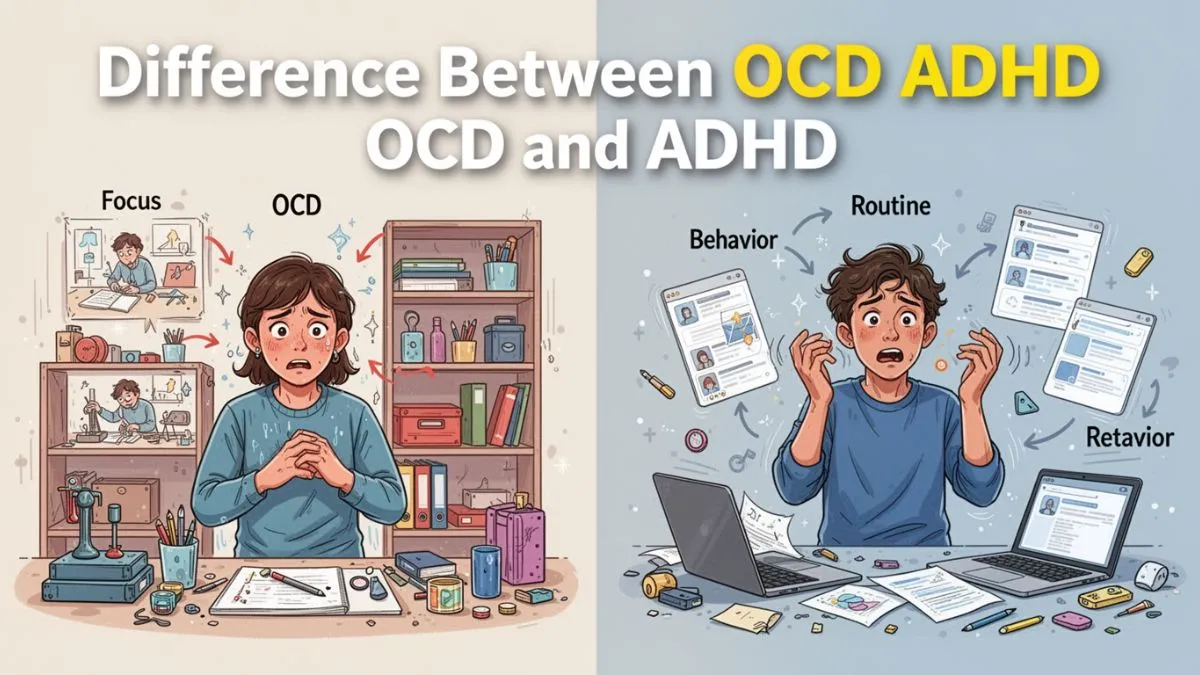
A teacher once noticed two students struggling in class. One kept rewriting notes perfectly, anxious about tiny mistakes. The other couldn’t sit still and forgot homework daily. Both were misunderstood. This real-life scenario explains the difference between OCD and ADHD in simple terms.
OCD (Obsessive-Compulsive Disorder) is a mental health condition where unwanted thoughts (obsessions) lead to repeated behaviors (compulsions). ADHD (Attention-Deficit/Hyperactivity Disorder) affects focus, impulse control, and activity levels.
Understanding the difference between OCD and ADHD is crucial because they may look similar but come from very different causes. One is driven by anxiety and fear, the other by attention regulation difficulties.
Many parents, teachers, and even adults confuse the two. That’s why learning the difference between OCD and ADHD helps in getting the right support and treatment.
In this guide, we will break down the difference between OCD and ADHD in the simplest way possible with examples, tables, and practical insights.
Pronunciation (US & UK)
- OCD
- US: /ˌoʊ.siːˈdiː/
- UK: /ˌəʊ.siːˈdiː/
- ADHD
- US: /ˌeɪ.diː.eɪtʃˈdiː/
- UK: /ˌeɪ.diː.eɪtʃˈdiː/
Now that we understand the basics, let’s explore the deeper layers behind these two conditions and see where the real differences lie.
Key Difference Between the Both
The main difference is this:
- OCD is driven by anxiety and fear of something bad happening.
- ADHD is driven by difficulty in attention control and impulse regulation.
In OCD, behaviors are repeated to reduce anxiety.
In ADHD, behaviors happen because of distractibility or impulsiveness.
Why Is Their Difference Necessary to Know?
Knowing the difference between OCD and ADHD is essential for:
- Accurate diagnosis
- Proper treatment plans
- Better classroom strategies
- Reducing stigma in society
For learners, early identification improves academic performance. For experts and professionals, proper distinction prevents misdiagnosis. In society, awareness promotes empathy instead of judgment.
Difference Between OCD and ADHD (10 Detailed Points)
1. Core Cause
- OCD: Anxiety-based disorder.
- Example 1: Fear of germs leads to repeated hand washing.
- Example 2: Fear of harm causes checking locks repeatedly.
- ADHD: Neurodevelopmental attention disorder.
- Example 1: Forgetting homework due to distraction.
- Example 2: Interrupting others impulsively.
2. Thought Pattern
- OCD: Intrusive, unwanted thoughts.
- Example 1: Repeated fear of contamination.
- Example 2: Obsession with symmetry.
- ADHD: Racing or scattered thoughts.
- Example 1: Jumping between tasks.
- Example 2: Difficulty finishing projects.
3. Behavior Type
- OCD: Repetitive rituals.
- Example 1: Counting steps repeatedly.
- Example 2: Arranging objects perfectly.
- ADHD: Hyperactivity or inattention.
- Example 1: Fidgeting constantly.
- Example 2: Losing items often.
4. Emotional Trigger
- OCD: Fear and anxiety.
- ADHD: Boredom or lack of stimulation.
5. Time Consumption
- OCD rituals consume hours daily.
- ADHD distractions cause time mismanagement.
6. Awareness
- OCD sufferers know thoughts are irrational but feel trapped.
- ADHD individuals may not notice distraction until consequences appear.
7. School Impact
- OCD: Slower work due to perfectionism.
- ADHD: Incomplete work due to distraction.
8. Social Interaction
- OCD: Avoidance due to anxiety.
- ADHD: Interrupting conversations impulsively.
9. Treatment
- OCD: Therapy (especially CBT) and anxiety medication.
- ADHD: Behavioral therapy and stimulant medication.
10. Brain Function
- OCD: Linked to overactive fear circuits.
- ADHD: Linked to dopamine regulation issues.
Nature and Behaviour
OCD Nature: Controlled yet anxious, perfectionistic, repetitive.
ADHD Nature: Energetic, spontaneous, distractible, impulsive.
Why People Are Confused?
- Both involve repetitive behaviors.
- Both can affect focus.
- Both may appear in childhood.
- Both can co-exist in some individuals.
Superficially similar — but fundamentally different.
Read More: Difference Between Factor and Multiple:(best for 2026)
Table: Difference and Similarity Between OCD and ADHD
| Feature | OCD | ADHD | Similarity |
| Type | Anxiety disorder | Neurodevelopmental disorder | Mental health conditions |
| Main Driver | Fear | Inattention | Affect daily life |
| Behavior | Ritualistic | Impulsive | Can impact school/work |
| Focus | Overfocus on obsession | Difficulty sustaining focus | Attention problems |
| Onset | Often adolescence | Often childhood | Can continue into adulthood |
Which Is Better in What Situation?
OCD traits such as attention to detail can be useful in jobs requiring precision, like accounting or quality control. However, untreated OCD can cause distress and time loss.
ADHD traits such as creativity and high energy can be beneficial in fast-paced environments like marketing or entrepreneurship. But without management, ADHD may cause inconsistency.
Neither is “better.” Both require understanding and proper support.
Metaphors and Similes
- OCD is like a broken record stuck on one fearful thought.
- ADHD is like a browser with too many tabs open at once.
Connotative Meanings
OCD
- Negative: “She’s so OCD about cleaning.”
- Neutral: Medical diagnosis.
- Positive: Detail-oriented personality.
ADHD
- Negative: “He’s too hyper.”
- Neutral: Clinical condition.
- Positive: Energetic and creative thinker.
Idioms & Proverbs (Used in Sentences)
- “Driven up the wall” – OCD rituals drove him up the wall.
- “All over the place” – His ADHD thoughts were all over the place.
- “Can’t sit still” – She can’t sit still due to ADHD.
Works in Literature
- Turtles All the Way Down (Novel, John Green, 2017) – OCD theme.
- Focused (Middle-grade novel, Alyson Gerber, 2019) – ADHD theme.
Movies on OCD & ADHD
- The Aviator (2004, USA) – OCD portrayal.
- Front of the Class (2008, USA) – ADHD-related learning challenges.
FAQs
1. Can a person have both OCD and ADHD?
Yes, co-occurrence is possible.
2. Is OCD worse than ADHD?
Neither is worse; both vary in severity.
3. Are they curable?
They are manageable, not permanently curable.
4. Do children outgrow them?
Symptoms may reduce but can continue into adulthood.
5. Who diagnoses them?
Psychiatrists and clinical psychologists.
How Both Are Useful for Surroundings
People with OCD may maintain high hygiene standards and structured systems.
People with ADHD may bring innovation, spontaneity, and energy to teams.
Final Words for Both
Both OCD and ADHD are not weaknesses.
They are different brain patterns requiring compassion and understanding.
Conclusion
A clear understanding of the difference between OCD and ADHD can transform confusion into clarity.
OCD revolves around fear-driven repetitive behaviors.
ADHD revolves around attention and impulse challenges.
While they may appear similar at first glance, their roots, triggers, and treatments differ greatly. Recognizing the difference between OCD and ADHD ensures proper support in schools, workplaces, and families.
Mislabeling someone can delay effective treatment. Awareness builds empathy. Knowledge removes stigma.
In today’s world, mental health literacy is not optional it is essential. By learning the difference between OCD and ADHD, we promote inclusion, accuracy, and compassion.
Every mind works differently.
And every mind deserves understanding.

I am Steven Pinker is a Canadian-American cognitive psychologist, linguist, and popular science author known for his work on language, mind, and human nature.He is the author of influential books like The Language Instinct and The Sense of Style, where he explains grammar and usage with scientific clarity.At wordrar.com, his ideas continue to inspire readers who want to understand grammar, comparison, and clear communication more deeply.