Imagine walking through the dense forests of Africa or South America. You suddenly hear the soft rustle of leaves.
Is it a leopard or a jaguar? Many people confuse these two magnificent big cats. Leopards and jaguars may look similar at first glance, but they are distinct species with unique traits.
Leopards are mostly found in Africa and parts of Asia, while jaguars roam the rainforests of South and Central America.
Both cats are stealthy hunters, but their hunting styles, physical features, and behaviors differ.
Understanding the difference between leopards and jaguars helps wildlife enthusiasts, researchers, and conservationists identify and protect these species better.
Knowing their differences also deepens our appreciation of nature’s diversity. Many documentaries, books, and wildlife studies often highlight these cats, but they often get misidentified.
Let’s explore their key differences, behaviors, and significance, so you’ll never confuse them again.
Key Difference Between Leopards and Jaguars
Understanding these differences is crucial for learners and wildlife experts. Leopards and jaguars play unique roles in their ecosystems. Leopards help control herbivore populations, while jaguars maintain the balance of riverine habitats. For conservationists, knowing which species inhabits a region is vital to design effective protection strategies.
Difference Between Leopards and Jaguars
Here are 10 main points of difference, with examples:
- Geographical Distribution
- Leopard: Africa, India, Southeast Asia. Example: A leopard spotted in Kruger National Park.
- Jaguar: Central & South America. Example: Jaguars in the Amazon rainforest.
- Physical Appearance
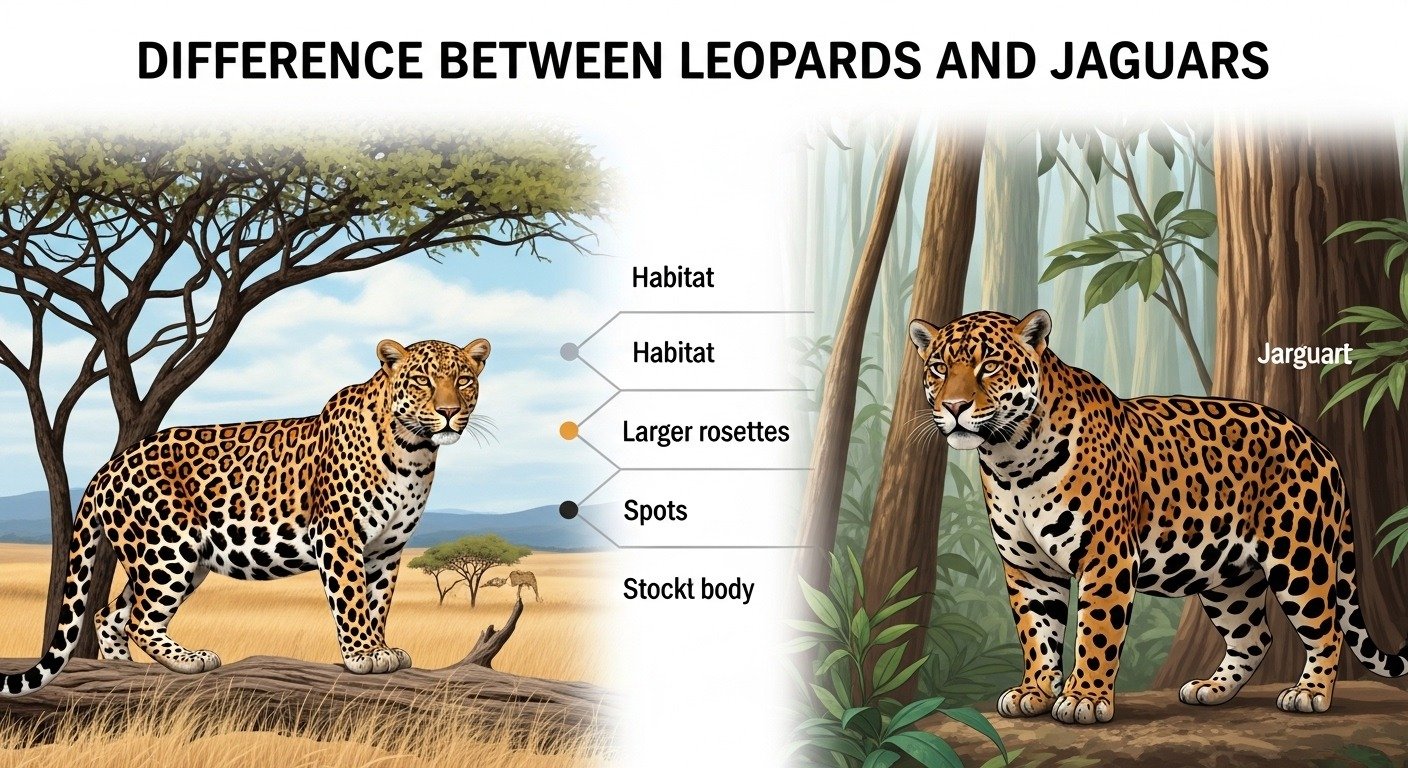
- Leopard: Smaller rosettes, no central spot.
- Jaguar: Larger rosettes with central spots. Example: Leopard’s coat is golden; jaguar’s coat has more black patches.
- Size & Weight
- Leopard: 60–200 lbs; 4.25–6.25 ft long.
- Jaguar: 100–250 lbs; 5–6 ft long. Example: Jaguars are bulkier, leopards are leaner.
- Head & Jaw Strength
- Leopard: Narrower jaw, weaker bite.
- Jaguar: Strong jaw; can crush turtle shells. Example: Jaguars can hunt caimans; leopards prefer antelopes.
- Habitat Preference
- Leopard: Savannas, forests, mountains.
- Jaguar: Rainforests, wetlands. Example: Leopard resting in a tree; jaguar near riverbanks.
- Hunting Style
- Leopard: Ambush predator; drags prey up trees.
- Jaguar: Strong swimmer; hunts aquatic animals. Example: Leopard drags impala; jaguar catches fish.
- Climbing Ability
- Leopard: Excellent climber; escapes predators.
- Jaguar: Climbs occasionally, mainly stays on ground.
- Swimming Ability
- Leopard: Avoids water.
- Jaguar: Loves water; excellent swimmer.
- Behavior & Temperament
- Leopard: Solitary, nocturnal, stealthy.
- Jaguar: Solitary, territorial, powerful.
- Conservation Status
- Leopard: Vulnerable; population declining.
- Jaguar: Near Threatened; faces habitat loss.
Nature and Behavior
Leopards: Adaptable, stealthy hunters. Prefer trees and open savannahs. Nocturnal. Can survive near human settlements.
Jaguars: Powerful, aquatic-friendly, territorial. Prefer dense rainforests. Strong swimmers; hunt caimans and fish.
Why People Get Confused
Leopards and jaguars share spotted coats, similar body shapes, and predatory behavior. Mislabeling occurs in photos, movies, and even zoos.
Comparison Table
| Feature | Leopard | Jaguar | Similarity |
| Distribution | Africa, Asia | Central & South America | Both are big cats |
| Rosettes | Smaller, no central spot | Larger, central spot present | Spotted coat |
| Weight | 60–200 lbs | 100–250 lbs | Solitary hunters |
| Habitat | Savanna, forest, mountain | Rainforest, wetlands | Both need cover for hunting |
| Climbing Ability | Excellent | Moderate | Can climb if needed |
| Swimming | Avoids water | Loves water | Carnivorous |
| Hunting Style | Ambush predator | Powerful ambush & swimmer | Stealthy |
| Conservation Status | Vulnerable | Near Threatened | Face habitat threats |
| Bite Force | Moderate | Extremely strong | Both predators |
| Behavior | Solitary, nocturnal | Solitary, territorial | Territorial |
Which is Better in What Situation?
For tree-dense savannahs or human-adjacent areas, leopards excel because of their climbing ability. Jaguars dominate wetlands and rivers, thanks to their swimming prowess. Each species thrives in its preferred habitat, and choosing “better” depends on environmental conditions and prey availability.
Use in Metaphors & Similes
- “Stealthy as a leopard” – silent hunter.
- “Powerful as a jaguar” – raw strength.
Connotative Meaning:
- Leopard: Positive (agile), neutral (elusive), negative (sneaky).
- Jaguar: Positive (strong), neutral (majestic), negative (ferocious).
Idioms / Proverbs
- “A leopard can’t change its spots” – true nature remains.
- “Like a jaguar in the jungle” – unstoppable force.
Literature Featuring Leopards and Jaguars
- “The Leopard” – novel, Giuseppe Tomasi di Lampedusa, 1958
- “Jaguar” – short story, Roland Barthes, 1957
- “Life of Pi” – Yann Martel, 2001 (features a tiger, often compared to big cats)
Movies Featuring Them
- “The Leopard” – 1963, Italy
- “Jaguar” – 1994, France
FAQs
- Are leopards and jaguars the same?
No, they differ in size, habitat, and physical features. - Which is stronger?
Jaguars have stronger jaws and bite force. - Can leopards swim?
Rarely; they usually avoid water. - Why do they look similar?
Both have rosetted coats and agile bodies. - Where can I see them in the wild?
Leopards: Africa, Asia. Jaguars: South & Central America.
Importance for Environment
Both species maintain ecological balance. Leopards control herbivore populations; jaguars manage riverine ecosystems. Their survival indicates a healthy ecosystem.
Final Words
Leopards and jaguars are iconic, powerful, and fascinating. Learning their differences helps us appreciate nature, aid conservation, and reduce confusion in media and research.
Conclusion:
The difference between leopards and jaguars is more than just looks. They differ in size, habitat, behavior, and hunting techniques.
Leopards are versatile climbers, thriving in trees and savannas, while jaguars are powerful swimmers, ruling rainforests and riverbanks.
Understanding these differences benefits wildlife conservationists, researchers, and nature lovers, ensuring accurate studies and protection plans. Both species contribute to their ecosystems’ balance, showcasing the marvel of biodiversity.
Recognizing these traits also allows writers, filmmakers, and educators to portray them correctly, preserving their unique identities in literature and media.

I am Steven Pinker is a Canadian-American cognitive psychologist, linguist, and popular science author known for his work on language, mind, and human nature.He is the author of influential books like The Language Instinct and The Sense of Style, where he explains grammar and usage with scientific clarity.At wordrar.com, his ideas continue to inspire readers who want to understand grammar, comparison, and clear communication more deeply.