Introduction
A student once told me, “I am in the bus,” while standing on the roof of it during a village trip. Everyone laughed, but it sparked a real lesson about the difference between in and on.
In daily life, we use these tiny words without thinking, yet they shape clarity and meaning. The difference between in and on decides whether you are inside something or simply touching its surface.
Imagine placing a book in a bag versus on a table. The situation changes instantly. That’s why understanding the difference between in and on is more than grammar—it’s real-world communication.
From classrooms to workplaces, these prepositions guide how we describe space, time, and position. Even experts rely on them to avoid confusion.
So, if you’ve ever paused mid-sentence wondering which one to use, this guide on the difference between in and on will make everything simple and clear.
Key Difference Between the Both
The core difference between in and on lies in position and relation:
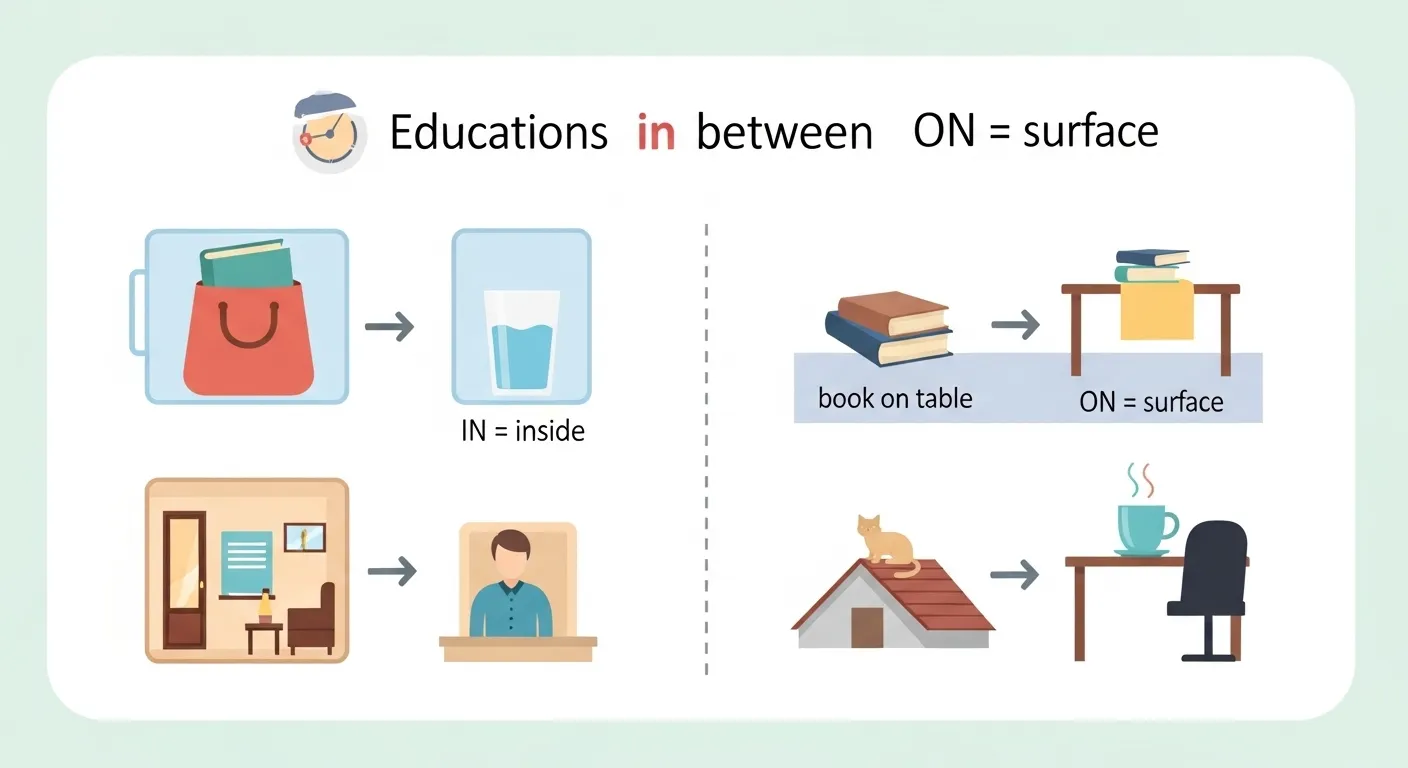
- “In” refers to something being inside or enclosed within a space.
- “On” refers to something being on a surface or in contact with something.
Why Is Their Difference Necessary to Know?
Understanding the difference between in and on is essential for both learners and experts because it ensures clear communication. In education, incorrect usage can change meanings entirely. In professional settings, it can affect instructions, reports, and presentations.
Socially, proper usage reflects language accuracy and confidence. Whether giving directions, writing emails, or speaking publicly, knowing these differences helps avoid misunderstandings and builds credibility.
Pronunciation (US & UK)
- In
- US: /ɪn/
- UK: /ɪn/
- On
- US: /ɑːn/
- UK: /ɒn/
Now that pronunciation is clear, let’s dive deeper into how their meanings truly differ in practice.
Difference Between the Keywords
1. Position
- In: Inside something
- The keys are in my pocket.
- She is in the room.
- On: On a surface
- The book is on the table.
- The cat is on the roof.
2. Enclosure vs Surface
- In: Enclosed space
- Water is in the bottle.
- Clothes are in the cupboard.
- On: Surface contact
- There is dust on the shelf.
- The phone is on the desk.
3. Time Usage
- In: Months, years, long periods
- I was born in 2000.
- We will meet in July.
- On: Days and dates
- The meeting is on Monday.
- Her birthday is on 5th May.
4. Transportation
- In: Private vehicles
- She is in the car.
- They sat in a taxi.
- On: Public or larger transport
- He is on the bus.
- They are on a train.
5. Technology
- In: Within systems
- The file is in the folder.
- Data is stored in the system.
- On: Devices or platforms
- I saw it on TV.
- She is on the internet.
6. Clothing
- In: Wearing something (less common, formal)
- He is dressed in black.
- She appeared in a gown.
- On: Items worn
- He has a hat on his head.
- She has shoes on.
7. Location
- In: Cities, countries
- She lives in Pakistan.
- They work in London.
- On: Streets or surfaces
- The shop is on Main Street.
- He lives on this road.
8. States/Conditions
- In: Condition or state
- He is in trouble.
- She is in love.
- On: Active state
- The machine is on.
- The show is on.
9. Groups
- In: Part of something
- She is in the team.
- He is in the group.
- On: Membership or listing
- He is on the list.
- She is on the committee.
10. Media
- In: Printed material
- The article is in the newspaper.
- The story is in the book.
- On: Broadcast media
- The news is on TV.
- The song is on the radio.
Nature and Behaviour
- In: Indicates depth, enclosure, inclusion, and internal position.
- On: Indicates contact, surface placement, and external relation.
Why People Are Confused
People often confuse them because both describe position, but the distinction between inside vs surface is subtle. Additionally, idiomatic usage (like “on the bus”) doesn’t always follow logical rules, making learning harder.
Table: Difference and Similarity
| Aspect | In | On | Similarity |
| Position | Inside | Surface | Both show location |
| Time | Months/years | Days/dates | Both relate to time |
| Transport | Private vehicles | Public transport | Both used for travel |
| Usage | Enclosed spaces | Flat surfaces | Both are prepositions |
Which Is Better in What Situation?
“In” is better when you are referring to something enclosed or surrounded. It is ideal for describing spaces like rooms, containers, or abstract conditions. For example, saying “in the room” clearly shows being inside, which avoids confusion.
“On” is better when referring to surfaces, positions, or active states. It works best when something is touching or resting upon another object. For instance, “on the table” clearly indicates placement, making communication precise.
Metaphors and Similes
- In: “He is in deep waters” (trouble)
- On: “She is on top of the world” (very happy)
Connotative Meaning
- In:
- Positive: “in love”
- Negative: “in danger”
- Neutral: “in the room”
- On:
- Positive: “on track”
- Negative: “on edge”
- Neutral: “on the chair”
Idioms and Proverbs
- “In hot water” – in trouble
- “In the long run” – eventually
- “On cloud nine” – very happy
- “On thin ice” – in a risky situation
Works in Literature
- “In Search of Lost Time” – Novel, Marcel Proust, 1913
- “On the Road” – Novel, Jack Kerouac, 1957
- “In Cold Blood” – True crime, Truman Capote, 1966
- “On Liberty” – Essay, John Stuart Mill, 1859
Movies
- “On the Waterfront” – 1954, USA
- “On the Road” – 2012, USA
- “In Time” – 2011, USA
- “Inception” – 2010, USA
FAQs
1. What is the main difference between in and on?
“In” means inside; “on” means on a surface.
2. Can both be used for time?
Yes, but “in” is for months/years, and “on” is for days/dates.
3. Why do we say “on the bus”?
Because it refers to being part of a larger public transport system.
4. Is “in the internet” correct?
No, we say “on the internet.”
5. Which is easier to learn?
Both are simple once you understand inside vs surface logic.
How Both Are Useful for Surroundings
These prepositions help describe location, movement, and relationships in our environment. They make navigation, instruction, and storytelling clear and effective.
Final Words
“In” and “on” may be small words, but they carry big meaning. Mastering them improves both spoken and written English significantly.
Conclusion
Understanding the difference between in and on is a foundational step toward mastering English. These simple prepositions guide how we describe space, time, and relationships, making communication more precise and effective.
“In” places you inside a boundary, while “on” connects you to a surface or position. This distinction may seem small, but it can completely change meaning in everyday conversations.
From writing professional emails to giving directions or expressing emotions, using these words correctly builds clarity and confidence. Even advanced speakers revisit these basics to refine their skills.
Remember the simple rule: inside equals “in,” surface equals “on.” With practice, this difference becomes natural.
Mastering these small details leads to big improvements in language fluency. Keep practicing, and soon you’ll use “in” and “on” effortlessly in every situation.

I am William Strunk Jr an American professor of English and the author of the classic style guide the Elements of Style. He emphasized clarity, brevity, and proper grammar in writing, influencing generations of writers. Learn more about his work and writing tips at wordrar.com.