A few years ago, Ali stood at a crossroads after finishing college. His friends were choosing between a degree and a diploma, and he felt confused. The difference between degree and diploma seemed small at first but it shaped their entire careers.
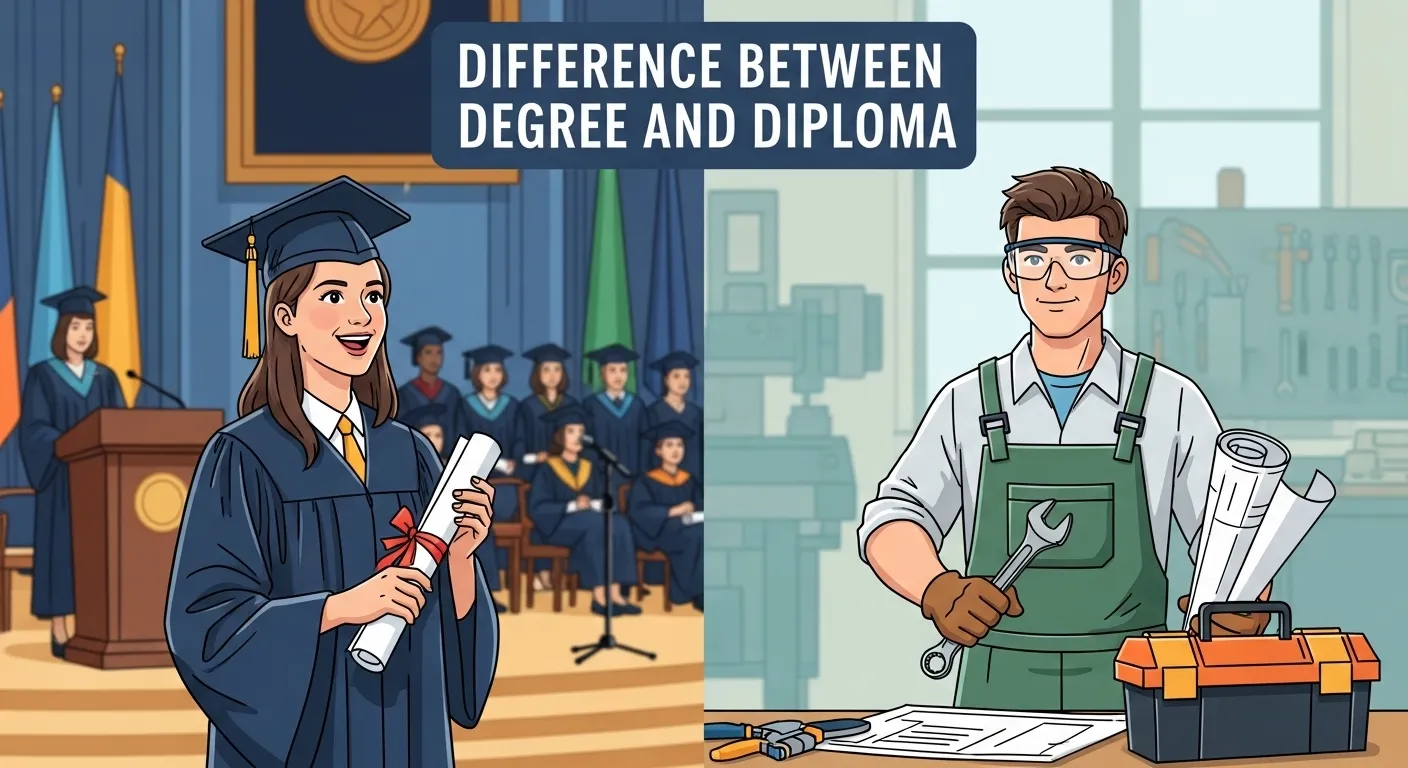
A degree is often linked with universities and long-term academic study, while a diploma focuses on practical skills and shorter programs. Understanding the difference between degree and diploma helps students make smarter career decisions.
Many learners today face the same dilemma. The difference between degree and diploma is not just about time it’s about depth, recognition, and career goals.
Some choose a degree for higher education and prestige, while others pick a diploma for quick job entry. Each has its own value in society.
So, if you’re wondering about the difference between degree and diploma, this guide will simplify everything in a clear and practical way.
Key Difference Between the Both
The main difference between degree and diploma lies in duration, depth, and purpose. A degree offers comprehensive academic knowledge, while a diploma provides focused, skill-based training for specific jobs.
Why Is Their Difference Necessary to Know for Learners and Experts?
Understanding the difference between degree and diploma is important because it directly impacts career growth, earning potential, and professional recognition.
For learners, it helps in choosing the right path based on time, budget, and career goals. For experts and employers, it ensures they hire candidates with the right level of knowledge and expertise.
In society, both play vital roles—degrees contribute to research and innovation, while diplomas support technical and vocational industries.
Pronunciation
- Degree
- US: /dɪˈɡriː/
- UK: /dɪˈɡriː/
- Diploma
- US: /dɪˈploʊmə/
- UK: /dɪˈpləʊmə/
Linking Hook
Now that you understand the basics, let’s dive deeper into the detailed difference between degree and diploma and explore how they truly compare.
Difference Between Degree and Diploma
1. Duration
A degree usually takes 3–4 years, while a diploma can be completed in 1–2 years.
- Degree Example: Bachelor’s in Business (4 years)
- Degree Example: BS Computer Science (4 years)
- Diploma Example: Diploma in Graphic Design (1 year)
- Diploma Example: Diploma in Electrical Work (2 years)
2. Depth of Study
Degrees provide in-depth theoretical knowledge, while diplomas focus on practical skills.
- Degree Example: Studying advanced economics theories
- Degree Example: Learning research methodologies
- Diploma Example: Hands-on training in web design
- Diploma Example: Practical cooking skills
3. Institution Type
Degrees are offered by universities, diplomas by colleges or institutes.
- Degree Example: University programs
- Degree Example: Research-based institutions
- Diploma Example: Technical training centers
- Diploma Example: Vocational institutes
4. Career Opportunities
Degrees open doors to professional and managerial roles, diplomas lead to technical jobs.
- Degree Example: Engineer
- Degree Example: Doctor
- Diploma Example: Technician
- Diploma Example: Electrician
5. Cost
Degrees are generally more expensive, diplomas are affordable.
- Degree Example: High university tuition
- Degree Example: Hostel and academic costs
- Diploma Example: Low course fees
- Diploma Example: Short-term expenses
6. Entry Requirements
Degrees require higher academic qualifications, diplomas have flexible entry.
- Degree Example: High grades required
- Degree Example: Entrance exams
- Diploma Example: Basic education
- Diploma Example: Skill-based entry
7. Recognition
Degrees have global recognition, diplomas may be region-specific.
- Degree Example: Recognized worldwide
- Degree Example: Accepted for higher studies
- Diploma Example: Local job market
- Diploma Example: Industry-specific roles
8. Focus
Degrees focus on academic learning, diplomas on job readiness.
- Degree Example: Research papers
- Degree Example: Theory exams
- Diploma Example: Workshops
- Diploma Example: Internships
9. Flexibility
Degrees offer specializations, diplomas offer specific skills.
- Degree Example: Majors in finance or marketing
- Degree Example: Elective subjects
- Diploma Example: Specific trade skills
- Diploma Example: Focused training
10. Career Growth
Degrees provide long-term growth, diplomas offer quick employment.
- Degree Example: Promotion to leadership roles
- Degree Example: Higher studies (Master’s, PhD)
- Diploma Example: Immediate job placement
- Diploma Example: Skill-based freelancing
Nature and Behaviour
- Degree: Academic, theoretical, long-term, research-oriented
- Diploma: Practical, skill-based, short-term, job-focused
Why People Are Confused About Their Use?
People often confuse them because both are educational qualifications. The terms sound similar, and sometimes institutions use them interchangeably. Also, the overlap in career opportunities adds to the confusion.
Table: Difference and Similarity
| Aspect | Degree | Diploma | Similarity |
|---|---|---|---|
| Duration | Long | Short | Both involve study |
| Focus | Theoretical | Practical | Skill development |
| Cost | Expensive | Affordable | Investment in education |
| Recognition | Global | Local/Industry | Career support |
| Purpose | Academic growth | Job readiness | Professional development |
Which Is Better in What Situation?
A degree is better if you aim for long-term career growth, higher education, or professional fields like medicine, engineering, or law. It provides deep knowledge and better global recognition.
A diploma is ideal if you want quick employment, practical skills, or cannot invest much time or money. It helps you enter the workforce faster and gain hands-on experience.
Metaphors and Similes
- A degree is like a deep ocean—vast and full of knowledge.
- A diploma is like a toolbox—practical and ready to use.
Connotative Meaning
- Degree: Positive (prestige, knowledge), Neutral (academic path), Negative (time-consuming)
- Example: “He earned a degree and gained respect.”
- Diploma: Positive (skills, quick job), Neutral (technical training), Negative (limited scope sometimes)
- Example: “Her diploma helped her start working early.”
Idioms or Proverbs
- “Knowledge is power” (applies to degree)
- Example: A degree proves that knowledge is power.
- “Practice makes perfect” (applies to diploma)
- Example: A diploma shows that practice makes perfect.
Works in Literature
- Degree:
- “The Idea of a University” – John Henry Newman (Essay, 1852)
- Diploma:
- “Educating Rita” – Willy Russell (Play, 1980)
Movies
- Degree:
- “The Social Network” (2010, USA)
- “Good Will Hunting” (1997, USA)
- Diploma:
- “3 Idiots” (2009, India)
- “October Sky” (1999, USA)
FAQs
1. What is the main difference between degree and diploma?
A degree is academic and long-term, while a diploma is short and skill-based.
2. Which is more valuable?
It depends on career goals—degrees for professional fields, diplomas for quick jobs.
3. Can I do a degree after a diploma?
Yes, many institutions allow progression.
4. Is a diploma enough for a job?
Yes, especially in technical fields.
5. Which is cheaper?
Diplomas are generally more affordable.
How Both Are Useful for Surroundings
Degrees contribute to innovation, research, and leadership, while diplomas support industries, technical work, and services. Both are essential for a balanced and growing society.
Final Words
Both a degree and diploma have unique strengths. Choosing the right one depends on your career goals, time, and resources.
Conclusion:
Choosing between a degree and a diploma is one of the most important decisions in a student’s life. The difference between degree and diploma goes beyond just duration it reflects your career direction, learning style, and future opportunities.
A degree offers depth, recognition, and long-term growth, making it ideal for those aiming for professional or academic careers. On the other hand, a diploma provides practical skills and quick job access, which is perfect for those who want to start earning early.
Both paths are valuable. Both create success. The key is to align your choice with your personal goals and strengths.
In the end, success does not depend on If you choose a degree or diploma it depends on how well you use it.

I am Steven Pinker is a Canadian-American cognitive psychologist, linguist, and popular science author known for his work on language, mind, and human nature.He is the author of influential books like The Language Instinct and The Sense of Style, where he explains grammar and usage with scientific clarity.At wordrar.com, his ideas continue to inspire readers who want to understand grammar, comparison, and clear communication more deeply.