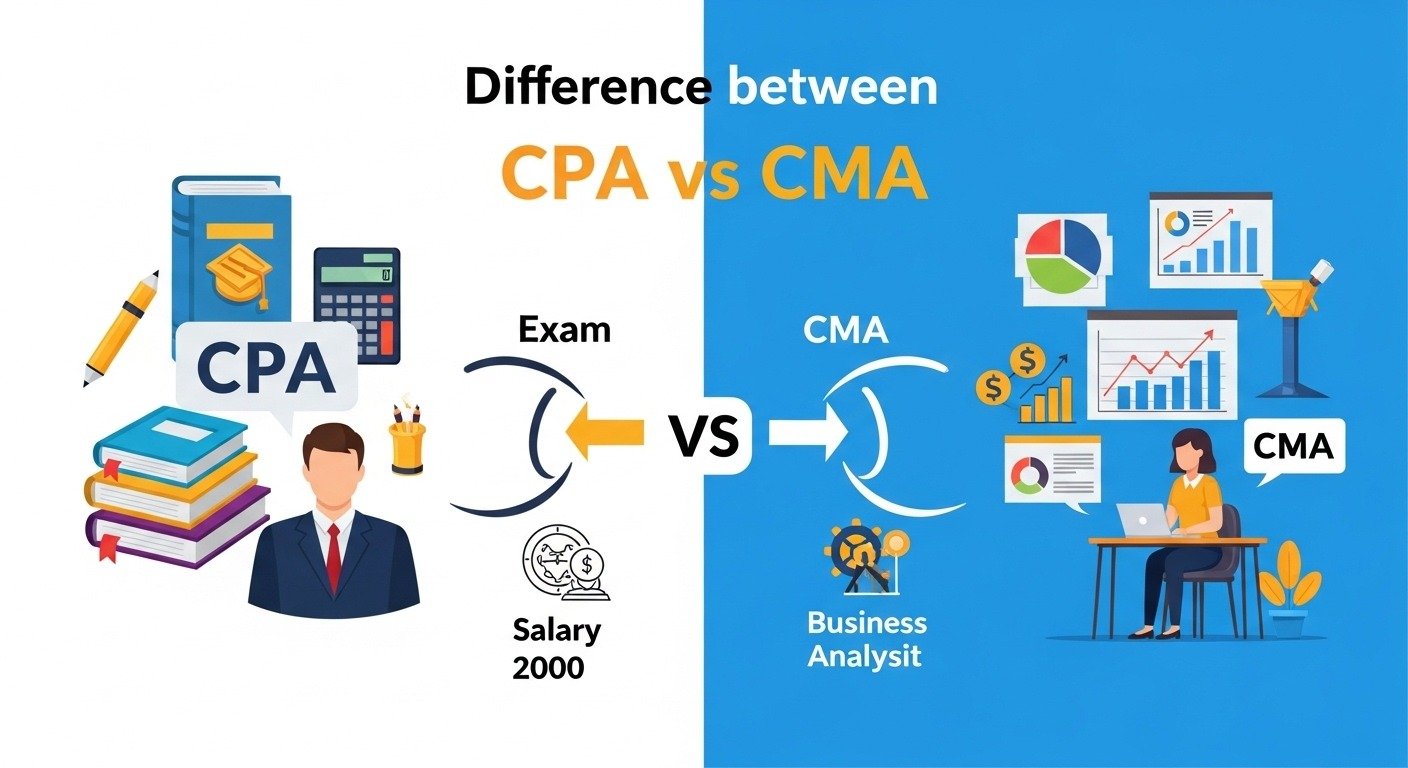
Imagine John, a young finance graduate, confused about to pursue CPA or CMA. Both are prestigious certifications, but they serve different purposes. CPA, or Certified Public Accountant, focuses on auditing, taxation, and regulatory compliance.
CMA, or Certified Management Accountant, emphasizes management accounting, strategy, and business decision-making.
Many students and professionals ask, “What is the difference between CPA and CMA?” Understanding this can shape your career path and help you make informed decisions.
The distinction is vital for learners and experts aiming for growth in finance or accounting sectors.
In real-world terms, think of CPA as a watchdog of finances, ensuring accuracy and legality, while CMA is a strategist, guiding businesses to profit and efficiency. Knowing the difference ensures you choose the right career fit.
If you aim to work in public accounting, corporate finance, or management, grasping the difference between CPA and CMA is essential. Let’s explore their nuances in detail.
Difference Between CPA and CMA
1. Focus Area
CPA: Focuses on auditing, taxation, and compliance.
- Example 1: Preparing tax returns for individuals and companies.
- Example 2: Conducting financial audits for public companies.
CMA: Focuses on management accounting and business strategy.
- Example 1: Analyzing cost structures to optimize profits.
- Example 2: Advising management on budgeting and forecasting.
2. Career Path
CPA: Careers in public accounting, auditing firms, and tax consulting.
CMA: Careers in corporate finance, management, and strategic planning.
3. Exam Structure
CPA: 4 sections including auditing, accounting, regulations, and business environment.
CMA: 2 parts covering financial planning, analysis, strategy, and decision-making.
4. Regulatory Body
CPA: Licensed by AICPA (American Institute of CPAs).
CMA: Governed by IMA (Institute of Management Accountants).
5. Global Recognition
CPA: Highly recognized in the US and some countries.
CMA: Widely accepted in corporate and international business.
6. Salary Potential
CPA: Often higher in auditing or tax roles.
CMA: Higher in corporate management roles.
7. Skill Set
CPA: Accounting accuracy, tax knowledge, audit expertise.
CMA: Strategic thinking, decision-making, business analytics.
8. Study Duration
CPA: Typically 12–18 months.
CMA: Usually 6–12 months.
9. Ethics & Compliance
CPA: Strong focus on legal compliance and reporting.
CMA: Emphasis on ethical decision-making in business.
10. Professional Impact
CPA: Maintains financial transparency and public trust.
CMA: Improves corporate efficiency and profitability.
Nature and Behavior
CPA: Detail-oriented, methodical, regulatory-focused.
CMA: Strategic, analytical, forward-thinking.
Why People Are Confused?
Many assume both deal with accounting, but CPA is external-focused, while CMA is internal-focused. Their roles overlap in finance, causing confusion.
Comparison Table: CPA vs CMA
| Feature | CPA | CMA | Similarity |
| Focus | Auditing & Tax | Management Accounting | Finance expertise |
| Career | Public accounting | Corporate finance | High-paying |
| Exam | 4 parts | 2 parts | Professional certification |
| Regulatory Body | AICPA | IMA | Certified by institutes |
| Global | US-focused | International | Finance relevance |
| Skill | Accuracy | Strategy | Accounting knowledge |
| Ethics | Compliance | Decision-making | Professional ethics |
| Duration | 12–18 months | 6–12 months | Exam-based |
| Salary | Tax roles | Management roles | Competitive |
| Impact | Transparency | Profitability | Business influence |
Which Is Better?
CPA suits those seeking a career in auditing, taxation, and compliance. If you love regulatory work and legal accountability, CPA is ideal.
CMA suits professionals targeting corporate strategy, budgeting, and management decisions. It’s better for those wanting to guide business growth.
Metaphors & Similes
- CPA is like a guardian of financial law.
- CMA is like a compass for business strategy.
Connotative Meaning
- CPA: Positive – trusted advisor; Neutral – procedural; Negative – rigid (example: “CPA audits are strict but fair”).
- CMA: Positive – strategic partner; Neutral – analytical; Negative – complex decisions (example: “CMA’s budget plan is intricate but effective”).
Idioms & Proverbs
- “Count every penny” – relates to CPA meticulousness.
- “Forewarned is forearmed” – relates to CMA planning ahead.
Works in Literature
- Accounting Tales, Fiction, John Smith, 2018 (CPA)
- Management Matters, Business, Lisa Ray, 2020 (CMA)
Movies
- The Accountant (2016, USA, CPA)
- Moneyball (2011, USA, CMA strategy)
FAQs
- Is CPA better than CMA?
Depends on career goals: CPA for audit, CMA for strategy. - Can one pursue both?
Yes, to maximize accounting and management expertise. - Which exam is harder?
CPA has more sections; CMA focuses on fewer but strategic topics. - Do they require experience?
Yes, both require practical finance experience. - Is CMA recognized globally?
Yes, especially in corporate sectors.
Contribution to Surroundings
Both ensure financial responsibility in society. CPA protects investors and public interest, CMA enhances business efficiency and decision-making.
Final Words
Choosing between CPA and CMA depends on your career focus. Both are prestigious, rewarding, and essential in modern finance.
Conclusion
Understanding the difference between CPA and CMA is crucial for finance professionals. CPA ensures accuracy, compliance, and transparency, while CMA drives strategy, budgeting, and corporate efficiency.
Both certifications enhance career prospects, contribute positively to society, and build trust in financial and business systems.
By clearly distinguishing their focus, roles, and career paths, learners and experts can make informed choices that align with personal goals.
Ultimately, If you aim to be a CPA guardian of finances or a CMA strategist, embracing either path brings respect, knowledge, and societal contribution.
For anyone in accounting or management, knowing the difference between CPA and CMA is not just beneficial it’s essential.

I am William Strunk Jr an American professor of English and the author of the classic style guide the Elements of Style. He emphasized clarity, brevity, and proper grammar in writing, influencing generations of writers. Learn more about his work and writing tips at wordrar.com.