A young entrepreneur once said, “I registered my business… now I have a corporation.”
But when asked how, he replied, “I just did incorporation.” The confusion was real.
Corporation and incorporation are often used interchangeably.
Yet, they are not the same thing at all.
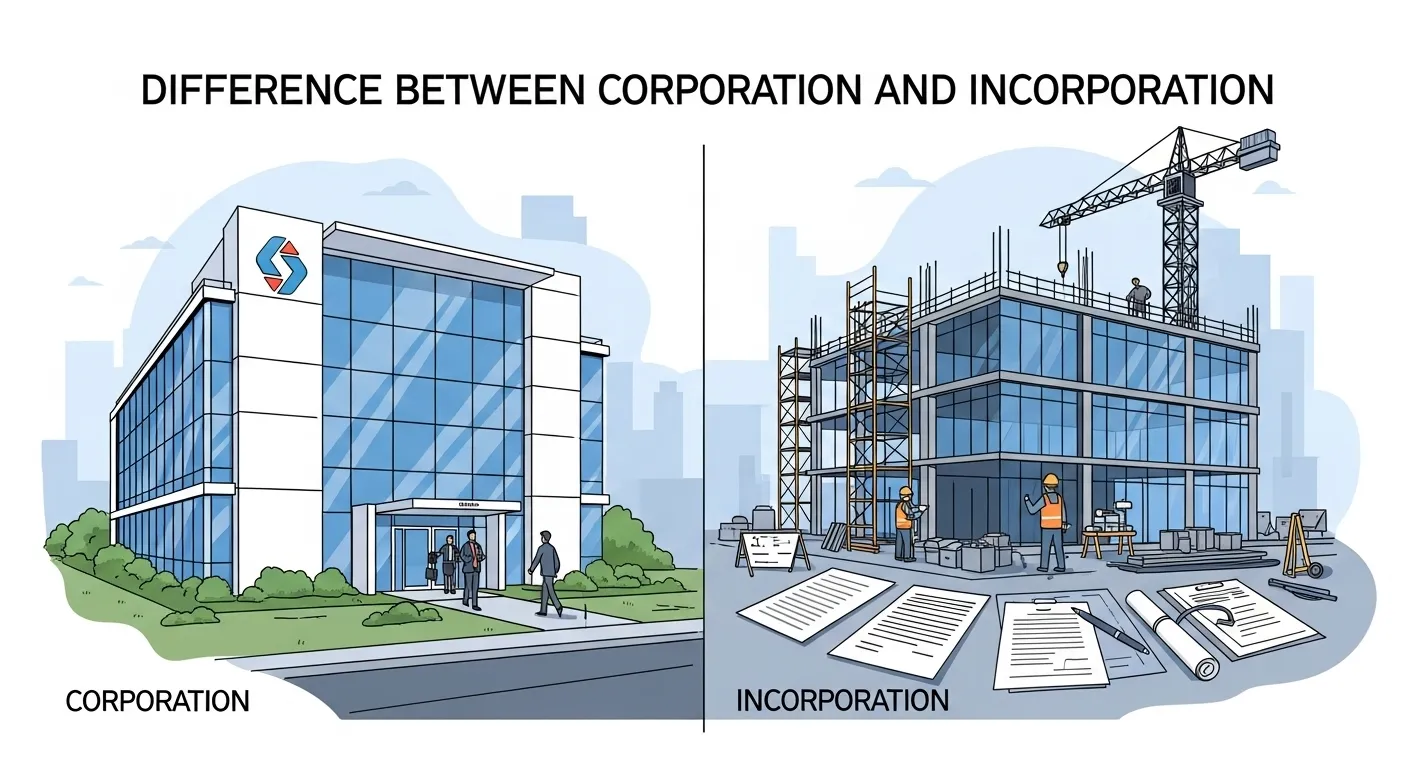
In simple terms, a corporation is a business entity, while incorporation is the process of creating it.
Still, many beginners mix them up in real-world situations.
Understanding the difference between corporation and incorporation helps avoid legal mistakes.
It also builds clarity for both learners and professionals.
This guide will explain the difference between corporation and incorporation in the simplest way.
So you can use these terms with full confidence.
Key Difference Between the Both
The main difference between corporation and incorporation lies in their roles:
- Corporation = The result (a legal business entity)
- Incorporation = The process (legal steps to create that entity)
Why Is Their Difference Important?
Knowing the difference between corporation and incorporation is essential in business and law.
- It helps entrepreneurs choose the right legal structure.
- It prevents confusion in legal documents and contracts.
- It improves communication in professional environments.
For experts, this distinction ensures accuracy in corporate governance and compliance.
For learners, it builds a strong foundation in business terminology.
Pronunciation
- Corporation
- US: /ˌkɔːr.pəˈreɪ.ʃən/
- UK: /ˌkɔː.pəˈreɪ.ʃən/
- Incorporation
- US: /ɪnˌkɔːr.pəˈreɪ.ʃən/
- UK: /ɪnˌkɔː.pəˈreɪ.ʃən/
Now that you understand the basics, let’s dive deeper into the main comparison.
Difference Between Corporation and Incorporation
1. Definition
- Corporation: A legal business entity separate from its owners.
- Example 1: Apple Inc. is a corporation.
- Example 2: A registered company with shareholders.
- Incorporation: The legal process of forming a corporation.
- Example 1: Filing documents with the government.
- Example 2: Registering a business officially.
2. Nature
- Corporation: It is a thing (noun).
- Example 1: The corporation owns assets.
- Example 2: It can sue or be sued.
- Incorporation: It is an action (process).
- Example 1: The company is undergoing incorporation.
- Example 2: Lawyers handle incorporation steps.
3. Purpose
- Corporation: To operate a business legally.
- Example 1: Hiring employees.
- Example 2: Generating profit.
- Incorporation: To legally establish that business.
- Example 1: Creating legal identity.
- Example 2: Getting tax benefits.
4. Time Frame
- Corporation: Exists long-term.
- Example 1: A company running for decades.
- Example 2: Continues despite ownership change.
- Incorporation: Happens once (or occasionally).
- Example 1: Initial setup process.
- Example 2: Re-incorporation in another country.
5. Legal Status
- Corporation: Has legal rights and responsibilities.
- Example 1: Signing contracts.
- Example 2: Owning property.
- Incorporation: Grants legal status.
- Example 1: Government approval.
- Example 2: Certificate issuance.
6. Focus
- Corporation: Focus on operations.
- Example 1: Business growth.
- Example 2: Market expansion.
- Incorporation: Focus on formation.
- Example 1: Documentation.
- Example 2: Legal compliance.
7. Usage in Sentences
- Corporation: “The corporation earned profits.”
- Example 1: The corporation expanded globally.
- Example 2: It hired new employees.
- Incorporation: “The incorporation took two weeks.”
- Example 1: Incorporation required paperwork.
- Example 2: Lawyers handled incorporation.
8. Stage
- Corporation: Post-formation stage.
- Example 1: After registration.
- Example 2: Fully operational.
- Incorporation: Pre-formation stage.
- Example 1: Before business starts.
- Example 2: During setup phase.
9. Tangibility
- Corporation: Tangible (exists legally).
- Example 1: Has offices.
- Example 2: Has employees.
- Incorporation: Intangible (process).
- Example 1: Legal procedures.
- Example 2: Paperwork only.
10. Outcome vs Action
- Corporation: Outcome of incorporation.
- Example 1: Final business structure.
- Example 2: Registered entity.
- Incorporation: Action leading to corporation.
- Example 1: Filing forms.
- Example 2: Legal approval process.
Nature and Behaviour
- Corporation behaves like a separate legal person. It can own assets, pay taxes, and enter contracts.
- Incorporation behaves like a legal procedure. It involves steps, rules, and documentation to create the corporation.
Why People Are Confused
People confuse these terms because:
- Both are used in business discussions.
- They sound very similar.
- They are closely connected in meaning.
Difference and Similarity Table
| Aspect | Corporation | Incorporation |
| Meaning | Business entity | Formation process |
| Type | Noun | Process |
| Role | Result | Action |
| Duration | Long-term | Short-term |
| Legal Status | Has rights | Grants rights |
| Similarity | Both related to business law | Both linked to company formation |
Which Is Better in What Situation?
A corporation is better when you want to run a structured and legally protected business. It offers benefits like limited liability, credibility, and easier access to funding. Businesses aiming for long-term growth usually choose a corporation.
On the other hand, incorporation is better when you are just starting your business journey. It is the necessary first step to transform your idea into a legal entity. Without incorporation, you cannot form a corporation.
Metaphors and Similes
- Corporation: “A corporation is like a machine running a business.”
- Incorporation: “Incorporation is like building the machine.”
Connotative Meaning
- Corporation: Neutral to positive
- Example: A corporation creates jobs.
- Incorporation: Neutral
- Example: Incorporation is a legal necessity.
Idioms / Proverbs
(Not directly related, but adapted usage):
- “Get the ball rolling” (Incorporation stage)
- Example: Incorporation got the ball rolling.
- “Run the show” (Corporation stage)
- Example: The corporation runs the show.
Works in Literature
- The Corporation (Documentary, Mark Achbar, 2003)
- Incorporating Cultural Theory (Academic, Mary Douglas, 1992)
Movies Related
- The Corporation (2003, Canada)
- Startup.com (2001, USA)
FAQs
1. What is the main difference between corporation and incorporation?
Corporation is the business entity, while incorporation is the process of creating it.
2. Can a business exist without incorporation?
Yes, but it won’t be a corporation legally.
3. Is incorporation necessary?
Yes, if you want legal protection and structure.
4. Which comes first?
Incorporation comes first, then the corporation exists.
5. Are they interchangeable?
No, they have different meanings and uses.
How Both Are Useful for Surroundings
- Corporations create jobs, boost the economy, and provide services.
- Incorporation ensures businesses follow legal frameworks and operate responsibly.
Final Words
Corporation is the result.
Incorporation is the journey.
Understanding both gives clarity in business and law.
Conclusion:
Many people misunderstand the difference between corporation and incorporation.
But the truth is simple when explained clearly.
A corporation is the final business entity, while incorporation is the process that creates it.
Both play essential roles in the business world.
For beginners, this knowledge avoids confusion.
For professionals, it ensures precision and legal accuracy.
Understanding this difference improves communication, decision-making, and legal awareness.
In today’s fast-paced business world, clarity like this is not just helpful it’s necessary.
I am Lynne truss , journalist, and broadcaster best known for her bestselling grammar book Eats, Shoots & Leaves, which highlights the importance of punctuation in clear writing. Her engaging and witty style has made grammar accessible and entertaining for millions of readers worldwide.at wordrar.com, we admire her work for inspiring readers to appreciate the power of precise language and proper grammar.