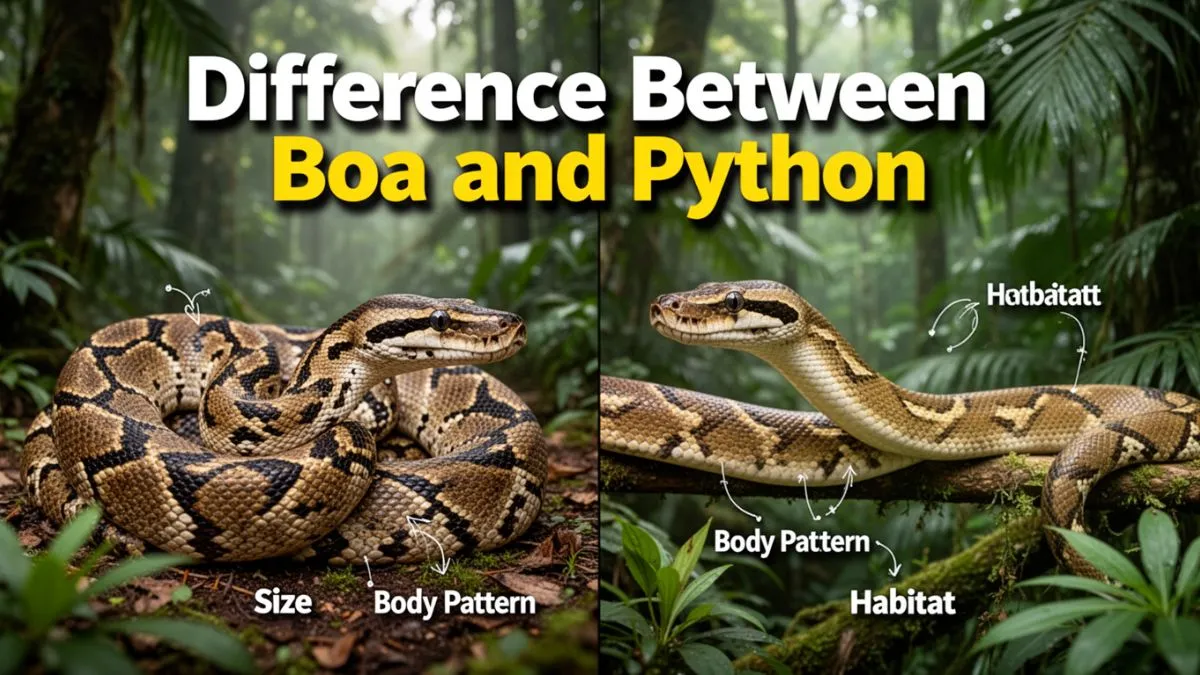
A few years ago, a wildlife documentary showed a massive snake wrapped around its prey.
The narrator called it a python, but a friend insisted it was a boa.
That small debate reveals a common confusion.
The difference between boa and python is not always obvious to beginners.
Both are large, non-venomous constrictor snakes.
Both squeeze their prey instead of injecting venom.
Yet scientifically, they belong to different families.
Understanding the difference between boa and python helps avoid mistakes in biology and wildlife studies.
If you’ve ever wondered about the difference between boa and python, you’re not alone.
Let’s break down the facts in a simple, clear, and engaging way.
Key Difference Between the Both
The main difference between boa and python lies in:
- Their reproduction method (live birth vs egg-laying)
- Their geographical distribution
- Their skeletal structure and teeth
- Their scientific classification
Why Is Their Difference Necessary to Know?
Knowing the difference between boa and python is important for:
- Students – Accurate biological classification improves learning.
- Wildlife experts – Correct identification supports conservation.
- Pet owners – Different care needs depend on species.
- Researchers – Evolutionary studies rely on clear distinctions.
Snakes play a crucial role in controlling rodent populations.
Correct identification helps protect ecosystems and prevent misinformation.
Pronunciation (US & UK)
Boa
- US: /ˈboʊ.ə/ (BOH-uh)
- UK: /ˈbəʊ.ə/ (BOH-uh)
Python
- US: /ˈpaɪ.θɑːn/ (PY-thon)
- UK: /ˈpaɪ.θən/ (PY-thuhn)
Before we dive deeper, let’s explore the detailed difference between boa and python point by point.
Difference Between Boa and Python
1. Scientific Family
- Boas belong to the Boidae family.
- Example 1: Boa constrictor
- Example 2: Emerald tree boa
- Pythons belong to the Pythonidae family.
- Example 1: Burmese python
- Example 2: Reticulated python
2. Reproduction
- Boas give birth to live young.
- Example: Boa constrictor babies are born alive.
- Example: Anaconda species produce live offspring.
- Pythons lay eggs.
- Example: Burmese python lays 20–50 eggs.
- Example: Ball python coils around eggs for warmth.
3. Geographic Location
- Boas are mostly found in Central and South America.
- Example: Amazon rainforest boas.
- Example: Caribbean tree boas.
- Pythons are native to Africa, Asia, and Australia.
- Example: Indian python in South Asia.
- Example: Carpet python in Australia.
4. Head Structure
- Boas have fewer head heat-sensing pits.
- Example: Boa constrictor has labial pits.
- Example: Tree boas have limited pits.
- Pythons have more developed heat pits.
- Example: Burmese python detects warm prey.
- Example: Reticulated python hunts at night.
5. Teeth Structure
- Boas lack certain premaxillary teeth.
- Example: Boa skull anatomy studies.
- Example: Reduced upper jaw teeth.
- Pythons have extra premaxillary teeth.
- Example: Python skull shows additional tooth row.
- Example: Helps grip slippery prey.
6. Body Build
- Boas are thick and muscular.
- Example: Red-tailed boa heavy body.
- Example: Stocky appearance.
- Pythons can grow extremely long.
- Example: Reticulated python over 20 feet.
- Example: Slender but very long body.
7. Habitat
- Boas prefer tropical forests.
- Example: Tree-dwelling emerald boa.
- Example: Riverbank anaconda.
- Pythons adapt to forests, grasslands, and swamps.
- Example: African rock python in savannas.
- Example: Burmese python in wetlands.
8. Egg Protection
- Boas do not lay eggs.
- Example: No nesting behavior.
- Example: Internal fertilization.
- Pythons incubate eggs by coiling around them.
- Example: Female python shivers to warm eggs.
- Example: Protects nest aggressively.
9. Size Record
- Boas rarely exceed 13 feet (most species).
- Example: Boa constrictor average 8–10 feet.
- Example: Tree boa smaller species.
- Pythons include the world’s longest snakes.
- Example: Reticulated python holds record.
- Example: African rock python grows massive.
10. Evolutionary Origin
- Boas evolved primarily in the Americas.
- Example: Fossil records in South America.
- Example: Island boa species.
- Pythons evolved in Old World regions.
- Example: Asian fossil findings.
- Example: African evolutionary lineage.
Nature and Behaviour
Boas:
Calm but powerful. They are ambush predators and generally less aggressive unless threatened.
Pythons:
Strong constrictors. Some species can be defensive, especially during egg incubation.
Why People Are Confused
- Both are large constrictor snakes.
- Both look similar in body shape.
- Media often uses the names interchangeably.
- Lack of awareness about reproductive differences.
Table: Difference and Similarity
| Feature | Boa | Python | Similarity |
| Family | Boidae | Pythonidae | Both constrictors |
| Reproduction | Live birth | Egg-laying | Non-venomous |
| Location | Americas | Africa/Asia/Australia | Large size |
| Teeth | Fewer | More | Sharp teeth |
| Hunting | Ambush | Ambush | Constriction |
Which Is Better in What Situation?
As Pets:
Boas are often considered easier for beginners because they are typically calmer and smaller. Their live-bearing reproduction reduces breeding complexity.
For Research & Wildlife Study:
Pythons are fascinating for evolutionary and incubation studies due to egg-laying and heat regulation behaviors. Their size and diversity offer broader scientific insight.
Metaphors and Similes
- “He squeezed like a boa.”
- “Her grip was tight as a python.”
- “Silent as a python in the grass.”
Connotative Meaning
Boa
- Neutral/Positive: Strength and calm control.
- Example: “She handled pressure like a boa.”
Python
- Negative/Neutral: Danger or overpowering force.
- Example: “Debt wrapped around him like a python.”
Idioms or Proverbs
While no direct common idioms exist, snake-related phrases apply:
- “Snake in the grass” – Hidden danger.
- “Wrapped up tight” – Like a constrictor’s grip.
Works in Literature
- “The Little Prince” – Fantasy, Antoine de Saint-Exupéry, 1943 (features a boa)
- “Harry Potter and the Philosopher’s Stone” – Fantasy, J. K. Rowling, 1997 (python scene in zoo)
Movies
- Anaconda – 1997, USA
- Python – 2000, USA
FAQs
1. Are boas and pythons venomous?
No, both kill by constriction.
2. Which is bigger?
Reticulated python is generally longer.
3. Do both make good pets?
With proper care and legal permission, yes.
4. Can they live together?
Not recommended due to stress and aggression.
5. What is the biggest difference?
Reproduction: live birth vs egg-laying.
How Both Are Useful for Surroundings
Both control rodent populations.
They help maintain ecological balance.
They are also important for scientific and educational research.
Final Words
Boas and pythons may look alike, but their biological differences matter greatly.
Knowing their traits improves knowledge, safety, and conservation awareness.
Conclusion:
At first glance, a boa and a python seem almost identical.
Both are large, muscular, and powerful constrictors.
However, the difference between boa and python becomes clear when we study reproduction, geography, skeletal traits, and evolution.
Boas give live birth, while pythons lay eggs.
Their habitats differ across continents.
Their evolutionary paths tell separate stories.
Understanding the difference between boa and python is not just academic.
It supports accurate education, wildlife conservation, and responsible pet ownership.
In society, knowledge prevents fear and misinformation.
Clear understanding builds respect for nature.
So next time you see a giant snake in a documentary,
you’ll confidently identify If it’s a boa or a python and know exactly why.

I am Lynne truss , journalist, and broadcaster best known for her bestselling grammar book Eats, Shoots & Leaves, which highlights the importance of punctuation in clear writing. Her engaging and witty style has made grammar accessible and entertaining for millions of readers worldwide.at wordrar.com, we admire her work for inspiring readers to appreciate the power of precise language and proper grammar.